We are in the process of migrating all NASA Earth science data sites into Earthdata from now until end of 2026. Not all NASA Earth science data and resources will appear here until then. Thank you for your patience as we make this transition.
Read about the Web Unification Project
Air Quality Data Access and Tools
NASA has air quality datasets that help researchers characterize the particular makeup of the air we breathe. Access a range of data and data tools such as AppEEARS, FIRMS, and Giovanni to make the most of air quality data.
Air quality comprises a constellation of scientific topics that inform our understanding of this field. Learn more about data and resources focused on aerosol optical depth, aerosol index, trace gases, land surface reflectance, the effect of dust, ash, and smoke, and human dimensions, including natural hazards.
Many NASA observation methods—platforms, instruments, and space geodesy techniques—provide data that improve our understanding of air quality, including NASA's Tropospheric Emissions: Monitoring Pollution (TEMPO) instrument, featured below. Learn more about how the Advanced Spaceborne Thermal Emission and Reflection Radiometer (ASTER), Harmonized Landsat Sentinel-2 (HLS), Moderate Resolution Imaging Spectroradiometer (MODIS), and Visible Infrared Imaging Radiometer Suite (VIIRS) continually acquire data about pollutants.
Air Quality Datasets
| Dataset Sort descending | Version | Platform | Instrument | Temporal Extent | Spatial Extent | Spatial Resolution | Data Format |
|---|---|---|---|---|---|---|---|
| ATom: L2 Halocarbons and Hydrocarbons from the UC-Irvine Whole Air Sampler (WAS) | 1 | NASA DC-8 | WAS | 2016-07-29 to 2018-05-21 |
N: 90 S: -90 E: 180 W: -180 |
ICARTT | |
| ATom: L2 In Situ Measurements from NOAA Nitrogen Oxides and Ozone (NOyO3) Instrument | 1 | NASA DC-8 | CHEMILUMINESCENCE | 2016-07-29 to 2018-05-21 |
N: 90 S: -90 E: 180 W: -180 |
ICARTT | |
| ATom: L2 In Situ Measurements from Single Particle Soot Photometer (SP2) | 1 | NASA DC-8 | PHOTOMETERS | 2016-07-29 to 2018-05-21 |
N: 82.9406 S: -86.1769 E: 180 W: -180 |
ICARTT | |
| ATom: L2 In Situ Measurements from the NCAR Airborne Oxygen Instrument (AO2), V2 | 2 | NASA DC-8 | GAS SENSORS | 2016-07-29 to 2018-05-21 |
N: 90 S: -90 E: 180 W: -180 |
ICARTT | |
| ATom: L2 In Situ Measurements of Aerosol Microphysical Properties (AMP) | 1 | NASA DC-8 | LASER SPECTROMETER | 2016-07-29 to 2018-05-21 |
N: 90 S: -90 E: 180 W: -180 |
ICARTT | |
| ATom: L2 In Situ Peroxyacetyl Nitrate (PAN) Measurements from Georgia Tech CIMS | 1 | NASA DC-8 | CIMS | 2017-01-26 to 2017-10-28 |
N: 90 S: -90 E: 180 W: -180 |
ICARTT | |
| ATom: L2 Measurements from CU High-Resolution Aerosol Mass Spectrometer (HR-AMS) | 1.1 | NASA DC-8 | AMS | 2016-07-29 to 2018-05-21 |
N: 90 S: -90 E: 180 W: -180 |
ICARTT | |
| ATom: L2 Measurements from NOAA ToF Chemical Ionization Mass Spectrometer, Version 2 | 2 | NASA DC-8 | CIT-ToF-CIMS | 2017-09-28 to 2018-05-21 |
N: 82.9406 S: -86.1769 E: 180 W: -180 |
ICARTT | |
| ATom: L2 Measurements from the Programmable Flask Package (PFP) Whole Air Sampler | 1 | NASA DC-8 | FLASKS | 2016-07-29 to 2018-05-21 |
N: 90 S: -90 E: 180 W: -180 |
ICARTT | |
| ATom: L2 Measurements of In Situ Airborne Formaldehyde (ISAF) | 1 | NASA DC-8 | FLUORESCENCE SPECTROSCOPY | 2016-07-29 to 2018-05-07 |
N: 80.5222 S: -80.1179 E: 180 W: -180 |
ICARTT | |
| ATom: L2 Trace Gas and Isotope Measurements from Medusa Whole Air Sampler, Version 2 | 2 | NASA DC-8 | FLASKS | 2016-07-29 to 2018-05-21 |
N: 90 S: -90 E: 180 W: -180 |
ICARTT | |
| ATom: Light-Absorbing Metallic Aerosols, Single Particle Soot Photometer, 2016-2018 | 1 | NASA DC-8 | DMT SP2 | 2016-07-29 to 2018-05-21 |
N: 82.9404 S: -86.1768 E: 180 W: -180 |
ICARTT | |
| ATom: Measurements from Airborne Tropospheric Hydrogen Oxides Sensor (ATHOS), V2 | 2 | NASA DC-8 | ATHOS | 2016-07-29 to 2018-05-21 |
N: 90 S: -90 E: 180 W: -180 |
ICARTT | |
| ATom: Measurements from Particle Analysis By Laser Mass Spectrometry (PALMS) | 1 | NASA DC-8 | PALMS | 2016-07-29 to 2018-05-21 |
N: 90 S: -90 E: 180 W: -180 |
multiple | |
| ATom: Measurements from the UAS Chromatograph for Atmospheric Trace Species (UCATS) | 1 | NASA DC-8 | TUNABLE DIODE LASER, UCATS-GC | 2016-07-12 to 2018-05-21 |
N: 90 S: -90 E: 180 W: -180 |
ICARTT | |
| ATom: Measurements of Soluble Acidic Gases and Aerosols (SAGA) | 1 | NASA DC-8 | ION CHROMATOGRAPHS | 2016-07-29 to 2018-05-21 |
N: 90 S: -90 E: 180 W: -180 |
ICARTT | |
| ATom: Merged Atmospheric Chemistry, Trace Gases, and Aerosols | 1.5 | NASA DC-8 | PALMS, WAS, LASER SPECTROMETER, SPECTROMETERS, CIMS, PHOTOMETERS | 2016-07-29 to 2018-05-21 |
N: 90 S: -90 E: 180 W: -180 |
netCDF-4 | |
| ATom: Merged Atmospheric Chemistry, Trace Gases, and Aerosols, Version 2 | 2.0 | NASA DC-8 | FLUORESCENCE SPECTROSCOPY, GAS CHROMATOGRAPHS, ION CHROMATOGRAPHS, UCATS-GC, TOGA, DMT SP2, PALMS, PICARRO G2401-mc CO2, CH4, CO, H2O INSTRUMENT, MMS, WAS, AMS, CIMS, DLH, CAPS, CAFS, ATHOS | 2016-07-29 to 2018-05-21 |
N: 82.9406 S: -86.1769 E: 180 W: -180 |
netCDF-4 | |
| ATom: Nucleation Mode Aerosol Size Spectrometer Calibration and Performance Data | 1 | LABORATORY | N-MASS | 2016-10-15 to 2018-01-20 |
N: 80.52 S: -65.33 E: 180 W: -180 |
CSV | |
| ATom: Observed and Modeled Organic Aerosol Mass Concentrations, 2016-2017 | 1 | MODELS | Computer | 2016-07-29 to 2017-02-22 |
N: 90 S: -90 E: 180 W: -180 |
netCDF-4 classic | |
| ATom: Ozone Profiles from Ozonesonde Instrument, Antarctica, Fiji, and Hawaii | 1 | BALLOONS | OZONESONDES | 2018-05-01 to 2018-05-09 |
N: 20 S: -90 E: 180 W: -180 |
multiple | |
| ATom: Simulated Data Stream for Modeling ATom-like Measurements | 1 | MODELS | Computer | 1997-08-01 to 2016-08-21 |
N: 59.8 S: -59.8 E: 180 W: 178.9 |
multiple | |
| ATom: Sulfur Dioxide by Laser Induced Fluorescence (LIF-SO2) for ATom-4 Campaign | 1 | NASA DC-8 | FLUORESCENCE SPECTROSCOPY | 2018-04-24 to 2018-05-21 |
N: 90 S: -90 E: 180 W: -180 |
ICARTT | |
| ATom: Volatile Organic Compounds (VOCs) from the TOGA instrument, Version 2 | 2 | NASA DC-8 | TOGA | 2016-07-29 to 2018-05-21 |
N: 90 S: -90 E: 180 W: -180 |
ICARTT | |
| Automated Surface Observing System (ASOS) IMPACTS | 1 | GROUND STATIONS | ANEMOMETERS, BAROMETERS, RAIN GAUGES, THERMOMETERS, Visibility Sensor | 2019-12-29 to 2023-03-01 |
N: 47.467 S: 36.571 E: -67.791 W: -89.694 |
netCDF-4 |
Featured Air Quality Observation Method: TEMPO
NASA's Tropospheric Emissions: Monitoring Pollution (TEMPO) instrument provides hourly measurements of O3, NO2, and other key elements of air pollution.
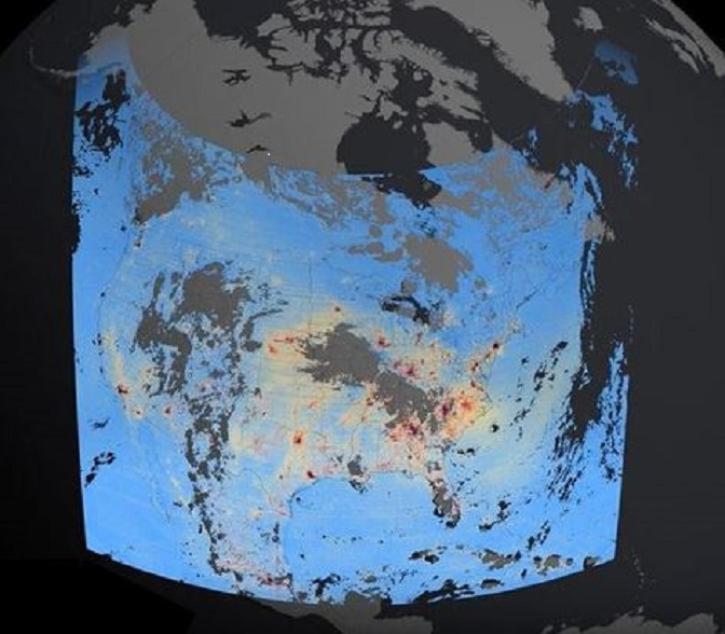
These new Tropospheric Emissions: Monitoring of Pollution (TEMPO) products will aid validation efforts and algorithm development, and will be used to expand the mission’s higher-level products.
5 MIN READ
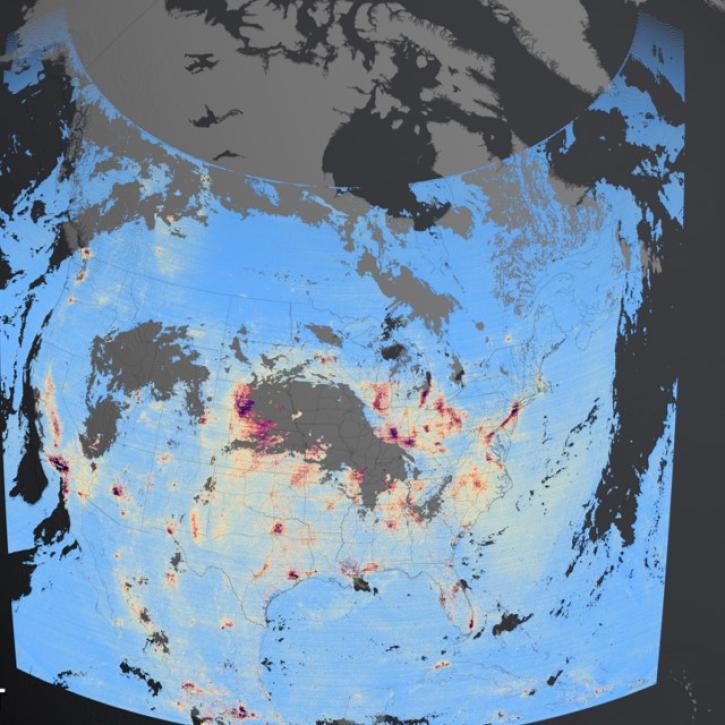
This webinar provides an overview of the TEMPO mission and its data products and shows how to discover and access TEMPO data products using NASA's Earthdata Search.
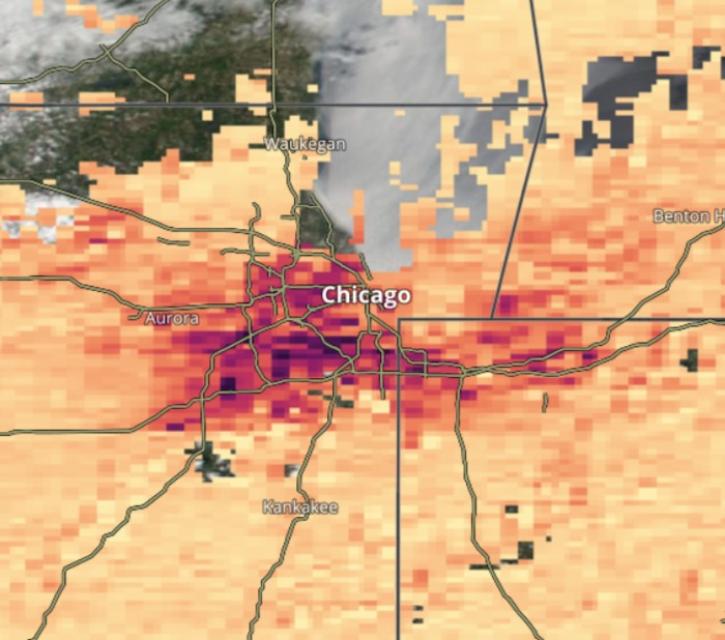
The 14 layers from the Tropospheric Emissions: Monitoring of Pollution mission offer data on clouds, nitrogen dioxide, ozone, and more.
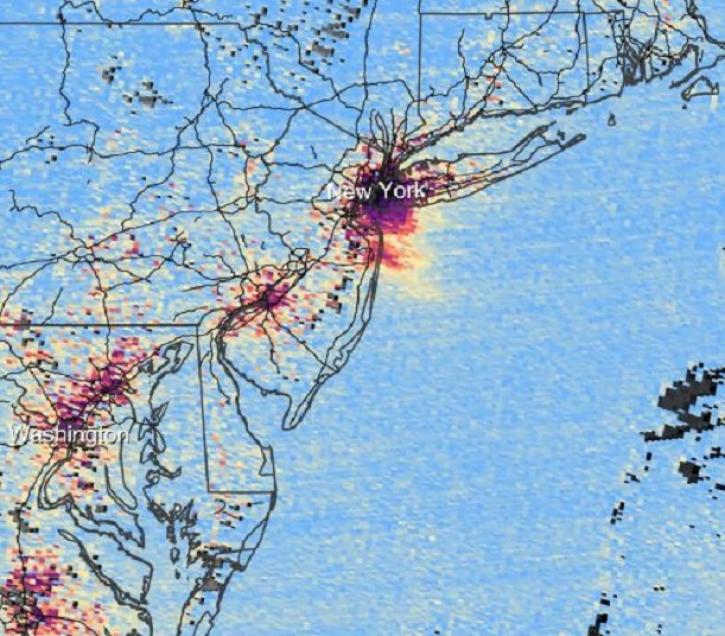
The beta release of Tropospheric Emissions: Monitoring of Pollution (TEMPO) mission data products lets users begin developing applications using these data.
Frequently Asked Questions
Earthdata Forum
Our online forum provides a space for users to browse thousands of FAQs about research needs, data, and data applications. You can also submit new questions for our experts to answer.
Submit Questions to Earthdata Forumand View Expert Responses