Tailoring the View: TiTiler-CMR Customizes HLS Imagery in Worldview and FIRMS

The TiTiler-CMR service generates dynamic, on-demand map tile layers that can be incorporated into GIS software and visualization applications. Two NASA mapping applications – Worldview and FIRMS – have harnessed the versatility of this service.

NASA’s Earth science missions collect and process large-scale and complex datasets that serve as a foundation for monitoring and understanding our ever-changing planet. Maximizing the return on investment and translating those volumes of data into actionable insights requires tools that are not only powerful, but also intuitive and efficient. 

Released in 2025, TiTiler-CMR is an open-source library designed to improve NASA’s data-to-action initiatives. This web-based service was developed by the Data Systems Evolution team in the Office of Data Science and Informatics (ODSI) at Marshall Space Flight Center and accesses the vast amounts of datasets catalogued in NASA’s Common Metadata Repository (CMR). It generates dynamic, on-demand map tile layers that can be easily incorporated into GIS software and visualization applications, providing increased efficiency in serving high-value data visualizations without data pre-processing.
Image
Image Caption

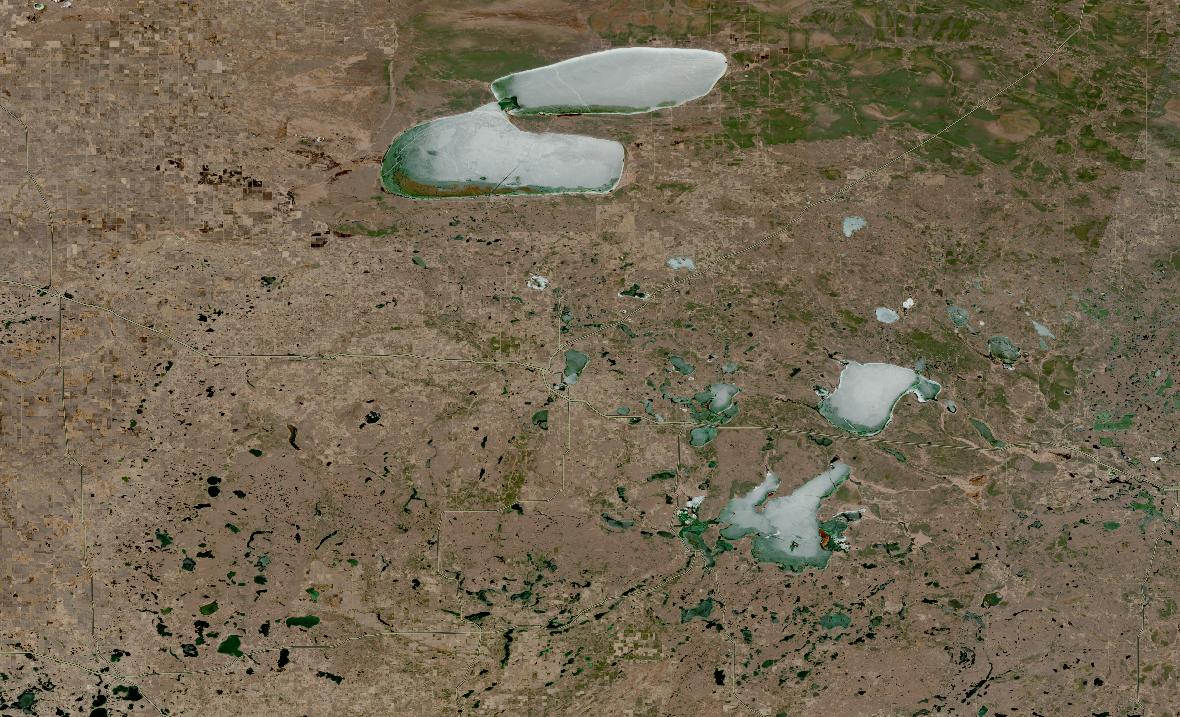
Figure 1: This composite image from the Harmonized Landsat and Sentinel-2 (HLS) dataset shows ice retreating across Lake Bemidji in northern Minnesota on April 21, 2026. HLS is often a key backbone element for visualizing other Earth science datasets. Credit: NASA Worldview.

TiTiler-CMR was built upon the original library that supported cloud-optimized GeoTIFF data formats, and now includes support for traditional formats including NetCDF, HDF-5, and Gridded Binary (GRIB). 

It also is now available for generating visualizations and analyses for several NASA data products, including Harmonized Landsat and Sentinel-2 (HLS), Integrated Multi-satellitE Retrievals for the Global Precipitation Measurement (IMERG), and NASA-ISRO Synthetic Aperture Radar (NISAR).

Two NASA flagship Earth science mapping applications – Worldview and the Fire Information for Resource Management System (FIRMS) – have harnessed the full versatility of this service, giving users direct access to individual spectral bands, customizable band combinations, and spectral indices for HLS visualizations that are not presently available via static imagery. Having these flexible data visualizations available in these applications without the need for advanced infrastructure or other web interfaces significantly improves the speed with which users can visualize, analyze, and interpret information. 

TiTiler-CMR Streamlines Workflows

TiTiler-CMR allows users to tailor high-resolution imagery to their specific research or operational needs, supporting a broad range of data-driven use cases and downstream applications. Different spectral bands and band combinations can yield a wide range of critical information, such as the condition and health of vegetation, drought stress impacts, burn severity, post-fire and wildfire recovery conditions, soil moisture content, flood and inundation impacts, and changes in land use. 

By providing these dynamically generated visualizations, users are able to efficiently explore additional data products on-demand – without the need for downloading or preprocessing data – and decrease time from research idea to scientific result.

“This furthers NASA’s mission to increase operational efficiency and user capabilities leveraging innovative technologies,” said Brian Freitag, research computer scientist for NASA’s ODSI and lead of the Data Systems Evolution team. “As NASA Earth science prepares for rapid increases in data volume, integrations like TiTiler-CMR into Worldview and FIRMS help us demonstrate how hybrid solutions of static and dynamic visualization capabilities can provide meaningful impact to the Earth science community and beyond.”

Image
Image Caption

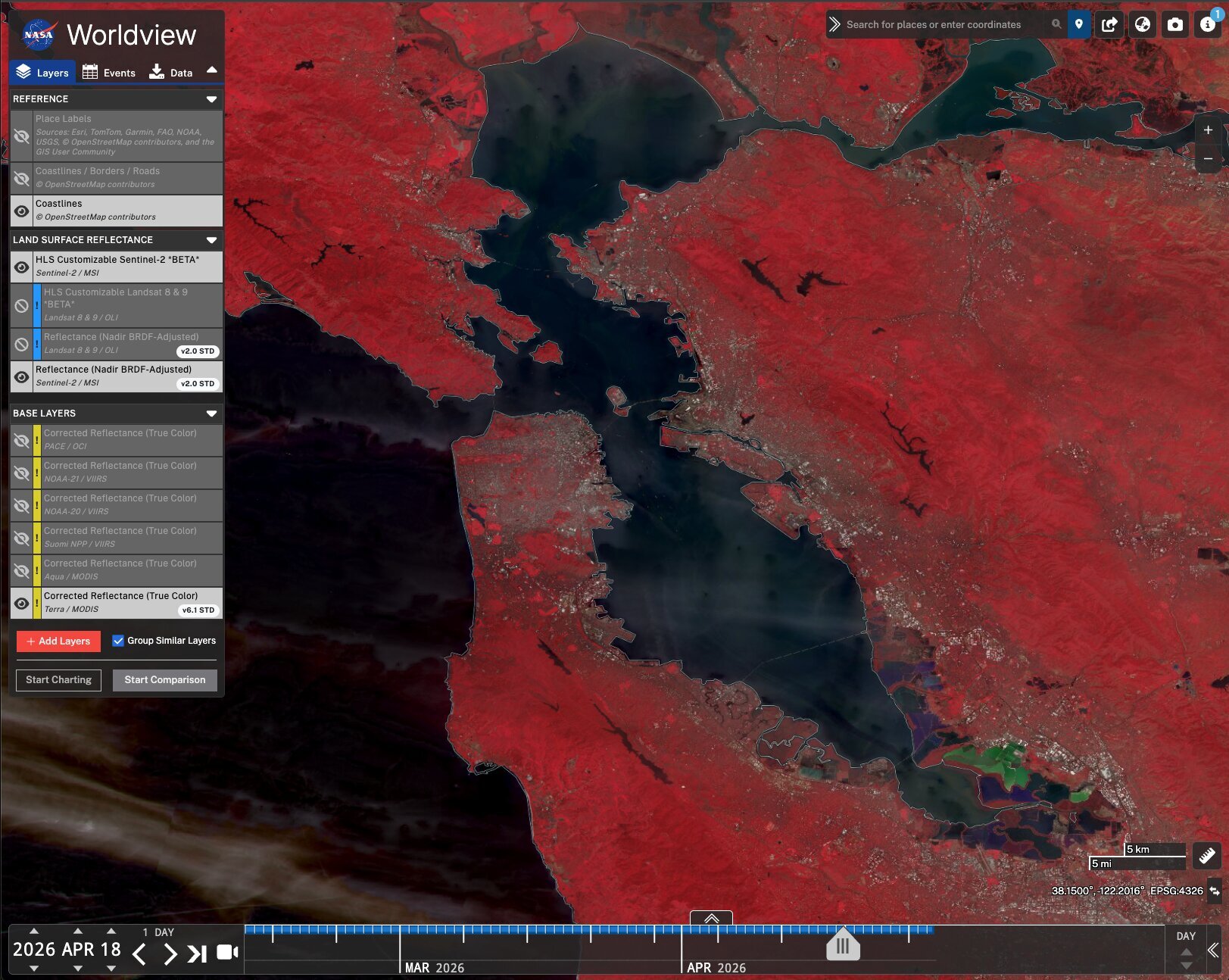
Figure 2: This HLS color-infrared composite image —generated via the TiTiler-CMR API in the Worldview application — shows the area around Cambridge, Maryland. Users can choose from preset options or they can manually select bands for each RGB channel. Credit: NASA Worldview.

Using TiTiler-CMR in Worldview and FIRMS

NASA’s Worldview application is a general purpose visualization tool, allowing users to interactively browse, compare, and animate more than a thousand NASA satellite products. Since 2021, Worldview has provided easy access to daily, global 30-meter resolution true-color imagery from the HLS project, via the Global Imagery Browse Services. GIBS is an open imagery archive of pre-generated imagery that is optimized to rapidly serve more than a thousand visualized data products from high-value missions. 

The integration of the TiTiler-CMR API into Worldview further enables multispectral visualization, allowing users to dynamically generate custom composites. Users can assign specific spectral bands to red, green, and blue channels, or they can select from pre-generated combinations and indices to highlight relevant features of the land, water, or atmosphere. This capability allows users to better distinguish between surface features and to identify unique information not visible in standard true-color imagery. 

For example, the color infrared (near-infrared) composite is often ideal for analyzing vegetation health, as chlorophyll reflects near-infrared light. The combination of near-infrared and visible light makes healthy vegetation appear vibrant red, water as dark blue/black, and urban areas as white or gray. Furthermore, custom indices can then be applied to monitor vegetation stress by utilizing the red band (absorption) and near-infrared band (reflection).

Future developments in Worldview will enable users to dynamically generate true-color composites for the Arctic polar stereographic projection, providing access to high-resolution imagery previously unavailable for this region. For a comprehensive walkthrough of how to visualize HLS data in Worldview, view this NASA Earthdata tutorial.

Image
Image Caption

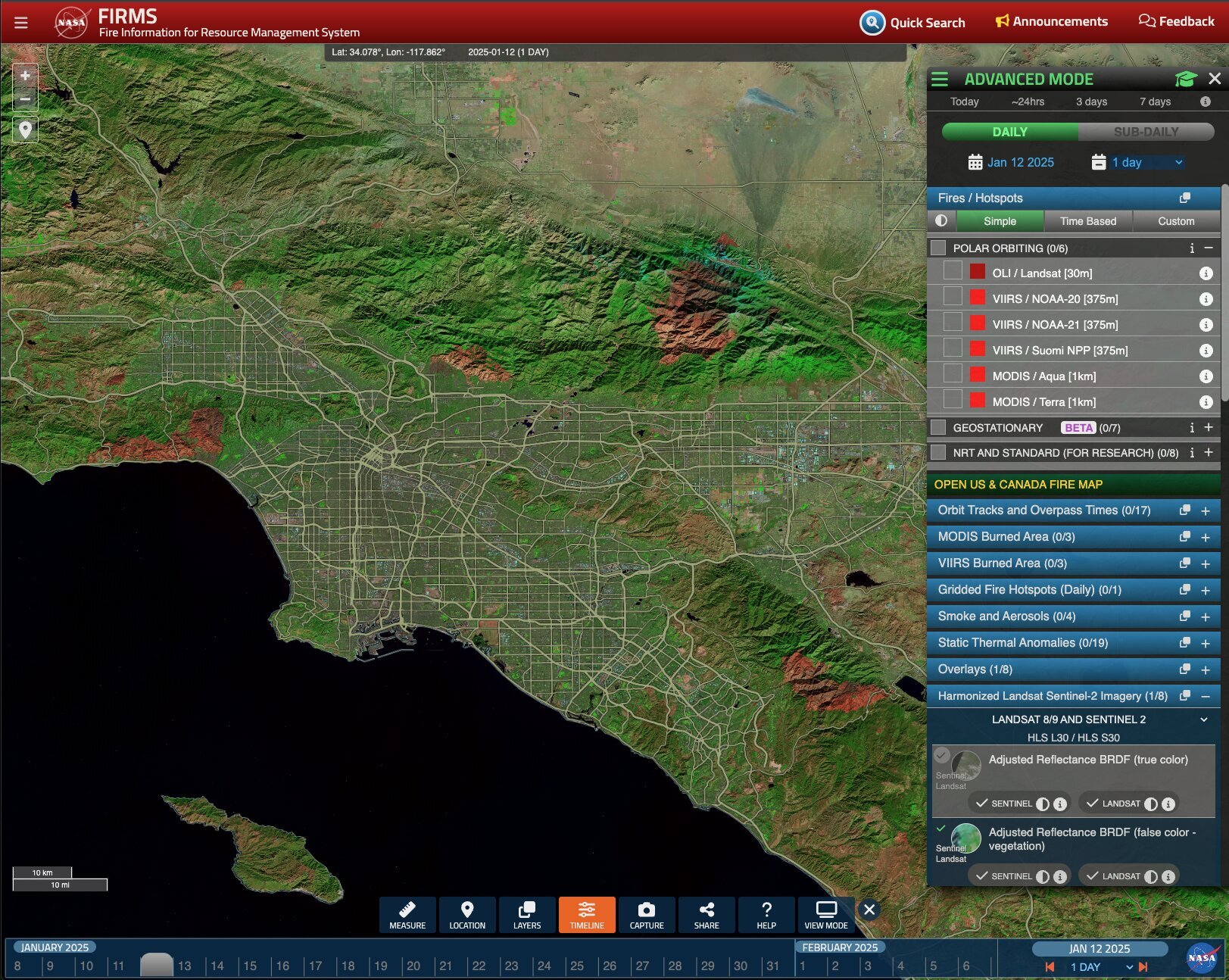
Figure 3: The integration of TiTiler-CMR into FIRMS enables better discrimination between healthy and burned vegetation, as shown in this image from the January 2025 Palisades and Eaton Fires in Southern California. Credit: NASA FIRMS.

FIRMS enables access to global near real-time satellite imagery, active fire/hotspots, and related products to identify the location, extent, and intensity of wildfire activity. Similarly, this application has specifically provided access to HLS data since 2022, enabling users to visualize true-color imagery from 2013 to the present, served from GIBS. The integration of the TiTiler-CMR API into FIRMS allows for highly customizable, on-demand imagery.

TiTiler-CMR enables users to tailor visualizations specifically to minimize the impact of smoke plumes, pinpoint active fire fronts, and monitor post-fire land surface changes at a granular level—down to the size of a football field. Furthermore, this dynamic rendering allows users to cross-validate lower-resolution fire products, such as Visible Infrared Imaging Radiometer Suite (VIIRS) active fire detections and perimeter data layers. Ultimately, this seamless combination of customizable data layers empowers researchers and first responders with much higher confidence when tracking the evolution of both active and historical fires from space. To learn how to utilize HLS data layers in FIRMS, follow this step-by-step NASA Earthdata tutorial. 

As NASA continues to advance Earth science research, services like TiTiler-CMR play a critical role in ensuring that data not only informs discovery, but empowers action. The combination of pre-generated imagery from GIBS and dynamically-generated imagery from TiTiler-CMR is a data visualization solution that increases user capabilities. It also provides a new path forward for visualization of cloud-hosted data.

To learn more about TiTiler-CMR’s features and capabilities, visit this NASA Earthdata release.

Details

Last Updated

April 29, 2026

Published