Kicking off Development of New Earth Observation Solutions

The Satellite Needs Working Group (SNWG) works to identify and address the Earth observation needs of civilian federal agencies. SNWG is launching its latest biennial survey to identify needs, while also reporting progress on previous solutions.

The Satellite Needs Working Group (SNWG) is an interagency effort – established through the White House National Science and Technology Council – to identify, communicate, and address the Earth observation needs of U.S. civilian federal agencies to support their ongoing missions and applications. As part of that effort, SNWG administers a biennial survey to assess community needs. The next survey opens May 18, 2026, and civilian federal agencies are encouraged to participate. 

Following the survey, SNWG will pass the results to NASA’s SNWG Implementation Team (NSITE) for a thorough and systematic assessment of responses. Subject matter experts from across thematic domains within the National Oceanic and Atmospheric Administration (NOAA), the U.S. Geological Survey (USGS), and NASA review each survey, conduct interviews with respondents to ensure a complete understanding of the need, and identify corresponding innovative Earth data solutions. After the assessment, SNWG solutions are presented for approval by NASA Earth Science Division (ESD) leadership and the Office of Management and Budget (OMB), then implemented by NASA or other teams. 

Examples of previously selected SNWG solutions include the Harmonized Landsat and Sentinel-2 (HLS) product, the NISAR soil moisture product (coming summer 2026), and Observational Products for End-Users from Remote Sensing Analysis (OPERA) products. 

Image
Image Caption

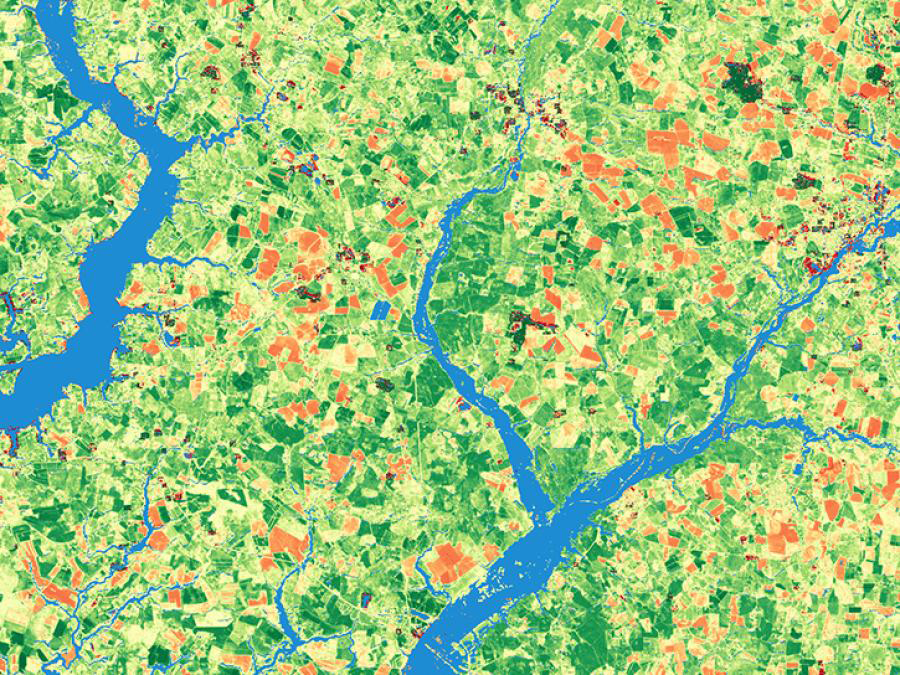
Figure 1: In the 2024 Satellite Needs Working Group assessment, federal agencies requested a 10 m version of the Harmonized Landsat and Sentinel-2 (HLS) dataset for better assessment of crop conditions, wildfire damage, coastal erosion, mining and reclamation resources, and disaster losses. The image above shows a portion of the Chesapeake Bay watershed through the lens of vegetation health mapping (Normalized Difference Vegetation Index) and HLS.

Introducing Selected Solutions from the 2024 Assessment

The 2024 SNWG assessment, designed to address the needs of federal agencies, concluded in May 2025 with the identification of six new solutions. These were among the most highly requested solutions to come out of the SNWG process to date, with the potential to meet hundreds of needs across the federal government and beyond. 

10-meter Harmonized Landsat and Sentinel-2 ​(HLS) Product​ 

This solution will build on the success of the existing Harmonized Landsat and Sentinel-2 (HLS) by providing harmonized, higher spatial resolution data at high temporal resolution for more efficient decision making across sectors such as agriculture and forestry. 

The HLS dataset is a solution from the 2016 SNWG cycle that involves resampling 10 m and 20 m Sentinel-2 data to the geometry of 30 m Landsat data and then providing atmospheric correction of both datasets. The result is a near-daily, global dataset of surface reflectance at 30 m resolution that is compatible with Landsat's historical data record. It is one of the world’s most distributed datasets and has applications across many thematic areas. 

Agencies requested a 10 m version of HLS for better assessment of crop conditions, wildfire damage, coastal erosion, mining and reclamation resources, and disaster losses. This solution will also enable higher resolution downstream services, such as the SNWG OPERA Surface Disturbance and Dynamic Surface Water eXtent solutions that identify surface disturbance and surface water, respectively. It could also support geospatial foundation models. 

High-Resolution Harmonized Land Surface Temperature (LST) Products within HLS​ 

This solution will further leverage the successes of HLS by combining it with other datasets to create a new 30 m harmonized land surface temperature (LST) product. Landsat has a thermal instrument; however, Sentinel-2 does not. Therefore, this solution will use thermal data from the Visible Infrared Imaging Radiometer Suite (VIIRS) and resample it to 30 m resolution. This will allow for the creation of a thermal dataset at the spatial and temporal resolution of HLS. High-resolution LST data have many downstream applications, including the widely used OpenET platform. 

Agencies requested higher resolution LST data in order to characterize urban heat, model fire behavior, improve agricultural management activities on water use, and detect early signs of crop stress​. 

High-Resolution Evapotranspiration (ET) ​Product within HLS 

This solution also will build on the successes of HLS by applying existing algorithms to produce evapotranspiration data at field scale for the entire globe, leveraging the OpenET platform. ET is the combination of evaporation and plant water loss due to transpiration. It is currently considered the largest data gap in water management globally. 

This SNWG solution answers the decision-making needs of stakeholders in agriculture, land management, and urban planning. High-resolution ET will support American crop productivity, water security, wildfire risk monitoring, and ecosystem health assessments. It will also enhance understanding of irrigation demands and water consumption​. 

Image
Image Caption

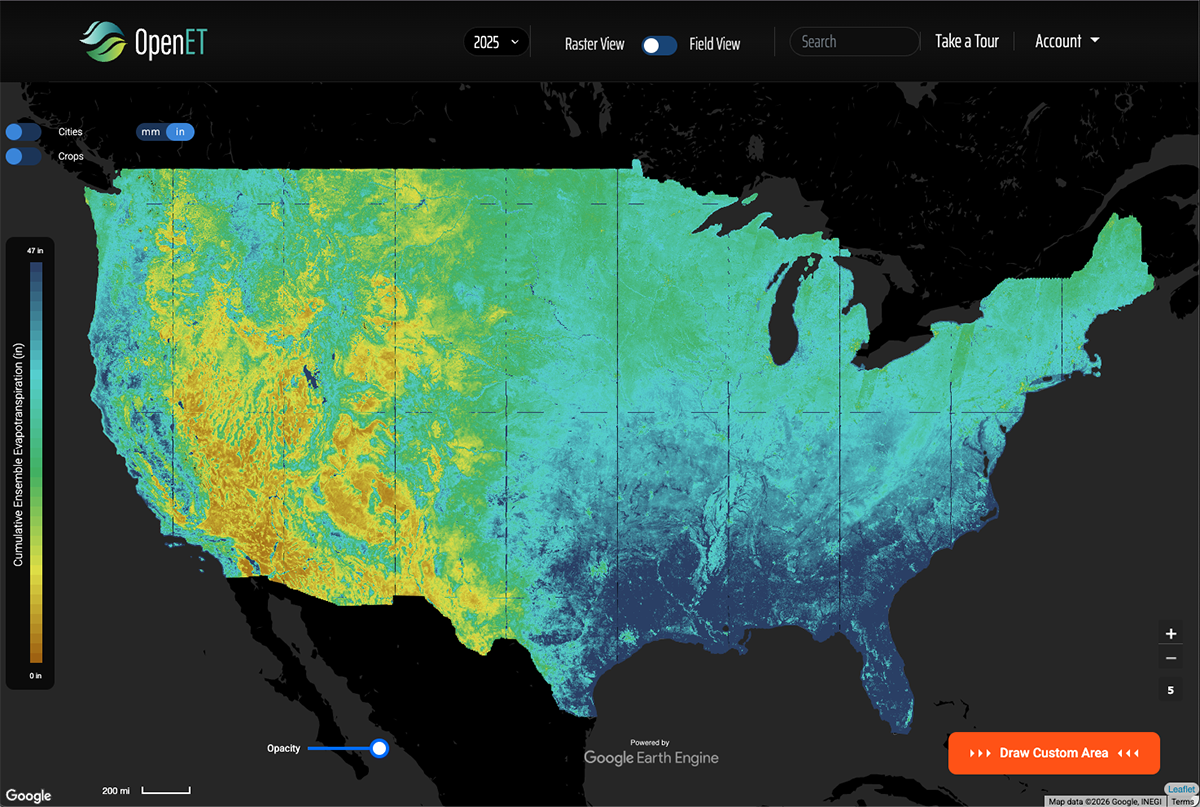
Figure 2: This map shows levels of evapotranspiration, as measured by the NASA-funded OpenET project, across the continental United States. In the 2024 Satellite Needs Working Group assessment, federal agencies requested a global version of this product that aids U.S. farmers as they manage water supplies, plantings, and other aspects of agriculture.

Accessible 3D Topographic Mapping Software​ 

This solution will enable the production of a web-based, user-friendly, graphical user interface for the NASA Ames Stereo Pipeline (ASP), and provide updated documentation. ASP is a suite of free and open-source tools used to generate high-resolution, three-dimensional  representations of the Earth's surface, digital elevation models (DEMs), orthoimages, point clouds, and textured meshes. ASP is currently packaged as command-line tools that require advanced user expertise; this solution will increase its accessibility to new users without coding expertise.

Accurate, up-to-date surface topography is an essential input for several applications including flood inundation mapping, forest and mineral resource assessment, disaster management, and landslide hazard assessment.​

Second Generation of the Fire Information for Resource Management System (FIRMS-2G)​ 

This solution will enable the continuity and improvement of active fire detections by the NASA Fire Information for Resource Management System (FIRMS). During major wildfire events, FIRMS is frequently the most visited NASA website, but it is built from data collected by Moderate Resolution Imaging Spectroradiometer (MODIS) sensors onboard the Aqua and Terra satellites that are reaching their end-of-life. This solution will focus on incorporating higher resolution and lower latency active fire datasets into FIRMS, such as those from Sentinel-2 B/C, Sentinel-3 A/B/C/D, NOAA-22, VIIRS, and commercial data sources like FireSat and WildFireSat. 

Enhancing FIRMS with additional datasets will help inform stakeholders on the evolution of aerosols, smoke plumes, and air quality downwind of fires. FIRMS-2G also will improve the timeliness of burned area estimates from the current three months to same day and 2 days post observation by incorporating VIIRS near real-time burned area and HLS vegetation indices.   

Timely monitoring of wildland fire extents, progression, and damages will help identify post-fire hazards, including flash flooding and habitat loss, and inform federal, state, and local decisions that help rebuild economies in the wake of a fire. Additionally, modeling of the trajectory of wildfire aerosol and smoke plumes will support timely public health warnings. 

Image
Image Caption

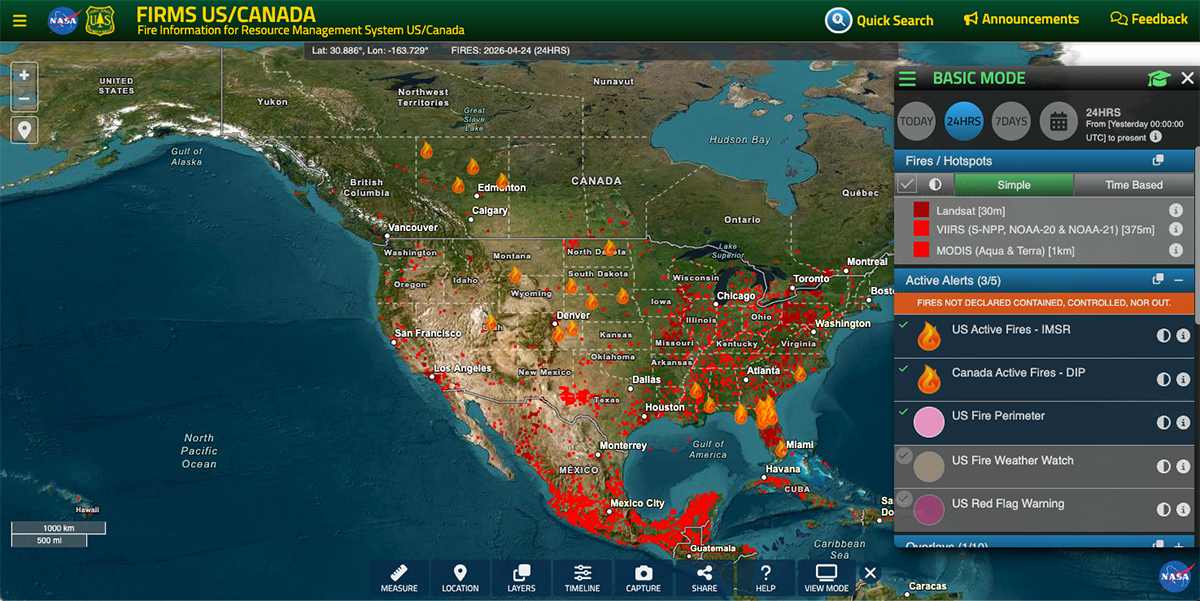
Figure 3: This screenshot from the NASA Fire Information for Resource Management System (FIRMS) dashboard shows active fire detections across North America. With the Terra and Aqua satellites nearing the end of their missions, federal agencies requested NASA find a way to continue supporting this fire mapping program by incorporating higher resolution and lower latency datasets into FIRMS to replace the datasets from MODIS that are sunsetting.

Ongoing and Mobile Pandora Measurements in Smoky Regions 

This solution is currently postponed but, if implemented, will acquire Pandora air quality monitoring instruments for deployment in typically smoky areas like Central Oregon, Northern California, and the U.S. Southeast. Some stations will have permanent locations, while others will be mobile units that can be relocated to understand prescribed burning effects. The observations from these low-cost sensors will help researchers interpret Tropospheric Emissions: Monitoring of Pollution (TEMPO) observations and provide hourly, near-surface information. ​

Poor air quality is a risk to human health and safety. This solution protects Americans by increasing the coverage of air quality monitoring and weather forecasting in particularly smoky regions. Agencies need to understand fire fuels, behavior, and weather; smoke emissions and deposition; and smoke plume transport and transformation processes.​ The high-resolution, localized smoke data resulting from this solution will help stakeholders understand smoke effects on nearby communities and landscapes. It will also support better forecasting of air quality during hazardous events.

Looking Ahead

As these solutions get underway, there will be opportunities for community and stakeholder involvement over the coming months and years. 

For more information on NASA’s contributions to SNWG, including existing and new solutions, visit the NSITE project page. To stay up to date with the latest news on SNWG solutions, please subscribe to the NSITE newsletter.

Details

Last Updated

April 27, 2026

Published