Introduction
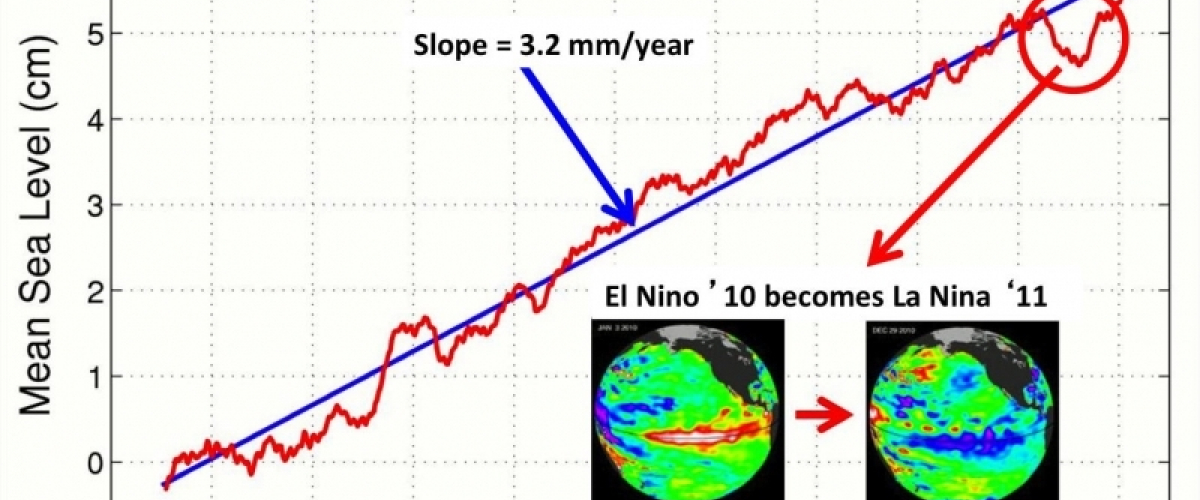
In mid 2010 to mid 2011, global mean sea level (GMSL) dropped by approximately 5 mm. By “weighing“ the ocean using the Gravity Recovery And Climate Experiment (GRACE) satellites, the source of this sudden decrease can be determined. Was there less water in the ocean or was it temporarily cooler than normal?
Measuring Earth's Gravity Field and Mass With GRACE
The GRACE platform, launched in 2002, measures changes in Earth’s gravity field. These changes are primarily due to variability in Earth’s water cycle. Melting ice sheets, changes in groundwater, sea level rise — all of these processes involve a local change in Earth’s mass that can be detected by GRACE.
Major Findings
Comparing the 2010-11 drop in GMSL to the change in ocean mass measured by GRACE indicates that the temporary decrease was related to freshwater transport from the ocean to the continents. The GRACE satellites also provide estimates of terrestrial water storage. This information is used to determine to what region of the world the freshwater was transported. The satellite observations show that more water than normal occurred in Australia and northern South America.
Heavy rainfall in 2010 led to increased terrestrial water storage in these regions. The El Niño Southern Oscillation is known to affect precipitation and evaporation over Australia and northern South America. In the El Niño phase it rains less, and in the La Niña phase it rains more. With the 2010-11 La Niña being one of the strongest over the past 60+ years, a large amount of water was transported from the ocean to the continents and led to the temporary drop in GMSL.
References
- Boening, C., J. K. Willis, F. W. Landerer, R. S. Nerem, and J. Fasullo (2012), The 2011 La Niña: So strong, the oceans fell, Geophys. Res. Lett., 39, L19602. doi:10.1029/2012GL053055
- Nerem, R. S., D. P. Chambers, C. Choe, and G. T. Mitchum (2010), Estimating Mean Sea Level Change from the TOPEX and Jason Altimeter Missions, Mar Geod, 33, 435-446.