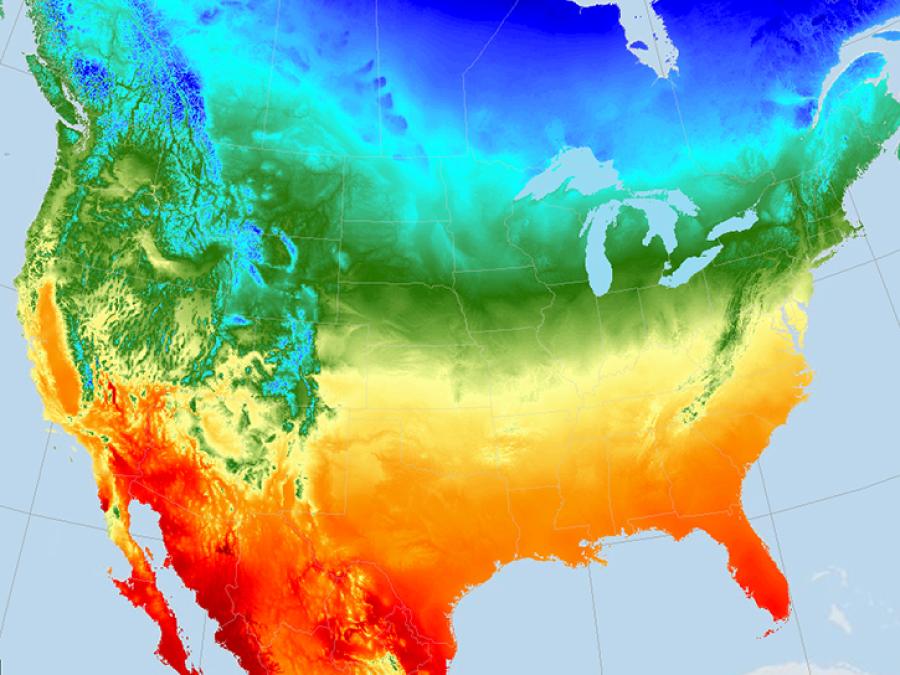
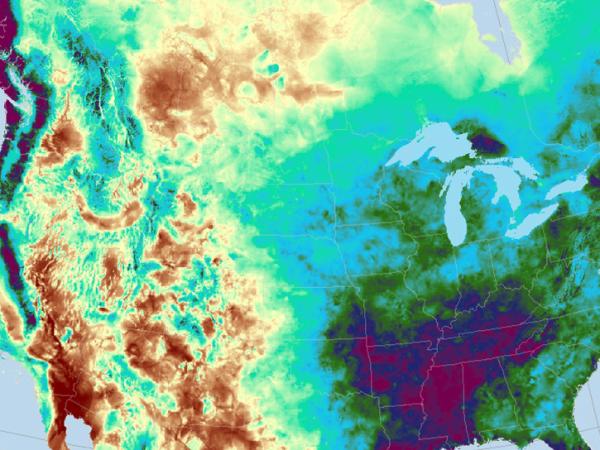
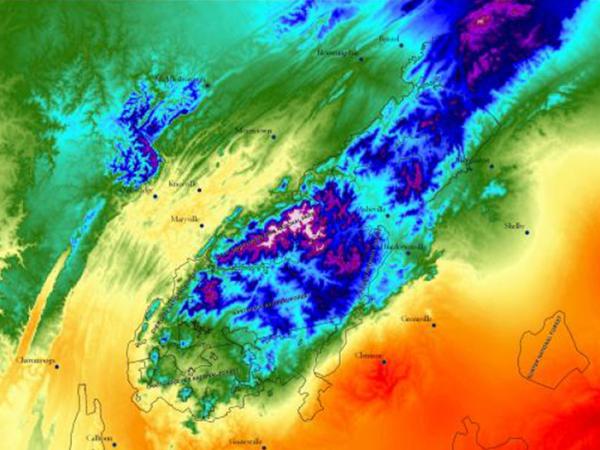
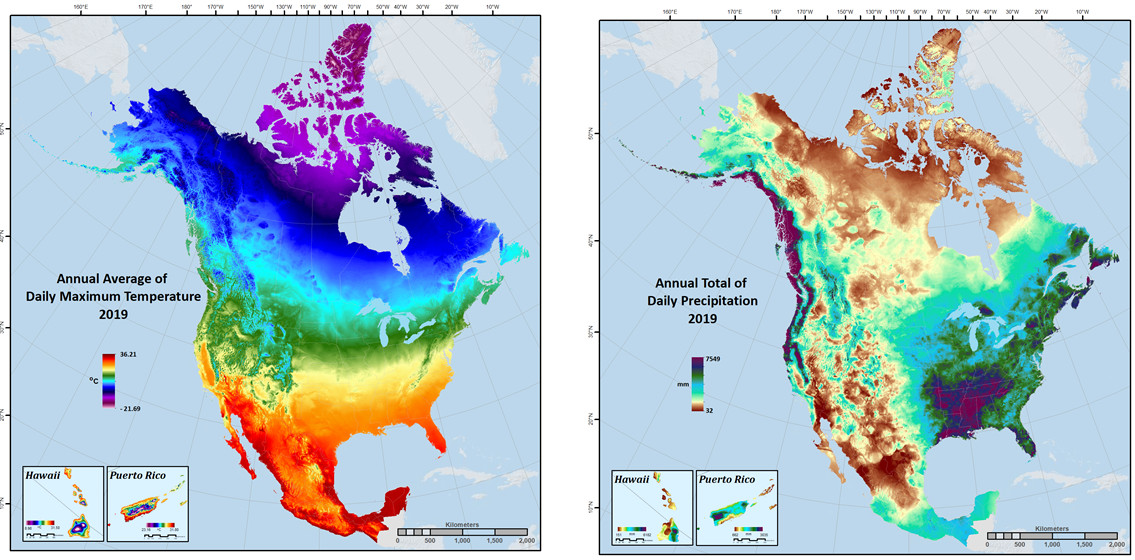
image of DAYMET data over North America

Daymet

Daymet uses statistical modeling techniques to provide long-term, continuous, gridded estimates of daily weather and climatology variables based on ground-based observations. The project's weather variables include daily minimum and maximum temperature, precipitation, vapor pressure, shortwave radiation, snow water equivalent, and day length over continental North America, Hawaii, and Puerto Rico.

Daymet data products provide driver data for biogeochemical terrestrial modeling and have myriad applications in Earth science, natural resource, biodiversity, and agricultural research areas. 

Daymet is a research product of the Environmental Sciences Division at Oak Ridge National Laboratory, Oak Ridge, TN. Daymet is supported by NASA through the Earth Science Data and Information System (ESDIS) and the Terrestrial Ecology Program. The continued development of the Daymet algorithm and processing is also supported by the Office of Biological and Environmental Research within the U.S. Department of Energy's Office of Science.

Principal Investigator

Peter Thornton (algorithm development) and Michele Thornton (data production)

Data Centers

ORNL DAAC

Funding Programs

NASA Terrestrial Ecology Program
DOE Office of Biological and Environmental Research
Study DatesContinental North America (Mexico, United States, Canada) and Hawaii: 1980 to recent full calendar year
Puerto Rico: 1950 to recent full calendar year
RegionContinental North America (Mexico, United States, Canada), Hawaii, and Puerto Rico
Focus AreasBiosphere
Atmosphere
Hydrosphere
Cryosphere
Scientific TopicsEcological and environmental modeling
Agriculture and crop science
Phenology and biology
Hydrology and water resources
Climate change analysis
Species distribution and biodiversity

Parameters, Parameter Abbreviations, Units, and Descriptions

ParameterAbbrUnitsDescription
Day lengthdayls/dayDuration of the daylight period in seconds per day. This calculation is based on the period of the day during which the Sun is above a hypothetical flat horizon.
Precipitationprcpmm/dayDaily total precipitation in millimeters per day; sum of all forms converted to water-equivalent. Precipitation occurrence on any given day may be ascertained.
Shortwave radiationsradW/m2Incident shortwave radiation flux density in watts per square meter, taken as an average over the daylight period of the day. NOTE: Daily total radiation (MJ/m2/day) can be calculated as follows: ((srad (W/m2) * dayl (s/day)) / l,000,000).
Snow water equivalentswekg/m2Snow water equivalent in kilograms per square meter. The amount of water contained within the snowpack.
Maximum air temperaturetmaxdegrees CDaily maximum 2-meter air temperature in degrees Celsius.
Minimum air temperaturetmindegrees CDaily minimum 2-meter air temperature in degrees Celsius.
Water vapor pressurevpPaWater vapor pressure in pascals. Daily average partial pressure of water vapor.