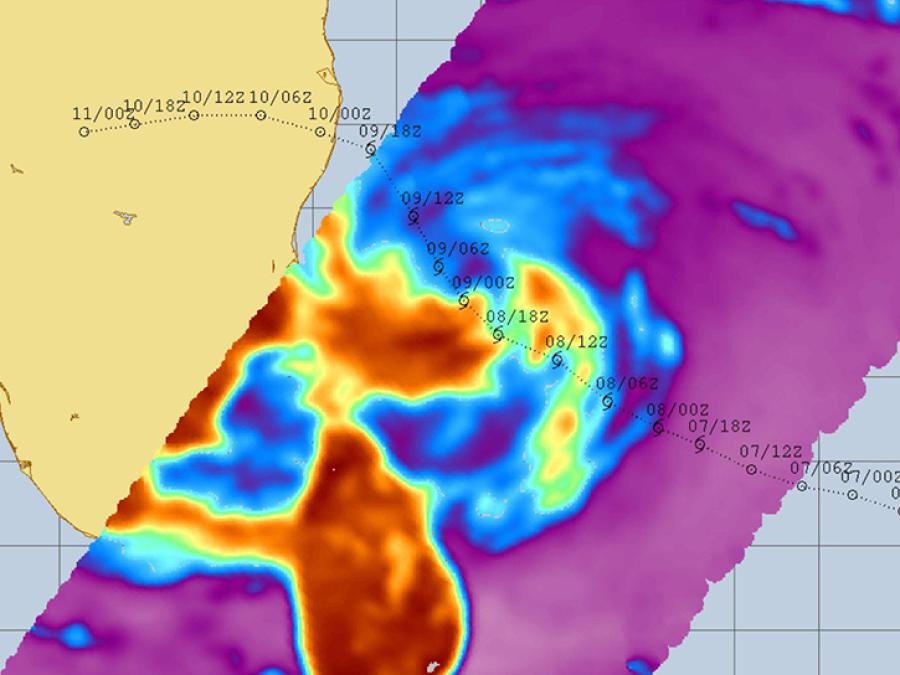
Tropical Cyclone Mandous on Dec. 9, 2022, as the storm approached the southeastern coast of India
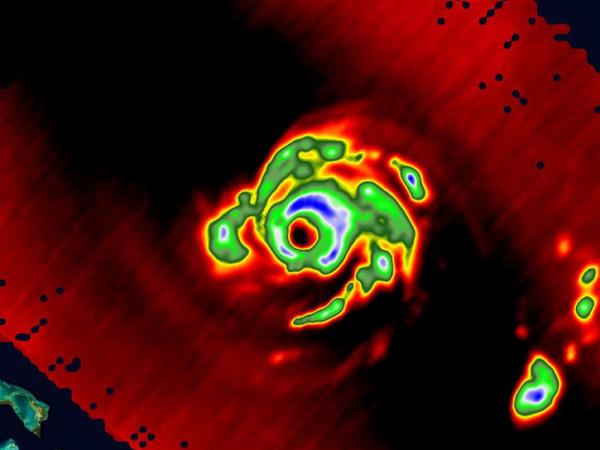
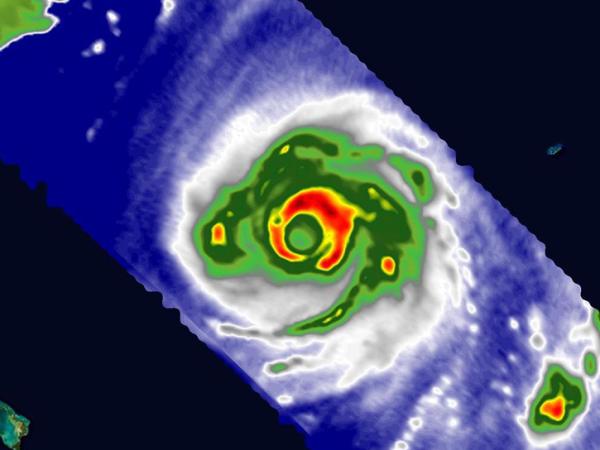
Hurricane Franklin as the Category 4 storm moved off the East Coast of the United States on Aug. 29, 2023

COWVR-TEMPEST/STP-H8

COWVR and TEMPEST on Space Test Program-Houston 8

The Department of Defense (DoD)-sponsored Space Test Program-Houston 8 (STP-H8) mission carried two instruments designed by NASA's Jet Propulsion Laboratory (JPL), the Compact Ocean Wind Vector Radiometer (COWVR) and Temporal Experiment for Storms and Tropical Systems (TEMPEST), and aimed to demonstrate new low-cost microwave sensor technologies for weather applications. Together, COWVR and TEMPEST provided measurements used to derive spatially coincident wind vector and atmospheric water quantities. The simultaneous measurements of air-sea interface and atmospheric profiles present significant advantages for research and applications in storm forecasting, weather and atmospheric dynamics, air-sea interactions, climate sciences, and model improvements.

Data Centers

PO.DAAC

Funding Programs

Earth Ventures Technology Demonstration Program

COWVR and TEMPEST were launched on Dec. 21, 2021, at 5:07 a.m. EST from the Kennedy Space Center to the International Space Station (ISS) as part of SpaceX’s 24th Commercial Resupply Mission (CRS-24). The instruments were deployed to the JEM-EF module of the ISS to commence a planned three-year operation (potentially extended five years as of 2025). The real-time stream of COWVR and TEMPEST measurements will be delivered via the Tracking and Data Reply Satellite System (TDRSS) with a latency of minutes. 

The development of TEMPEST-D and its spare copy, which became TEMPEST-H8, was funded by NASA through the Earth Ventures Technology Demonstration Program. NASA also provided the launch as a part of the ISS crew resupply missions. COWVR uses receiver designs from Jason-3, which was an instrument originally developed by JPL for NASA to support the Jason altimeter mission. The Air-Sea interface and Atmospheric Profile observatory Science Working Group (ASAP-SWG) is composed of scientists from NASA (JPL, Goddard Space Flight Center, Marshall Space Flight Center), DoD, National Oceanic and Atmospheric Administration (NOAA), universities, private sector, and Météo France. Tony Lee (JPL), Ben Ruston (Joint Center for Satellite Data Assimilation), Clark Rowley (Naval Research Laboratory), and Hui Su (JPL) serve as ASAP-SWG co-chairs.

Remote video URL
This animation was created using daily wind speed measurements from the COWVR instrument during its first year of operation. COWVR was developed at NASA's JPL and is installed on the International Space Station, where it has been collecting measurements since January 2022. COWVR aims to demonstrate new low-cost microwave sensor technologies for weather applications. This animation uses the first public release of the data which includes wind speed, wind direction, and moisture parameters. Credit: PO.DAAC

Both COWVR and TEMPEST provide brightness temperature measurements at their respective frequencies, and the first set of derived physical variables include ocean surface winds and column-integrated water quantities (cloud liquid water, precipitable water vapor). Additionally, the Air-Sea interface and Atmospheric Profile observatory Science Working Group (ASAP-SWG) was formed in early 2021 to provide community leadership for advancing research and applications with COWVR and TEMPEST measurements. With NASA's support, the ASAP-SWG will also develop products for water vapor profile, precipitation rate, and ice water path using the STP-H8 measurements. PO.DAAC is the designated data archive and distribution center, with science data provided in HDF-5 format. These measurements supplement the PO.DAAC archive with non-sun-synchronous wind and water data, enhancing existing measurements from sun-synchronous sensors/platforms. The anticipated data products are listed in Table 1. 

Data Products from COWVR and TEMPEST

VariableSpatial ResolutionExpected uncertaintyData producer
Wind vector (speed and direction)30 kmWind speed < 6 m/sWind speed between 6 & 12 m/s

Wind speed

> 12 m/s

JPL
38°16°
1 m/s1 m/s1 m/s
Precipitable water vapor30 km< 0.3 cmJPL
Cloud liquid water30 km0.05 mmJPL
Precipitation rate15 kmTBD*CSU/JPL
Ice water path15 km<50% for IWP>200g/m2*CSU
Water vapor profile15 km15%*CSU
Brightness temperature13-30 km< 0.3KJPL

*NASA funded development

Documents provided here include information on the general COWVR-TEMPEST project. A complete set of documents specific to each data product (if further resources are available) can be found on that product's landing page.