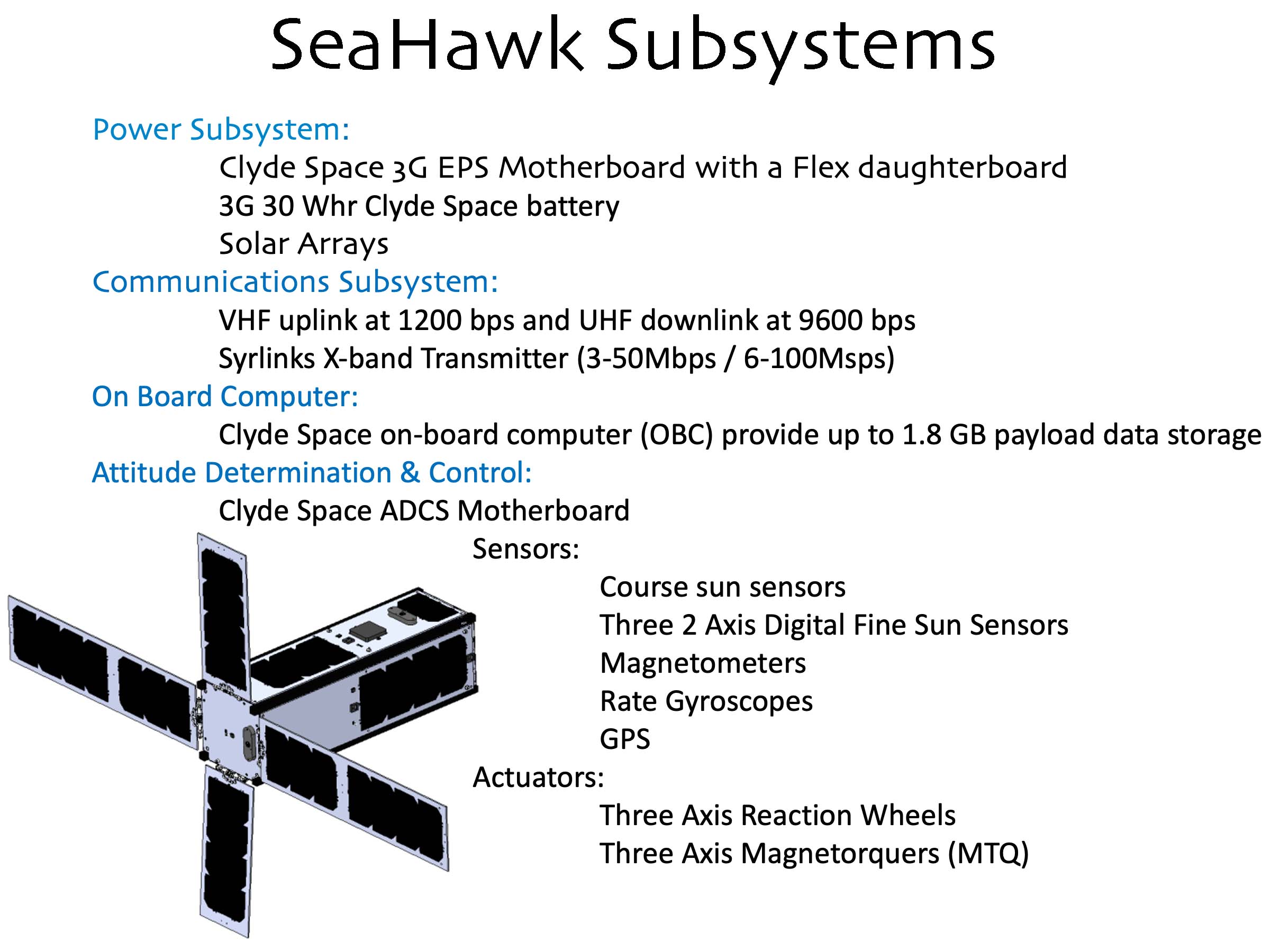
The goal of the SeaHawk mission was to construct and demonstrate the potential scientific applications of a high-resolution (~120m) ocean color instrument on a 3U (10cm x 10cm x 30cm) cubesat platform. The cubesat bus was named SeaHawk and carried the HawkEye sea and land imaging sensor. The project observed the changing biology of the ocean surface and gathered data to increase understanding of the marine food chain, oceanic climate, fisheries, and pollution phenomena.

Type

Earth Observation Satellite

Data Center

OB.DAAC

Launch

Dec. 3, 2018

Objective

Land and Ocean Monitoring
  • Nominal orbital height = 575 km
  • Sun-synchronous around 10:30 a.m.
  • 9-day repeat orbit
  • Baseline orbital lifetime of 1 year (18-24 months)
  • Baseline of 15 scenes per day (200 x 600 km of approximately 120 meter resolution - 100 MB/scene)
  • X-band downlink (Wallops Flight Facility and Alaska) data rate of 6 - 100 mbps
  • Weight:
    • Instrument: less than 1 kilogram
    • Total (spacecraft plus instrument): less than 5 kilograms
  • Off-the-shelf CCD arrays
  • Sensitivity comparable to SeaWiFS
  • Open intellectual property and knowledge sharing
Image
Image

Instruments Aboard SeaHawk

Instrument Name Operational Date(s) Spectral Resolution Type of Instrument
HawkEye

8 bands (nm): 412, 447, 488, 510, 556, 670, 752, 867

Spectrometer/Radiometer

Frequently Asked Questions

Earthdata Forum

Our online forum provides a space for users to browse thousands of FAQs about research needs, data, and data applications. You can also submit new questions for our experts to answer.

Submit Questions to Earthdata Forumand View Expert Responses

Earthdata
Forum