Discharge is a fundamental concept in hydrology, and important to any understanding of hydrodynamics and flow modeling. It refers to the flow rate of water in a channel, usually measured in cubic meters per second. Another way of picturing this is to imagine standing at one spot on the bank of a river and measuring the water flowing by: What volume of water passes you within one second?

Discharge is determined by the size and speed of a river, and includes any chemicals, biological materials, or solids in the water. Modeling discharge can thus help us understand how runoff from fertilizers and industry affect downstream habitats, predict where flooding is most likely during heavy rainfall, and monitor the water level in reservoirs.

NASA's Surface Water and Ocean Topography (SWOT) mission uses radar interferometry to measure global freshwater levels. SWOT emits radar waves that reflect off the surface of bodies of water. By measuring the precise angle and speed at which those signals return to the satellite, scientists can determine the precise elevation of the water.

The Gravity Recovery and Climate Experiment/GRACE Follow-On (GRACE and GRACE-FO) missions also help track water balances across the Earth's surface, measuring tiny variations in gravity that can indicate surface water movement. NASA supplements these remote sensing observations with in-situ data from stream gauges to build up a global picture of hydrology and stream flow.

NASA data on river discharge support streamflow models, flood predictions, and nutrient cycling research around the world. NASA also provides tutorials on working with SWOT data to find and access river discharge data.  
Get Discharge/Flow Data

Access a range of datasets and data tools to further your research on river discharge and flow

Learn How to Use Discharge/Flow Data

Access a range of webinars, tutorials, data recipes, and data stories to enhance your knowledge of Earth Observation data.
Earthdata grapic identifier on patterned background
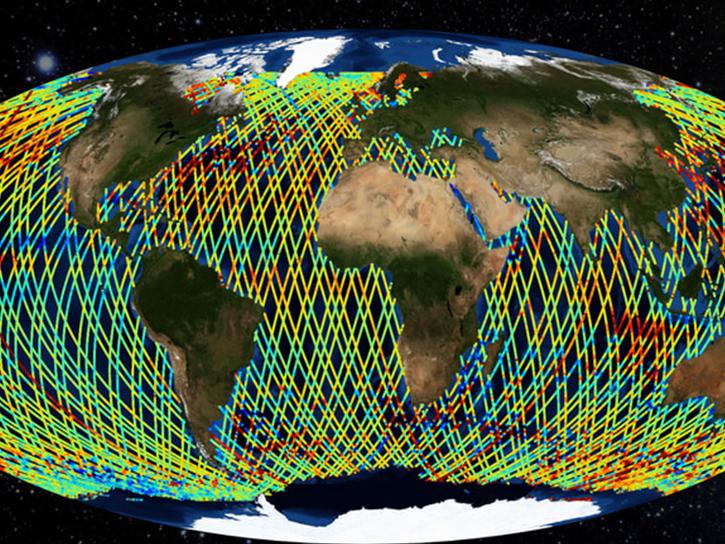
Surface Water and Ocean Topography (SWOT) Swath Visualizer
The Surface Water and Ocean Topography (SWOT) Swath Visualizer provides a visualization of two instruments’ coverage of Earth's surface: the Ka-band Radar Interferometer and altimeter.
global sea surface height data collected by SWOT
Download PO.DAAC SWOT Data Using HiTIDE
Use HiTIDE to select, subset, and download KaRIn sea surface height data from SWOT.
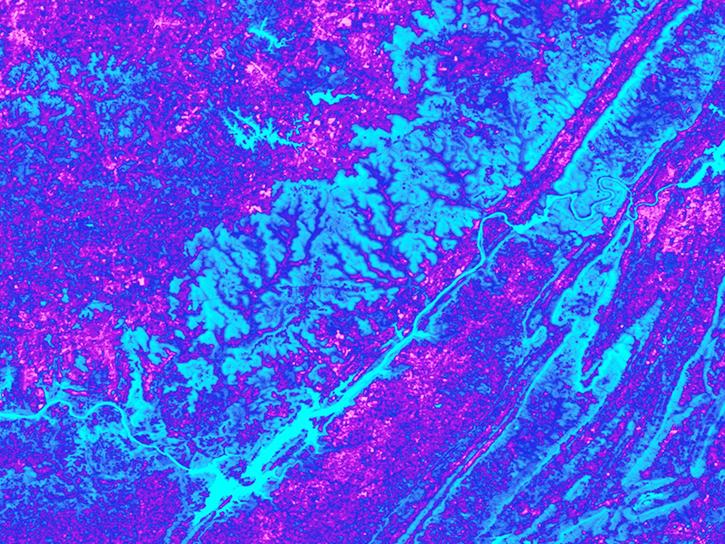
Change between daytime and nighttime land surface temperature based on ECOSTRESS Land Surface Temperature data from August 30 to September 1, 2019
Predicting Tennessee River Water Temperature With Earth Data
See how the Tennessee Valley Energy DEVELOP team used Earth observations to predict river water temperatures for managing and protecting aquatic ecosystems.
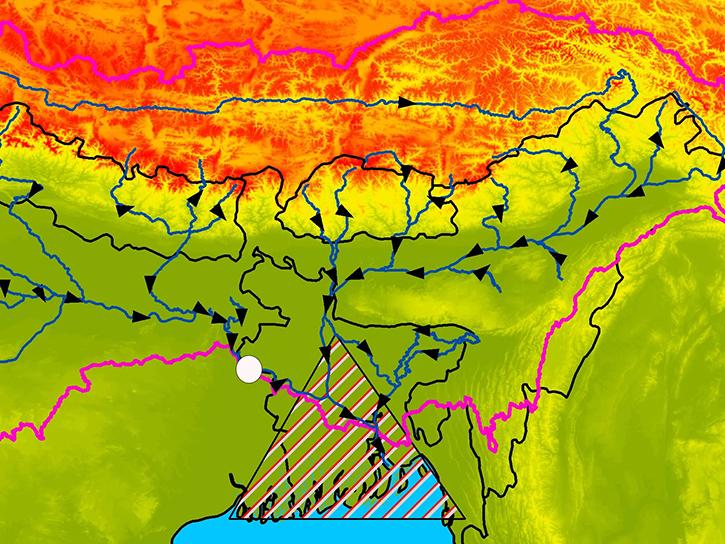
JASON-2 data predicting flood areas in the Ganges River basin
Utilization of Satellite Altimetry for Bangladesh Flood Forecasting and Warning System
Learn how satellite altimetry is used to measure the heights of rivers and lakes.
Discover and Visualize Discharge/Flow Data
NASA data help us understand Earth's changing systems in more detail than ever before, and visualizations help make Earth science concepts accessible, beautiful, and impactful.
Data visualization is a powerful tool for analysis, trend and pattern recognition, and communication. Our resources help you find data visualizations to complement and enhance your research. We also have tools and tutorials to help you translate discharge and flow data into compelling visuals.
Image
Flooding along the Brahmaputra River, Bangladesh on 25 July 2020 (VIIRS/NOAA-20) - Feature Grid
False-color image of flooding along the Brahmaputra River in Bangladesh. The image was acquired on 25 July 2020 by the Visible Infrared Imaging Radiometer Suite (VIIRS) instrument, aboard the joint NASA/NOAA NOAA-20 satellite. The image is comprised of the VIIRS Bands M11-I2-I1. This band combination is useful for distinguishing floods from the surrounding landscape.

Join Our Community of NASA Data Users

While NASA data are openly available without restriction, an Earthdata Login is required to download data and to use some tools with full functionality.

Learn About the Benefits of Earthdata Login

Frequently Asked Questions

Earthdata Forum

Our online forum provides a space for users to browse thousands of FAQs about research needs, data, and data applications. You can also submit new questions for our experts to answer.

Submit Questions to Earthdata Forumand View Expert Responses

Earthdata
Forum