Sea surface temperature (SST) can range from 28°F near the North and South poles to more than 86°F in the tropics. SST measurements provide details on ocean processes and dynamics, and can indicate the location of ocean features including fronts and eddies as well as highlight coastal upwelling and exchanges between the coastal shelf and open ocean. Sea temperature also affects weather and climate systems, as warm ocean waters can intensify tropical storm, hurricane, and typhoons, and influences the El Niño-La Niña cycle that shapes temperature and precipitation patterns across the Pacific. It's also important for marine life, as abnormally high temperatures can cause algal blooms, fish kills, or coral bleaching. 

SST can be measured by satellite instrument observations, buoys, ocean gliders, drifters, mooring, ships or from the shoreline. Depending on the method, temperature measurements range in depth from 10 microns up to approximately 15 feet. For example,  NASA's Moderate Resolution Imaging Spectroradiometer (MODIS) detects infrared signals from the ocean to keep track of sea surface temperature. 

NASA’s data archives house current and historical measurements from virtually all of these methods, many in analysis-ready formats and available in the cloud. Data like these assist researchers in understanding long-term cycles in ocean circulation, climate, and weather patterns. It can also help illuminate the ways marine environments may change in the years to come, as ocean and global temperatures  rise and put stress on organisms adapted to narrow temperature ranges. 

Get Sea Surface Temperature Data

Access a range of datasets and data tools to further your sea surface temperature research.

Remote video URL
Animation of the Group for High-Resolution Sea Surface Temperature (GHRSST) Level-3 supper-collated (L3S) daily Sea Surface Temperature (SST) v2.81 dataset derived from multiple low earth orbit (LEO) satellites by the NOAA Advanced Clear-Sky Processor for Ocean (ACSPO) system.
Remote video URL
Animation of the GHRSST L4 Operational Sea Surface Temperature and Ice Analysis (OSTIA) global reprocessed foundation Sea Surface Temperature (SST) v2.0 dataset derived from the multiple satellite and climatology observations by the UK Met Office.

Learn How to Use Sea Surface Temperature Data

This image from PO.DAAC's State of the Ocean tool shows the continent of Australian with red, orange, yellow, green and blue colors around it. These colors are associated with sea surface temperatures, with oranges and reds indicating warm water and greens and blues indicating cooler water.
Data Tool in Focus: State of the Ocean
With the State of the Ocean tool, visualizing ocean data is just a web browser away.
Photograph of Saildrone and researcher
New Saildrone Dataset at NASA’s PO.DAAC
Data from the Atlantic Tradewind Ocean-Atmosphere Mesoscale Interaction Campaign (ATOMIC) shed new light on ocean-atmosphere interactions.
image of cloud over circuit board
From Ocean to Cloud: Enabling Workflows and Data Utilization
This webinar describes how to set up and use cloud services to run analyses on physical oceanography data at NASA's Physical Oceanography Distributed Active Archive Center (PO.DAAC).
Radar image of the swirl of a tropical storm
Observing Tropical Storms Using NASA GIS Data
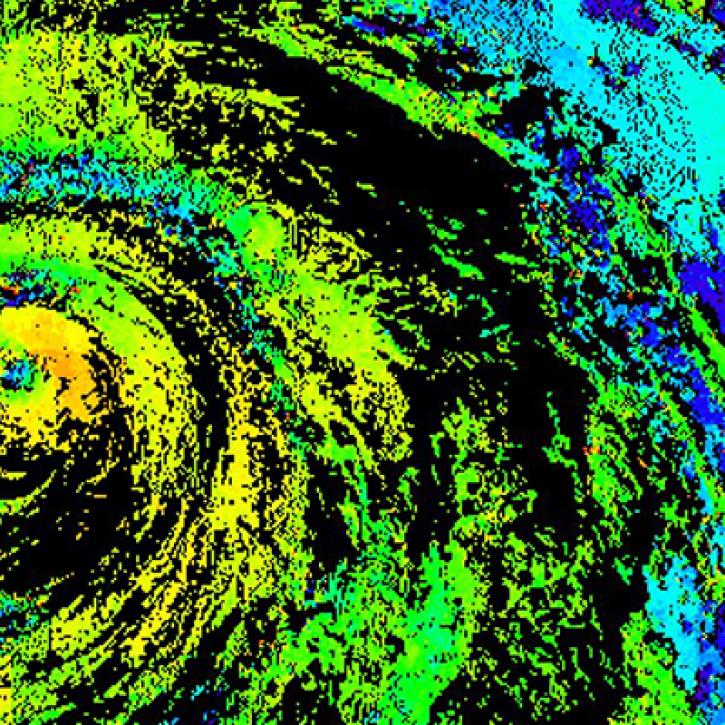
Near real-time monitoring of tropical storms and observations of previous hurricanes.
Discover and Visualize Sea Surface Temperature Data
NASA data help us understand Earth's changing systems in more detail than ever before, and visualizations bring these data to life, making Earth science concepts accessible, beautiful, and impactful.
Data visualization is a powerful tool for analysis, trend and pattern recognition, and communication. Our resources help you find world-class data visualizations to complement and enhance your research. We also have tools and tutorials to help you translate sea surface temperature data into compelling visuals.
Image
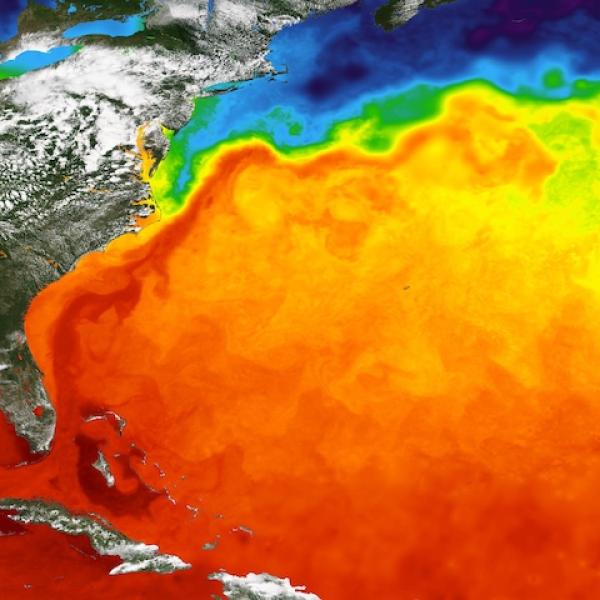
GHRSST Sea Surface Temperature showing the Gulf Stream of the Atlantic Ocean on 29 May 2024
This image shows the Gulf Stream as a ribbon of dark red hugging the East coast of the United States before heading toward the North Atlantic Current and Europe. The base true-color corrected reflectance image was acquired by the Visible Infrared Imaging Radiometer Suite (VIIRS) aboard the joint NASA/NOAA NOAA-20 satellite. Overlaid on the base image is sea surface temperature from the Group for High Resolution Sea Surface Temperature (GHRSST) product derived from several instruments including the NASA Advanced Microwave Scanning Radiometer-EOS (AMSR-E), the Moderate Resolution Imaging Spectroradiometer (MODIS) aboard NASA's Aqua and Terra platforms, the U.S. Navy microwave WindSat radiometer, and in-situ SST observations from the NOAA iQuam project.

Join Our Community of NASA Data Users

While NASA data are openly available without restriction, an Earthdata Login is required to download data and to use some tools with full functionality.

Learn About the Benefits of Earthdata Login

Frequently Asked Questions

Earthdata Forum

Our online forum provides a space for users to browse thousands of FAQs about research needs, data, and data applications. You can also submit new questions for our experts to answer.

Submit Questions to Earthdata Forumand View Expert Responses

Earthdata
Forum