
NASA POWER's PRUVE Tool Streamlines Data Validation

PRUVE is built on open-source frameworks to make assessing data uncertainty more accessible.

NASA’s archive of Earth observation and modeling datasets has an incredibly diverse range of uses, and assessing data uncertainty is a critical step toward ensuring the data and analyses are accurate, reliable, and trustworthy. Several factors, such as instrument calibration, atmospheric corrections, and land-surface albedo, can affect the quality of satellite data. For users working with solar and meteorological datasets, quantifying uncertainty is especially critical, as these data often inform decisions and policymaking at the community level.

However, characterizing data product uncertainty can be a complex process, especially for less technical users. Existing options frequently require a level of know-how that can present a barrier to entry and may dissuade users from trusting the data. NASA’s Prediction of Worldwide Energy Resources (POWER) project, which provides datasets from NASA in support of energy, buildings, and agroclimatology decisions, developed a tool that enables users to assess data uncertainty for selected surface variables from POWER’s data catalog with corresponding surface measurements.

The cloud-based tool — the PaRameter Uncertainty ViEwer (PRUVE) — makes assessing data uncertainty more straightforward for users across disciplines and skill levels. PRUVE uses surface observed site meteorological data from the National Oceanic and Atmospheric Administration (NOAA) and surface radiation data from Baseline Surface Radiation Network (BSRN) to compare against POWER-provided surface meteorological and radiation data values. This user-friendly application gives users an opportunity to quickly confirm data validation through customizable queries.
Image
Image Caption

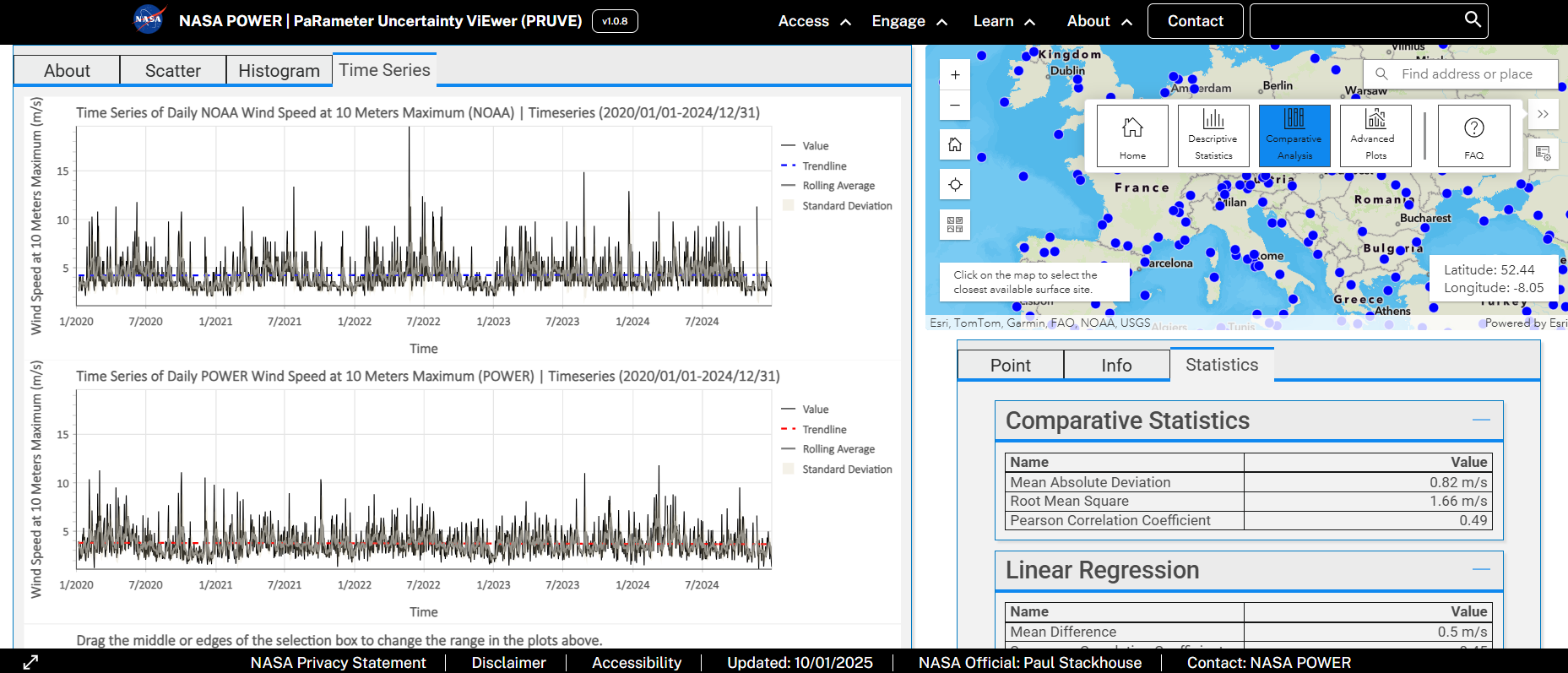
This screenshot shows the PRUVE tool’s comparative analysis feature. The location of interest in this case is in Italy, specified by the orange dot, with blue points showing locations of nearby surface meteorological sites. The bottom-right panel shows the time series comparing wind data from NASA’s Modern-Era Retrospective analysis for Research and Applications, Version 2 (MERRA-2) as compared to NOAA Global Surface Summary of the Day (GSOD) measurements. A scatter plot, histogram, and other information are available to user under various tabs within the same panel. Credit: NASA POWER

For example, consider a student wanting to install a small wind turbine for a study project at their college. They are limited by size and cost, so they need to make sure the predictions and analyses are reliable. As part of the study, they can use wind and other historical data parameters available through POWER to forecast how much energy will be produced from the wind turbine system. The student wants to limit the level of uncertainty in their prediction calculations as much as possible.

Using PRUVE’s comparative analysis feature, they can compare POWER-obtained estimated wind speed at 10 meters against NOAA-archived wind speed measurements at the same resolution for nearby locations to ensure that the differences are within the limits of uncertainty in their calculations.

Additional Features

To further enhance accessibility for data users with different backgrounds and skill sets, PRUVE has a number of innovative features:

  • No-coding access.
  • More than 3,000 surface sites.
  • Dynamic data visualization available for each site.
  • Ability to create maps and plots and to conduct spatial analysis on the fly.
  • User-selectable point-based descriptive statistics.
  • User-selectable site-based intercomparisons.
  • Advanced custom plotting for specific uses.

PRUVE also enables spatial visualizations and specific point-based analyses for single and multiple data series. These capabilities include:

  • Interactive visualizations of meteorological datasets of various chart types.
  • Text-based statistical information in support of the visualizations.
  • A resizable interactive map.

The PRUVE development team is also working to expand the number of variables and the number of ground stations integrated into the tool. Their long-term goal is to build functionality that will enable users to upload their own data securely and run the same statistical algorithm to confirm data validation.

Using Technology to Elevate Trust

Crediting the science teams who do the hard work of providing NASA data is a core value for the POWER team, whose goal is to promote and make solar and meteorological datasets accessible to a wide range of users. By creating the free, easy-to-use PRUVE tool, the POWER team instills an additional layer of trust, empowering users to tackle some of the most important long-term weather challenges facing our planet.

Details

Last Updated

Dec. 17, 2025

Published

Dec. 17, 2025