Introduction
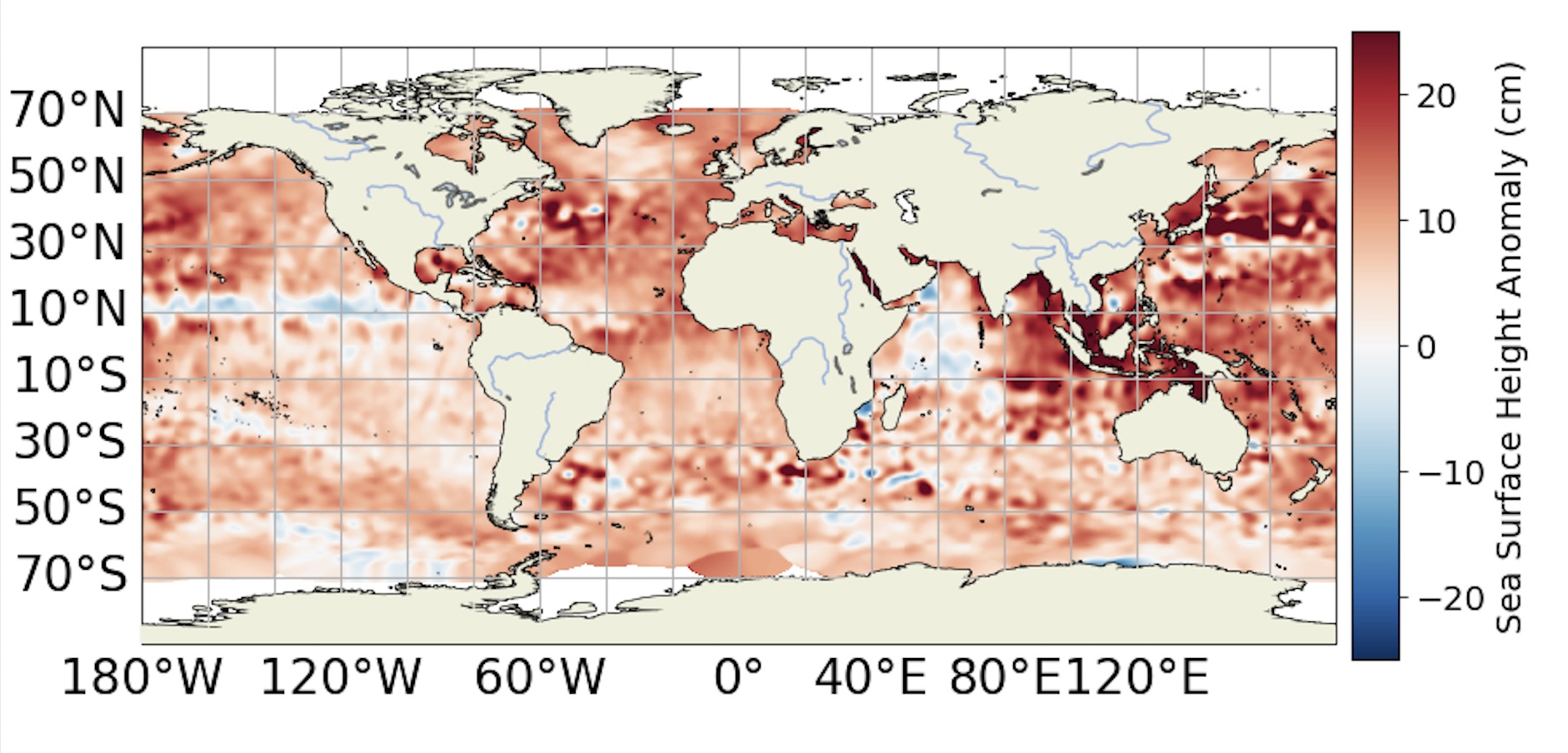
On Nov. 16, 2025, NASA launched Sentinel-6B. The satellite mission continues the long-term record of ocean height measurements that began in 1992. For more than three decades, NASA and its partners have maintained satellites in the same orbit (TOPEX/Poseidon, Jason-1, -2, -3, and Sentinel-6 Michael Freilich (Sentinel-6A)) to measure global ocean height every ten days with centimeter-level precision (see Figure 1, top).
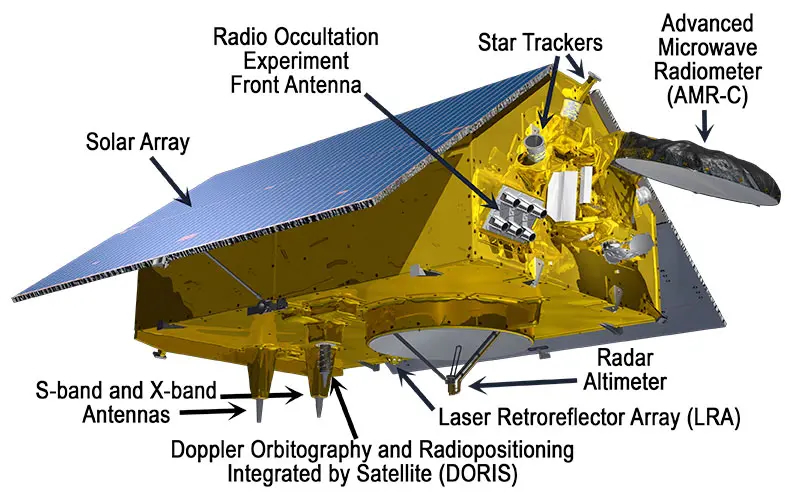
Sentinel-6B carries several instruments (see Figure 1, bottom). Its radar altimeter sends radar pulses toward the ocean surface to determine the distance to the sea surface. The Advanced Microwave Radiometer (AMR) measures water vapor between the satellite and ocean to correct for radar signal delays.
Additional instruments, including the Doppler Orbitography and Radiopositioning Integrated by Satellite (DORIS) system and the Laser Retroreflector Array (LRA), ensure precise orbit determination. Combining the satellite’s position with the distance measurements to the ocean, the system can calculate sea surface height. Sentinel-6B also features S- and X-band antennas for data transmission and a solar array to supply power.
Using Sentinel-6B to Monitor Earth’s Changes
Sentinel-6B continues the high precision record of sea level achieved by NASA's succession of satellite missions. It stands as one of the most successful examples of international cooperation in observing Earth's changes from space. With the launch of Sentinel-6B, this record will extend to nearly 40 years of uninterrupted measurements.
Ocean height is a key indicator of Earth's climate as it reveals how heat, water, and energy move around the planet. Because water expands as it warms, variations in sea level reflect changes in ocean temperature. A warm region of the ocean stands slightly higher (shown in dark red in Figure 1) than a cooler one (blue and light red), allowing scientists to track how the ocean stores heat, a major driver of global climate. Also, as water moves from one place to another, it tilts the surface of the ocean, and by measuring this tilt the sea level satellites allow scientists to calculate ocean currents.
More than 90% of the heat trapped by Earth is stored in the oceans and it accounts for about one-third of the observed global rise in sea level. The remainder is driven by melting glaciers and ice sheets, which add water to the oceans. The result is a long-term rise in sea level by more than 10 cm (4 inches) since the early 1990s. Sentinel-6B will keep monitoring changes in sea level, which is crucial to help local and state governments to make informed decisions on protecting coastal infrastructure.
Sentinel-6B observations will also be used as an early warning system for large-scale climate phenomena, like El Niño/Southern Oscillation (ENSO), and to improve forecasts of storm intensity and ocean circulation, which is of extreme importance for anticipating changes days or months in advance and allowing communities to plan accordingly.
Supported by a vibrant global community of scientists and operational users, the insights and value derived from these observations are expected to continue well into the 2030s and beyond. The addition of Sentinel-6B into the suite of ocean observing satellites is highly anticipated for researchers, decision-makers, and other data users, as the mission promises to further advance our understanding of Earth's changing oceans throughout the remainder of this decade.
Sentinel-6B is a collaboration among NASA, the European Space Agency (ESA), the European Organisation for the Exploitation of Meteorological Satellites (EUMETSAT), the National Oceanic and Atmospheric Administration (NOAA), the French National Centre for Space Studies (CNES), and the European Commission.