Introduction
In May 2015, more than 35 trillion gallons of water fell over Texas, enough to cover the entire state eight inches deep in water. A study by Fournier et al (2016) present the first two-sided land/sea analysis of the flood.
Using SMAP, TRMM, GPM, GRACE, and MODIS to Study the Flood
NASA's Soil Moisture Active Passive (SMAP) satellite and other satellite instruments along with in situ data were used to create a comprehensive chronology of the flood from land to ocean. Besides SMAP sea surface salinity (SSS) and soil moisture data, the study used a wide array of other NASA observations.
The observations included precipitation data from the Tropical Rainfall Measuring Mission (TRMM) and Global Precipitation Measurement (GPM) missions, water storage observations from the Gravity Recovery and Climate Experiment (GRACE/GRACE-FO) mission, ocean color observations from the Moderate Resolution Imaging Spectroradiometer (MODIS) instrument on board the Aqua satellite, and altimetric currents from the Jason satellite series.
Major Findings
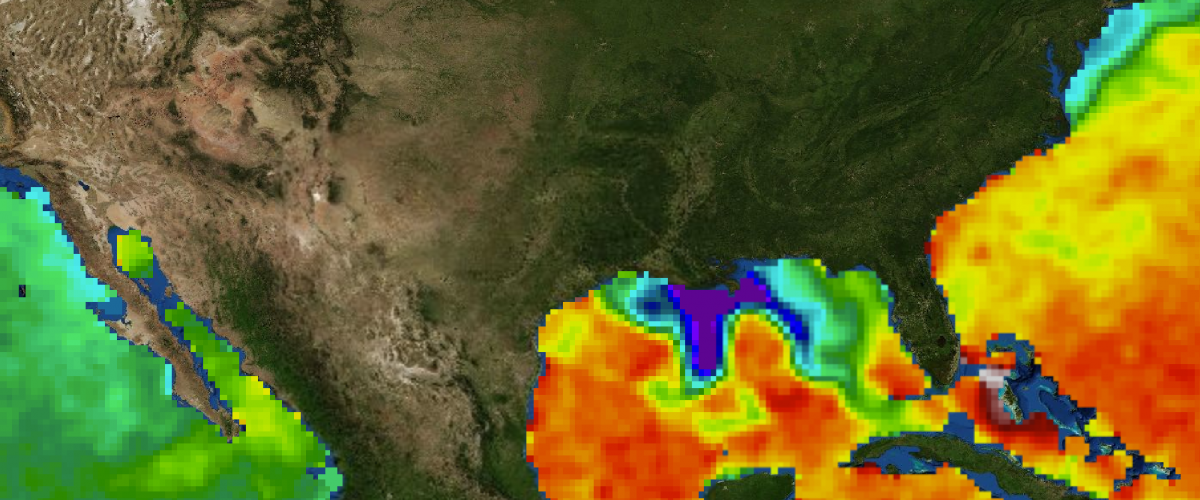
The significant amount of freshwater was observed by SSS as it interacted with the regional circulation in the Gulf of America. The freshwater plume emerged from the Texas shelf in May 2015 and was carried along the coast in the northern part of the Gulf of America in June and July. From July 2015, the plume was carried southward in the central gulf while the typical freshwater plume emerged from the Mississippi River mouth in the eastern part of the Gulf of America.
Together with the typical Mississippi River plume, the Texas freshwater plume caused an unusual freshwater plume forming a “horseshoe” from August to September 2015. The rare occurrence of the horseshoe-shaped freshwater plume was caused by the freshwater plume from the Texas flood, the typical Mississippi River plume, an unusually strong Loop Current and its anticyclonic eddy to the west.
Related Links
References
Fournier, S., J.T. Reager, T. Lee, J. Vazquez-Cuervo, C.H. David, and M.M. Gierach, 2016: SMAP observes flooding from land to sea: The Texas event of 2015, Geophysical Research Letters. doi:10.1002/2016GL070821