Introduction
In response to increasing emissions of greenhouse gases and the radiative forcings and feedbacks they impose, Earth gains heat energy and its climate changes. Often referred to as Earth’s energy imbalance (EEI), the contemporary energy gain of 0.5-1 W/m2 is quite small compared to the radiation fluxes that enter and exit the Earth system at the top of the atmosphere. Therefore, it is difficult to accurately measure the small but crucial EEI as the residual of observed incoming and outgoing radiative fluxes.
An alternative approach to estimating EEI is to take inventory of the heat content changes in Earth’s ocean, land, atmosphere, and cryosphere. Since the voluminous ocean absorbs ~90% of Earth’s energy gain, ocean heat uptake provides a major constraint for EEI and its uncertainty. Direct observations of sub-surface ocean temperature change form the basis for estimating ocean heat uptake and constraining EEI.
As with many in-situ sensor networks, the coverage by ocean profiling floats (e.g., Argo) is incomplete in space and time, which may introduce biases. For example, the deep ocean below 2000 m (comprising approx. 50% of the total ocean volume) is not covered by the current Argo float network. Independent estimates of ocean heat uptake are therefore required to complement the sensor-float results and to better constrain EEI.
Using Jason, Sentinel, and GRACE to Measure Sea Level and Mass Changes
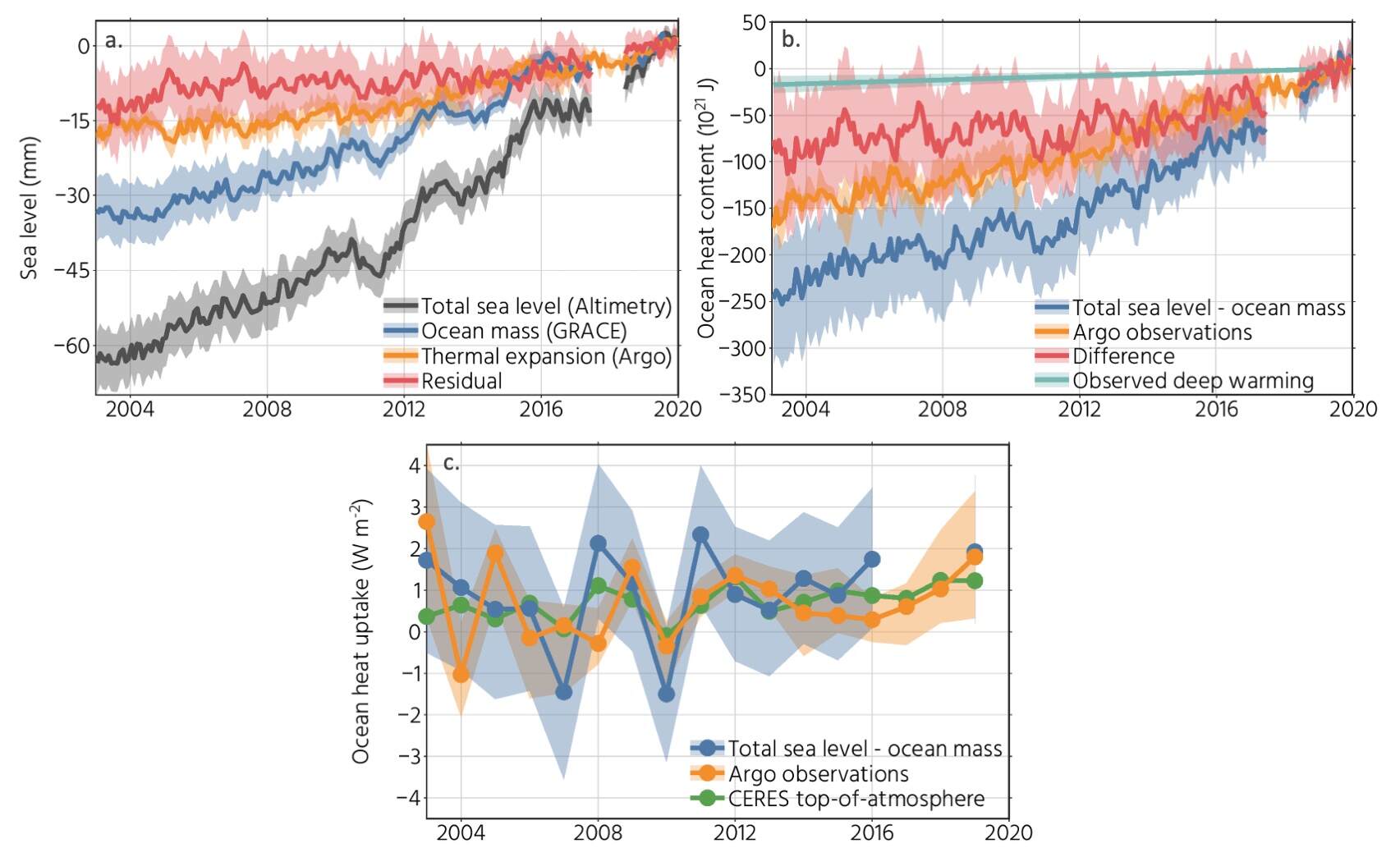
Satellite observations of total sea level change (altimetry: Jason-2, -3, and Sentinel-6 Michael Freilich) and ocean mass change (gravimetry: GRACE/GRACE-FO) allow us to dissect the sea level budget into its mass and thermosteric (thermal) components (Figure a). From the latter, ocean heat content is derived (Figure b), using the expansion efficiency of sea water to convert from thermosteric sea level heights to heat energy (for details see Hakuba et al., 2021). From the temporal change in ocean heat content, we can estimate the rate of ocean heat uptake (W/m2) and its year-to-year variability (Figure c).
Major Findings
Over 2005-2019, ocean heat uptake amounts to 0.86 W/m2 (at the top of the atmosphere, not just the ocean surface area!) as Earth continues to get warmer. Although the radiation fluxes provided by the Clouds and Earth Radiant Energy System (CERES) do not resolve the absolute magnitude of EEI, they track the temporal EEI variability accurately.
The ocean heat uptake series derived from the geodetic satellite observations correlates very well with the net radiative flux, but exhibits a larger variability. Both these data sets agree that there is a significant increasing trend in EEI, which implies an accelerated warming of Earth by at least 0.4 W/m2 per decade.
Related Links
References
- Hakuba, M. Z., Frederikse, T., & Landerer, F. (2021). Earth’s Energy Imbalance from the ocean perspective (2005 ‐ 2019). Geophysical Research Letters. doi:10.1029/2021GL093624
- Data output: Code and data supplement for "Earth’s Energy Imbalance from the ocean perspective (2005-2019)