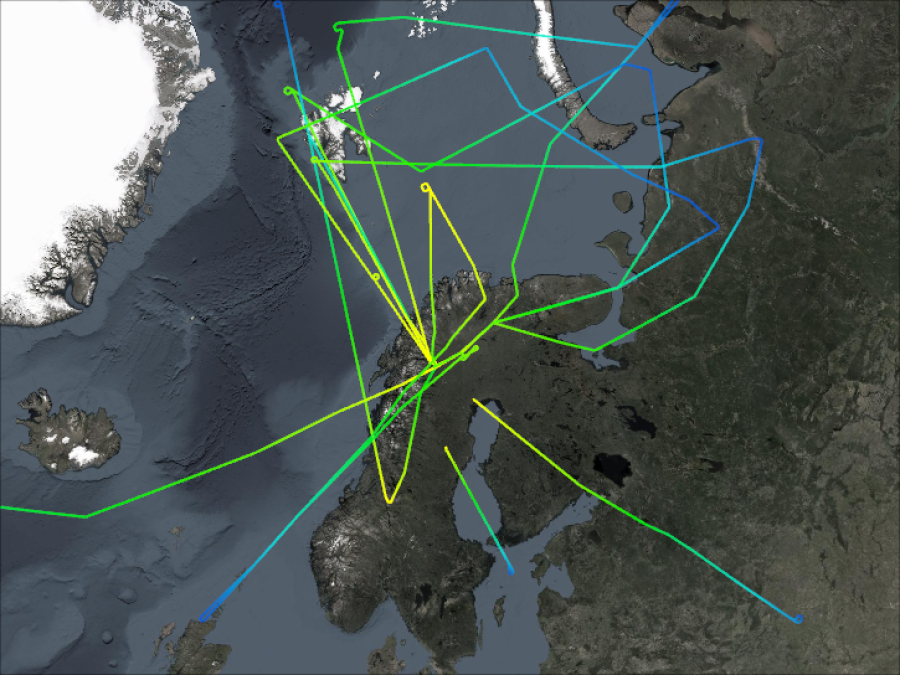
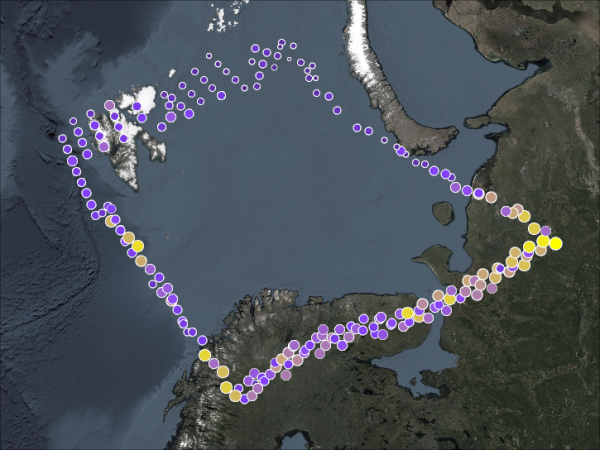
SOLVE Flightpaths
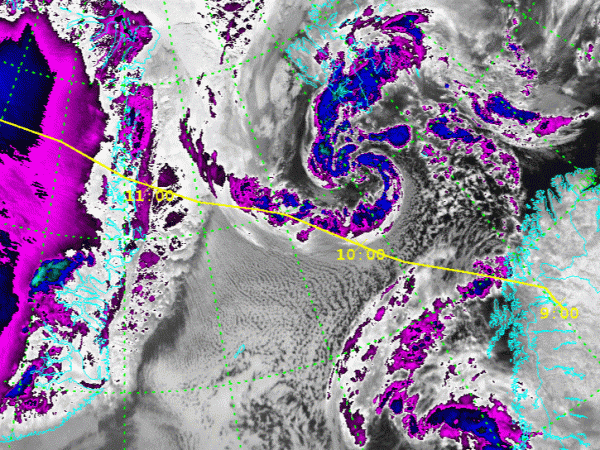
Weather Data from the NOAA 14 instrument taken at the time of the SOLVE flight on Dec. 16th, 1999
SOLVE Ozone Data

SOLVE

SAGE III Ozone Loss and Validation Experiment

Data Centers

ASDC

The SAGE III Ozone Loss and Validation Experiment (SOLVE) was a NASA multi-program effort of the Upper Atmosphere Research Program (UARP), Atmospheric Effects of Aviation Project (AEAP), Atmospheric Chemistry Modeling and Analysis Program (ACMAP) and Earth Observing System (EOS) of NASA’s Earth Science Enterprise (ESE). 

SOLVE’s primary objective was for calibrating and validating the Stratospheric Aerosol and Gas Experiment (SAGE) III satellite measurements, while examining the processes that controlled ozone levels at a mid- to high-latitude range. The major goal of SAGE III was to quantitatively assess ozone loss at high latitudes. SOLVE was a two-phase experiment, the first phase, SOLVE, occurred during the fall of 1999 through the spring of 2000. The second phase, SOLVE II, occurred during the winter of 2003.

SOLVE took place in the Arctic high-latitude region during the winter. The polar ozone depletion processes cause by human-produced chlorine and bromine are most active in mid-to-late winter and early spring in the high Arctic. In order to conduct this validation experiment, NASA deployed the NASA ER-2 aircraft and NASA DC-8 aircraft. 

The ER-2 measured a variety of atmospheric data, including ozone (O3), H2O, CO2, ClONO2, HCl, ClO/BrO, and Cl2O2. The DC-8 aircraft measured ozone, ClO/BrO, and aerosol, among other atmospheric data. SOLVE also utilized balloon platforms, ground-based instruments, and collaborations with the German Aerospace Center’s (DLR) FALCON aircraft equipped with the OLEX Lidar to achieve the mission objectives. Overall, the campaign had 28 flights, with SOLVE featuring 17 total flights among the different aircrafts and SOLVE II featuring 11 flights.

SOLVE Project Page

  • Calibrate and validate the Stratospheric Aerosol and Gas Experiment (SAGE) III satellite measurements
  • Examine the processes that controlled ozone levels at a mid- to high-latitude range
PlatformsInstruments
NASA DC-8

Forward Scattering Spectrometer Probe (FSSP)

Passive-Cavity Aerosol Spectrometer Probe (PCASP)

TSI Condensation Particle Counter 3025 Manufactured by TSI Inc.

Condensation Nuclei Counter (CNC)

Focused Cavity Aerosol Spectrometer II (FCAS II)

Nucleation-Mode Aerosol Size Spectrometer (N-MASS)

High Spectral Resolution Lidar (HSRL)

Lidar Atmospheric Sensing Experiment (LASE)

Differential Absorption Lidar (DIAL)

Airborne Raman Ozone, Temperature, and Aerosol Lidar (AROTAL)

Scanning Actinic Flux Spectroradiometer (SAFS)

Composition and Photodissociative Flux Measurement (CPFM)

Diode Laser Hygrometer developed by NASA LaRC (DLH)

JPL LASER HYGROMETERS

Microwave Temperature Profiler (MTP)

DC-8 DATA ACQUISITION AND DISTRIBUTION SYSTEM (DADS)

Cryogenic Hygrometer (CRYO)

Harvard Water Vapor (HWV)

Meteorological Measurement System (MMS)

Microwave Temperature Profiler (MTP)

JPL LASER HYGROMETERS

ER-2 NAV RECORDER (NAVREC)

Airborne SUbmillimeter Radiometer (ASUR)

ER-2

Nucleation-Mode Aerosol Size Spectrometer (N-MASS)

Condensation Nuclei Counter (CNC)

Focused Cavity Aerosol Spectrometer II (FCAS-II)

Multiple-Angle Aerosol Spectrometer Probe (MASPR)

Field Campaign Ground Site

Light Detection and Ranging (LiDAR)

Differential Absorption Lidar (DIAL)

MARK IV INTERFEROMETER

Platforms Instruments
NASA DC-8

TSI-3563 Nephelometer

TSI Model 3760 Condensation Nuclei Counter

Cloud, Aerosol, Precipitation Spectrometer (CAPS)

Focused Cavity Aerosol Spectrometer II (FCAS II)

Condensation Nuclei Counter (CNC)

Nucleation-Mode Aerosol Size Spectrometer (N-MASS)

Ames 14-Channel Airborne Tracking Sunphotometer (AATS14)

High Spectral Resolution Lidar (HSRL)

Differential Absorption Lidar (DIAL)

Airborne Raman Ozone, Temperature, and Aerosol Lidar (AROTAL)

Diode Laser Hygrometer developed by NASA LaRC (DLH)

Microwave Temperature Profiler (MTP)

Computer

Direct Irradiance Airborne Spectrometer (DIAS)

Langley In Situ Fast-Response Ozone Measurements (FASTOZ)

Differential Absorption CO, CH4, N2O Measurements (DACOM)

PAN and Trace Hydrohalocarbon ExpeRiment (PANTHER)

Gas and Aerosol Measurement Sensor/Langley Airborne A-Band Spectrometer (GAMS/LAABS)

Sounding RocketRocketsondes
BalloonsOzonesondes
Field Campaign Ground Site

HYGROMETERS

MARK IV INTERFEROMETER

Optical Plankton Counter (OPC)

Condensation Nuclei Counter (CNC)