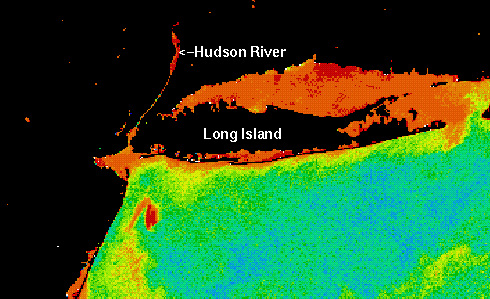
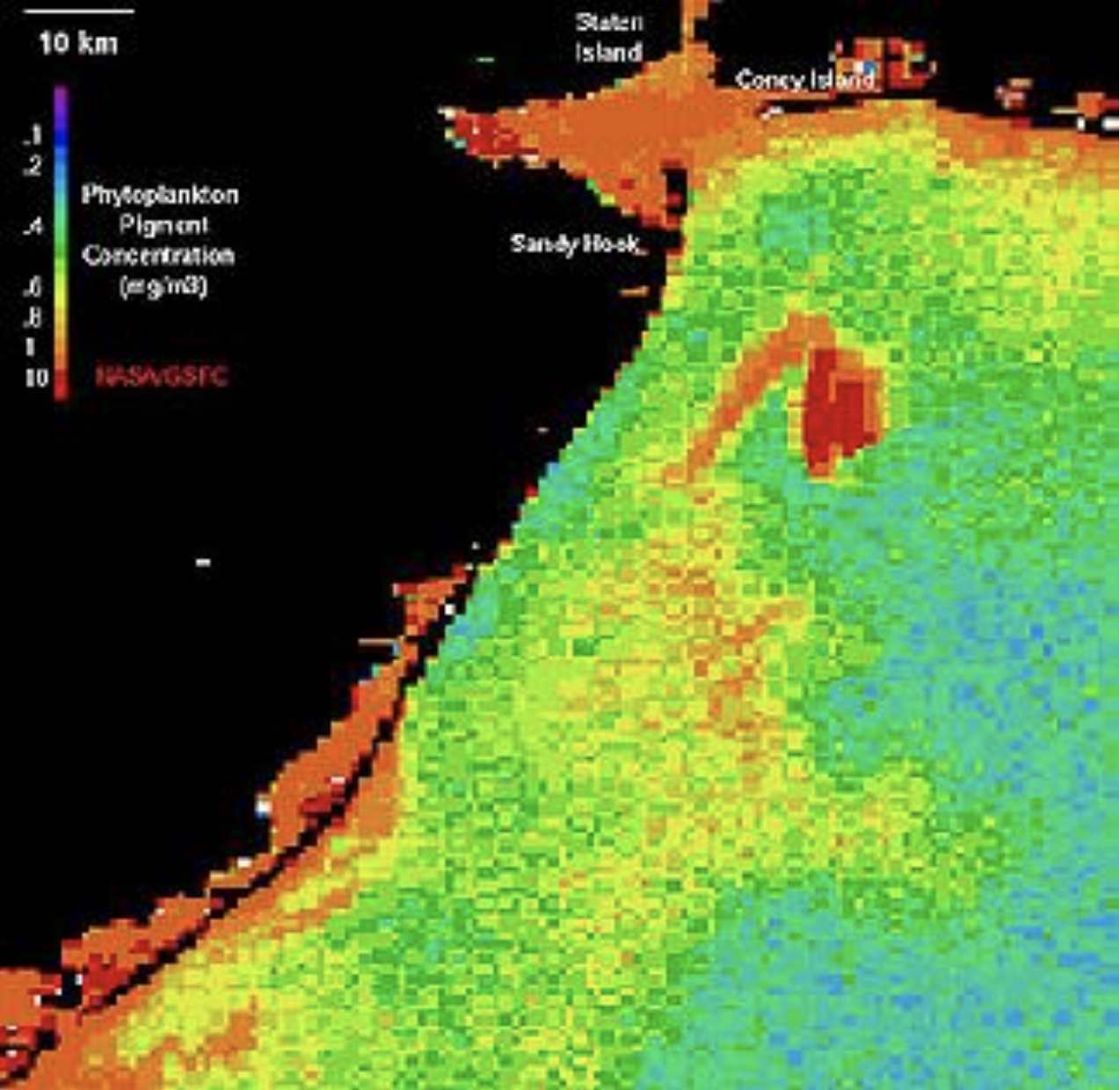
The image shown here illustrates an obvious anthropogenic (human-related) influence on the oceans. Many other influences are not as obvious. The supply of nutrients to the ocean via rivers can be considerably augmented by fertilizer and human waste. If the greater supply of nutrients causes a great increase in the abundance of phytoplankton, eutrophication may result. Eutrophication is an exhaustion of the oxygen in the water, caused by the decomposition of large amounts of organic material. One of the areas in which this may be occurring is the Mediterranean Sea. In many parts of the Mediterranean, the water column is very well-stratified, meaning that is has distinct layers of warm, highly saline water and colder, less saline water. Because the circulation of the Mediterranean Basin is so restricted (the single place where water flows in and out is the narrow Straits of Gibraltar), and because there are so many people living in the countries around the Mediterranean, the basin receives a wide variety of substances that can have a detrimental effect on water quality and ocean life.
Several areas of the Adriatic Sea have experienced blooms of a noxious algae, and areas that once had thriving coral reefs have seen substantial coral death and decay. Coral reefs require very clear water conditions, so an increase in the turbidity of the water column due to algal growth can reduce the available light, as well as cover the coral with a blanket of living algae and dead organic matter.
Floods can also cause detrimental effects on the ocean. Mankind's activities on land lead to a greater amount of erosion and thus more suspended material in runoff, so that when a major flood occurs, turbid plumes of water can enter the ocean and extend over wide areas. Such features have been observed in the Gulf of Mexico stemming from the Mississippi River, in the North Sea coming from the Rhine River, and in the Mediterranean from several different rivers.
There are other ways in which mankind's activities can affect the oceans. A global question is the role of the oceans with regard to the cycling of carbon dioxide in the atmosphere. Primary productivity uses carbon dioxide to produce organic carbon, so the oceans could be taking up some of the carbon dioxide that humans produce when fossil fuels are burned for energy. One of the main reasons to attempt to accurately estimate global primary production in the oceans is to determine how much carbon dioxide from the atmosphere is taken up by this process.