The Coastal Zone Color Scanner Experiment (CZCS) was the first instrument devoted to the measurement of ocean color and flown on a spacecraft. Although other instruments flown on other spacecraft had sensed ocean color, their spectral bands, spatial resolution and dynamic range were optimized for land or meteorological use and had limited sensitivity in this area. In CZCS, every parameter was optimized for use over water to the exclusion of any other type of sensing. 

CZCS had six spectral bands, four of which were used primarily for ocean color. These were of a 20 nanometer bandwidth centered at 443, 520, 550, and 670 nm. Band 5 had a 100 nm bandwidth centered at 750 nm and a dynamic range more suited to land. Band 6 operated in the 10.5 to 12.5 micrometer region and sensed emitted thermal radiance for derivation of equivalent black body temperature. (This thermal band failed within the first year of the mission, and so was not used in the global processing effort.) Bands 1-4 were preset to view water only and saturated when the instrument field of view was over most types of land surfaces or clouds.

The CZCS Instrument

CZCS was one of eight instruments flown on the Nimbus-7 spacecraft launched on October 24, 1978. The spacecraft was in a Sun-synchronous orbit, with an inclination of 104.9 degrees, and a nominal altitude of 955 km. CZCS had an equatorial crossing time of noon in an ascending orbit.

The CZCS was a cross-track scanning system using a conventional multi-channel scanning radiometer with a rotating plane mirror at a 45 degree angle to the optic axis of a Cassegrain telescope. The rotating mirror scanned 360 degrees; however, only data centered plus or minus 40 degrees of the spacecraft nadir were collected for ocean color measurements. The instrument field of view (IFOV) of each detector was 0.865 mrad, yielding a resolution of 825 m at the satellite subpoint (i.e. nadir view). The swath covered 1566 km in width. Data were then transmitted to a receiving station at a rate of 800 kbps at a digital resolution of 8-bits.

The table below shows the minimum signal-to-noise ratio specified for the instrument at its most sensitive gain setting.

BandWavelength (nm)SNRRadiance (mW/cm^2/nm/ster)
14431505.41
25201403.50
35501252.86
46701001.34
575010010.8
BandWavelength (nm)NEδT (K)Brightness Temperature (K)
611500.220270

Optical Schematic

This line diagram illustrates the optical method by which discrimination of the spectral bands was achieved. The incoming beam was first split by a dichroic beam splitter, one portion of the beam going through a set of depolarizing wedges to a small polychromator where the radiance was dispersed and detected by five silicon diode detectors in the focal plane of the polychromator. Radiance in the 10.5 to 12.5 micron spectral band was reflected off the dichroic and then imaged onto an infrared detector of mercury cadmium telluride cooled to approximately 120 degrees Kelvin using a radiative cooler.

Polarization Sensitivity

As can be seen in the above optical schematic, the instrument was equipped with a depolarization apparatus (denoted 'pseudodepolarizer wedges' in the above figure). A piece-part depolarization scrambler test indicated a 0.5% sensitivity to monochromatic light (wavelength not provided). However, a system-level test showed that the instrument exhibited a polarization sensitivity upwards of 3% at +/-10 degrees tilt (the instrument manufacturer did not report sensitivity above 10 degrees), with the highest sensitivity at the 443nm band. No information was provided on polarization phase function. The validity of the system-level test is uncertain due to problems with test setup.

Instrument Tilt and Commanded Gain

Since NIMBUS 7 flew in an ascending orbit (i.e. from south to north in daylight), the CZCS scan mirror was positioned to aft of the satellite when the spacecraft was south of the subpolar point and forward of the spacecraft when it was north of the subpolar point. The instrument was capable of adjusting the tilt in 2-degree increments from 20 degrees aft to 20 degrees forward.

The radiometric sensitivity of the first four bands was adjustable. Each of these bands have four separate gains that change on command to accommodate the range of sun angles observed during a complete orbit and throughout the various seasons. The gains are changed to utilize the best dynamic range possible without saturating over water targets. Normally, the gain used in the first four channels is determined by the solar elevation angle of the target to be acquired. Most of the imagery was acquired at the two higher gain settings (gains 1 and 2)

Tilt and gain setting information were transmitted with the CZCS data and are included in the data product metadata records.

CZCS Thermal Band

The infrared temperature sensor (channel 6, 10.5-12.5 microns) never functioned satisfactorily and was useful only in the first year (1979) in a relative sense.

The detector lost sensitivity rapidly above its operation temperature, and eventually, saturated only a few degrees above its operation point. The date ranges given above indicate when the detector was within the range 119.1 to 121.1 K. The reasons for the failure were never determined with any degree of confidence. Three potential reasons were:

  • Contamination of the cooler by an unknown substance or substances,
  • Delamination of the silver-teflon tape on the annulus, or
  • Unidentified thermal loads of about 1 watt due to glint or scatter.

Because of the variability, no correction algorithms were ever developed. Most of the CZCS team was concerned with problems in the visible data, and good atmospheric corrections were precluded because CZCS lacked the split thermal channels.

Subsequent to August 1982, all attempts to restore some useful operation to the thermal channel were discontinued.

The most important objective of the CZCS mission was to determine if satellite remote sensing of color could be used to identify and quantify material suspended or dissolved in ocean waters. Specifically, CZCS attempted to discriminate between organic and inorganic materials in the water, determine the quantity of material, and discriminate between different organic particulate types.

Being satellite mounted, CZCS was able to provide measurements of ocean color over large geographic areas in short periods of time in a way that was not previously possible with other measurement techniques, such as from surface ships, buoys, and aircraft. These measurements allowed oceanographers to infer the global distribution of the standing stock of phytoplankton for the first time.

A "proof-of-concept" experiment, CZCS also showed that satellite ocean color measurements could be reliably used to derive products such as chlorophyll and sediment concentrations and provided justification for future ocean color missions such as the Sea-viewing Wide Field of View Sensor (SeaWiFS) and Moderate Resolution Imaging Spectroradiometer (MODIS). The algorithms developed to analyze CZCS data were a considerable step forward from those available earlier and included corrections for atmospheric backscatter, limb brightness, and gelbstoffe. Ground truth campaigns led to empirical correlation of ocean color and biomass. CZCS also showed the need for good radiometric calibration and stability and the necessity of sufficient ground truth data to verify sensor and algorithm performance over time.

CZCS Data Collection

The CZCS data were transmitted from the spacecraft to ground receiving stations at a rate of 800 kbs either in real time or via playback of the onboard tape recorder. The tape recorder was utilized when the spacecraft was out of the range of ground tracking stations. Due to the power demands of the various on-board experiments the CZCS sensor was operated on an intermittent schedule and collected data only two hours per day on the average.

Due to the power demands of the various on-board experiments, the CZCS sensor was operated on an intermittent schedule. In 1981, it was determined that the sensitivities of the CZCS was degrading with time and with the 443nm band in particular. Sensitivity degradation was persistent and increased during the rest of the mission. In mid-1984, Nimbus-7 mission personnel experienced turn-on anomalies with the CZCS system, which were related to power supply problems. Spontaneous shutdown of the CZCS system began occurring as well and persisted for the rest of the mission. From March 9, 1986 to June, 1986, the CZCS system was given highest priority for the collection of a contemporaneous data set of ocean color. It was turned off in June 1986 at the start of the low-power season with the intention of turning it back on in December when power conditions would be more favorable. Attempts to reactivate the CZCS system in December 1986 failed and the CZCS sensor was officially declared non-operational as of December 18, 1986.

During the 91 months of its operation (October 1978-June 1986), CZCS acquired nearly 68,000 images. Many of these images were duplicates from near-by ground stations and/or on-board recorded data. The Ocean Biology Processing Group has processed the L1A data from these 68,000 images to reduce duplicate data and combine the files by orbit, resulting in approximately 15,500 merged local area coverage (MLAC) data files.

Image
Image Caption

CZCS mission timeline. Credit: OB.DAAC

Mission Events Timeline

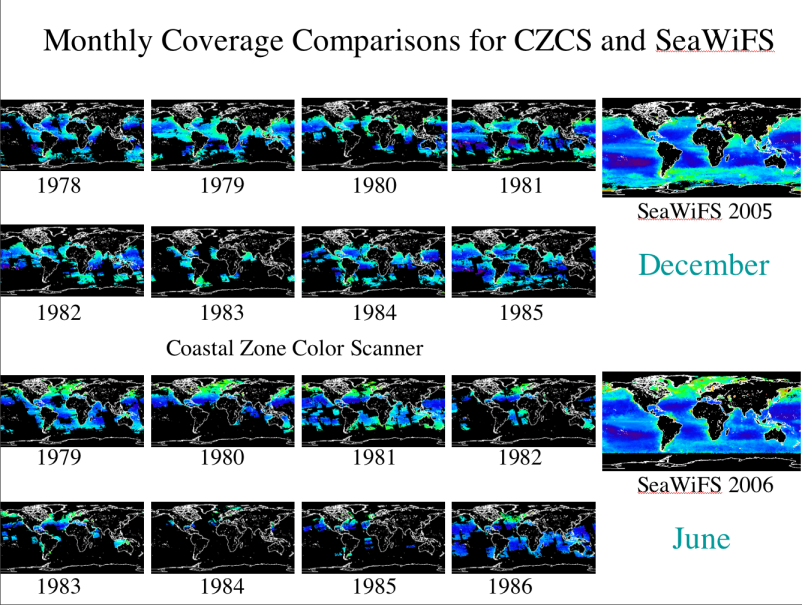
Although CZCS data was collected in nearly continuous along track segments, early human screening of the orbital near real-time Laserfax images cut these segments into smaller, 2-minute files for subsequent Level-1 processing. Consequently, a great deal of CZCS data while collected on the spacecraft was never processed beyond Level-0 as it was deemed unsatisfactory due to cloud cover, lack of ocean coverage or other reasons. Numerous reanalyses of the Laserfax were done towards the end of the mission to try and recover as much useful data as possible which significantly increased the number of scenes ultimately available. Finally, toward the end of the mission as the instrument's behavior was more problematic, CZCS was given the highest priority for data collection with the goal of trying to obtain as close to a contemporaneous global data set of ocean color as possible. The maps below show the monthly coverage for December and June throughout the CZCS mission life as compared to a representative December and June from SeaWiFS. You can see how patchy the coverage was both in time and space and that large portions of the Southern Ocean in particular were rarely sampled. You can also see the increase in coverage at the very end of the mission in June 1986 as a result of the dedicated sampling effort. Then, CZCS was turned off in late June 1986 and officially declared non-operational on December 18, 1986.

Image
Image Caption

CZCS coverage time series. Credit: OB.DAAC

CZCS Coverage

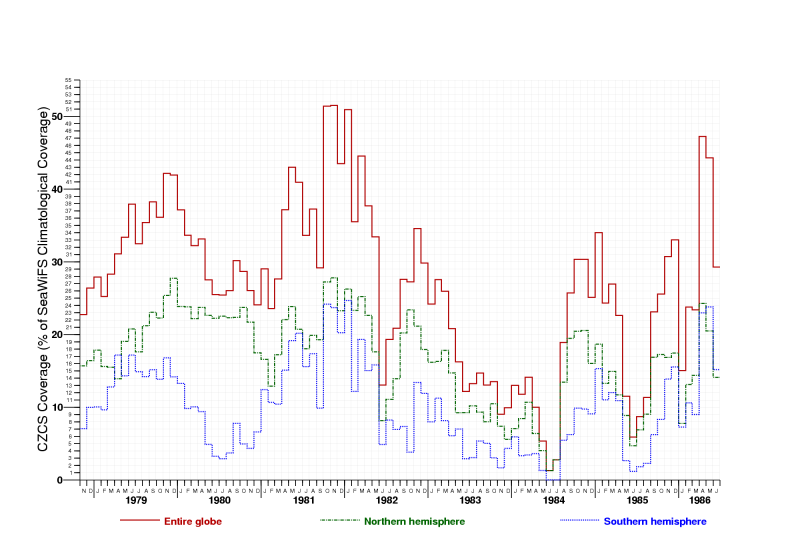
Because CZCS shared power and data recorder storage with the other instruments on Nimbus-7, data collection was not uniform in time or space. It was originally estimated that the CZCS would only have a 10% duty cycle and was never intended to provide the kind of consistent, global sampling that we have become accustomed to with the Sea-viewing Wide Field of View Sensor (SeaWiFS) and Moderate Resolution Imaging Spectroradiometer (MODIS). To get an idea of the spatial and temporal density of sampling that CZCS acquired as compared with SeaWiFS, the plot below shows a timeline of the percentage of coverage obtained by CZCS, normalized against the representative monthly coverage from SeaWiFS. The assumption is that a monthly SeaWiFS image represents the maximum realistically obtainable ocean coverage taking into account land surface, persistent cloud regions, sea ice, and low sun elevations. You can see that on average CZCS acquires approximately 30% of what SeaWiFS does globally (red) over the course of a month and that there are times (1982-1984 for example) when the coverage is significantly less than that. You can also see that the northern hemisphere (green) was uniformly sampled more regularly than the southern hemisphere (blue).

Image
Image Caption

CZCS monthly coverage. Credit: OB.DAAC

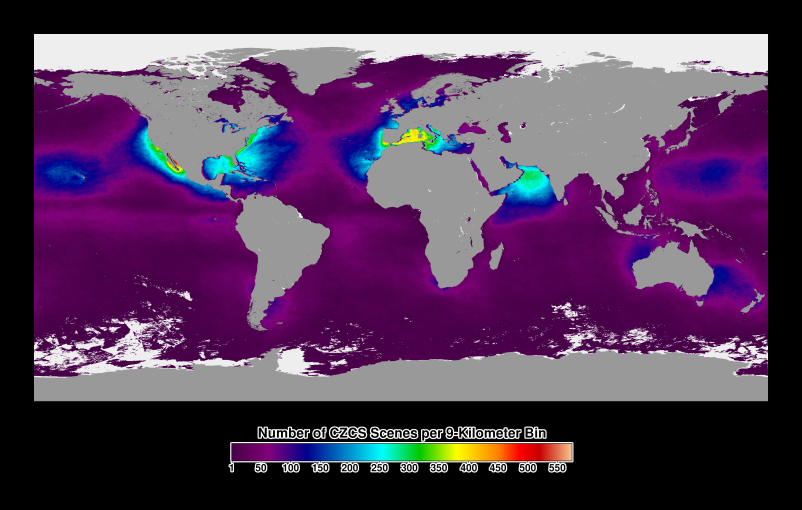
The image below shows the mission-long sampling density for the CZCS. It is very clear from this image that it really was a coastal zone color scanner with heavy emphasis on sampling being given to the coastal waters, and primarily those in the northern hemisphere. Although persistent cloud cover in regions like the Intertropical Convergence Zone and other factors influence the patterns of coverage, and since the CZCS was scheduled to take data over specific regions rather than follow a more uniform global distribution of sampling as is the case with SeaWiFS and MODIS, the impact of this selection can be easily seen. However, one must remember that environmental awareness was just coming of age in the 1970's at the time of the CZCS mission and that most people's attentions were focused along the coasts and the concern was focused on what impact humankind was having in these regions. The decades of the 80's and 90's saw the focus shift to a more global approach to environmental studies.

Image
Image Caption

CZCS mission-long sampling density. Credit: OB.DAAC

Learn more about the The Coastal Zone Color Scanner Experiment (CZCS) — a pioneering instrument in ocean color research — by viewing a series of classic ocean color data visualizations.

Instrument Type

Spectrometer/Radiometer

Instrument Subtype

Ocean Color Sensor

Specifications

Resolution

Spatial

825 m

Spectral

443, 520, 550, and 670 nanometers

Temporal

Two hours per day

Related Data Centers/Projects

Frequently Asked Questions

Earthdata Forum

Our online forum provides a space for users to browse thousands of FAQs about research needs, data, and data applications. You can also submit new questions for our experts to answer.

Submit Questions to Earthdata Forumand View Expert Responses

Earthdata
Forum