Description
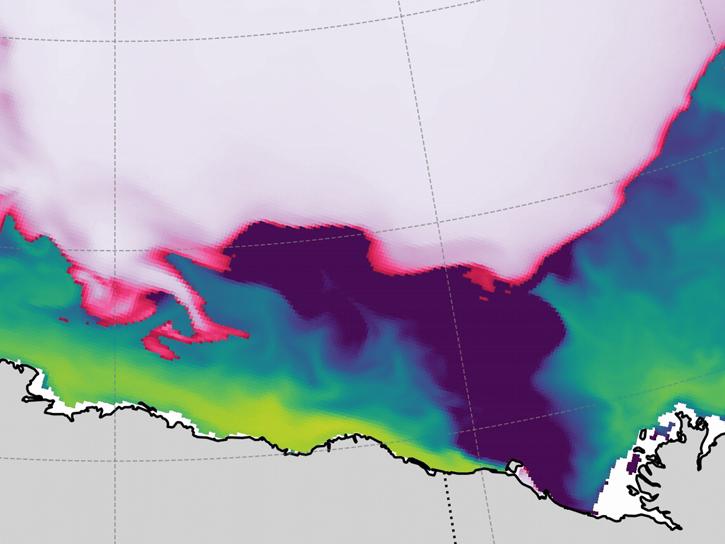
This dataset provides daily-averaged model-simulated ocean and sea-ice surface stress from the SASSIE ECCO Version 1 Release 1 (V1R1) ocean and sea-ice state estimate. ECCO (Estimating the Circulation and Climate of the Ocean) is a 4D ocean circulation model combining observations with a general circulation model (GCM) to estimate the complete time-evolving state of the global ocean. In this project, it was run over the Arctic polar region in support of the Salinity and Stratification at the Sea Ice Edge (SASSIE) field experiment - a NASA experiment focused on salinity anomalies in the upper ocean generated by melting sea ice. The SASSIE ECCO simulation was produced by downscaling the global ECCO state estimate from 1/3 to 1/12 degree grid cells, where the global solution provided initial and boundary conditions and atmospheric forcing. The output fields for this dataset cover the period 2014-01-15T12:00:00 to 2021-02-07T12:00:00 and are consolidated onto a single curvilinear grid face focusing on the Arctic domain, using the 5 faces of the lat-lon-cap 1080 (llc1080) native grid from the original simulation. Ocean density and pressure are provided at 90 depth levels from 0.5 meters to 6760 meters. Daily files are available in netCDF-4.
<br><br>
This dataset is one of 22 produced by SASSIE ECCO - the full list can be found in the user guide. To cite all 22 datasets with a single DOI, please cite the user guide (citation details and DOI can be found within the user guide).
Product Summary
Citation
Citation is critically important for dataset documentation and discovery. This dataset is openly shared, without restriction, in accordance with the EOSDIS Data Use and Citation Guidance.
Copy Citation
Documents
Variables
Variables are a set of physical properties whose values determine the characteristics or behavior of something. For example, temperature and pressure are variables of the atmosphere. Parameters and variables can be used interchangeably. Variable level attributes provide individual information for each variable.
The Name in this table is the variable name. Fill value indicates missing or undefined data points in a variable. Valid range is the range of values the variable can store. Scale factor is used to increase or decrease the size of an object and can be used to correct for distortion. For questions on a specific variable, please use the Earthdata Forum.
| Name Sort descending | Description | Units | Data Type | Fill Value | Valid Range | Scale Factor |
|---|---|---|---|---|---|---|
| EXFtaux | Wind stress in the +x direction at the tracer cell on the native model grid. Note: EXFtaux is the stress applied to the ice-free ocean surface and sea-ice covered surface. When sea-ice is present, the total stress applied to the ocean surface in the +x direction is NOT EXFtaux, but a combination of EXFtaux wind stress in the open water fraction and a stress from sea-ice in the ice-covered fraction (see oceTAUX). | N m-2 | float | 9.96921E+36 | -0.29217579960823 to 0.37097510695457 | 1 |
| EXFtauy | Wind stress in the +y direction at the tracer cell on the native model grid. Note: EXFtauy is the stress applied to the ice-free ocean surface and sea-ice covered surface. When sea-ice is present, the total stress applied to the ocean surface in the +y direction is NOT EXFtauy, but a combination of EXFtauy wind stress in the open water fraction and a stress from sea-ice in the ice-covered fraction (see oceTAUY). | N m-2 | float | 9.96921E+36 | -0.30194661021233 to 0.3529888689518 | 1 |
| i | In the Arakawa C-grid system, tracer (e.g., THETA) and 'v' variables (e.g., VVEL) have the same x coordinate on the model grid. | N/A | int | N/A | N/A | 1 |
| i_g | In the Arakawa C-grid system, 'u' (e.g., UVEL) and 'g' variables (e.g., XG) have the same x coordinate on the model grid. | N/A | int | N/A | N/A | 1 |
| j | In the Arakawa C-grid system, tracer (e.g., THETA) and 'u' variables (e.g., UVEL) have the same y coordinate on the model grid. | N/A | int | N/A | N/A | 1 |
| j_g | In the Arakawa C-grid system, 'v' (e.g., VVEL) and 'g' variables (e.g., XG) have the same y coordinate. | N/A | int | N/A | N/A | 1 |
| oceTAUX | Ocean surface stress due to wind and sea-ice in the +x direction centered over the 'u' side of the the native model grid. Note: in the Arakawa-C grid, wind stress acts on horizontal velocities which are staggered relative to the tracer cells with indexing such that +oceTAUX(i_g,j) corresponds to +x momentum fluxes at 'u' edge of the tracer cell at (i,j,k=0). Also, the model +x direction does not necessarily correspond to the geographical east-west direction because the x and y axes of the model's curvilinear lat-lon-cap (llc) grid have arbitrary orientations which vary within and across tiles. | N m-2 | float | 9.96921E+36 | -0.33684223890305 to 0.78317868709564 | 1 |
| oceTAUY | Ocean surface stress due to wind and sea-ice in the +y direction centered over the 'v' side of the the native model grid. Note: in the Arakawa-C grid, wind stress acts on horizontal velocities which are staggered relative to the tracer cells with indexing such that +oceTAUY(i_g,j) corresponds to +y momentum fluxes at 'v' edge of the tracer cell at (i,j,k=0). Also, the model +y direction does not necessarily correspond to the geographical north-south direction because the x and y axes of the model's curvilinear lat-lon-cap (llc) grid have arbitrary orientations which vary within and across tiles. | N m-2 | float | 9.96921E+36 | -0.52171355485916 to 0.38614037632942 | 1 |
| time | midpoint time of averaging period | hours since 1992-01-01T12:00:00 | int | N/A | N/A | 1 |
| time_bnds | Start and end times of averaging period. | N/A | int | N/A | N/A | 1 |
| XC | nonuniform grid spacing | degrees_east | float | N/A | -179.9994354248 to 179.99996948242 | 1 |
| XC_bnds | Bounds array follows CF conventions. XC_bnds[i,j,0] = 'southwest' corner (j-1, i-1), XC_bnds[i,j,1] = 'southeast' corner (j-1, i+1), XC_bnds[i,j,2] = 'northeast' corner (j+1, i+1), XC_bnds[i,j,3] = 'northwest' corner (j+1, i-1). Note: 'southwest', 'southeast', northwest', and 'northeast' do not correspond to geographic orientation but are used for convenience to describe the computational grid. See MITgcm documentation for details. | N/A | float | N/A | N/A | 1 |
| XU | The u point is at midpoint between the 'southwest' and 'northwest' corners of the tracer grid cell. Grid spacing is nonuniform. Note: 'west' refers to the computational grid orientation and does not necessarily correspond to geographic west. See MITgcm documentation and Arakawa C grid notation for details. | degrees_east | float | N/A | -179.99995422363 to 179.99995422363 | 1 |
| XV | The v point is at midpoint between the 'southwest' and 'southeast' corners of the tracer grid cell. Grid spacing is nonuniform. Note: 'south' refers to the computational grid orientation and does not necessarily correspond to geographic south. See MITgcm documentation and Arakawa C grid notation for details. | degrees_east | float | N/A | -179.99990844727 to 180 | 1 |
| YC | nonuniform grid spacing | degrees_north | float | N/A | 48.678619384766 to 89.978286743164 | 1 |
| YC_bnds | Bounds array follows CF conventions. YC_bnds[i,j,0] = 'southwest' corner (j-1, i-1), YC_bnds[i,j,1] = 'southeast' corner (j-1, i+1), YC_bnds[i,j,2] = 'northeast' corner (j+1, i+1), YC_bnds[i,j,3] = 'northwest' corner (j+1, i-1). Note: 'southwest', 'southeast', northwest', and 'northeast' do not correspond to geographic orientation but are used for convenience to describe the computational grid. See MITgcm documentation for details. | N/A | float | N/A | N/A | 1 |
| YU | The u point is at midpoint between the 'southwest' and 'northwest' corners of the tracer grid cell. Grid spacing is nonuniform. Note: 'west' refers to the computational grid orientation and does not necessarily correspond to geographic west. See MITgcm documentation and Arakawa C grid notation for details. | degrees_north | float | N/A | 48.652774810791 to 89.984642028809 | 1 |
| YV | The v point is at midpoint between the 'southwest' and 'southeast' corners of the tracer grid cell. Grid spacing is nonuniform. Note: 'south' refers to the computational grid orientation and does not necessarily correspond to geographic south. See MITgcm documentation and Arakawa C grid notation for details. | degrees_north | float | N/A | 48.678611755371 to 89.984642028809 | 1 |