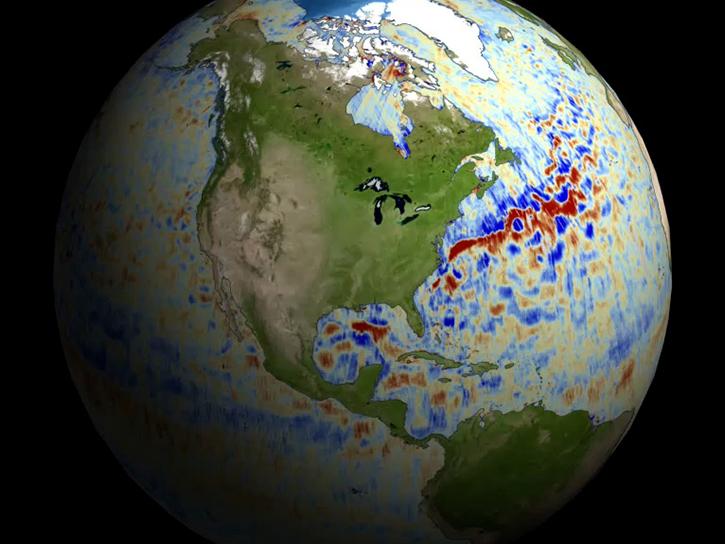
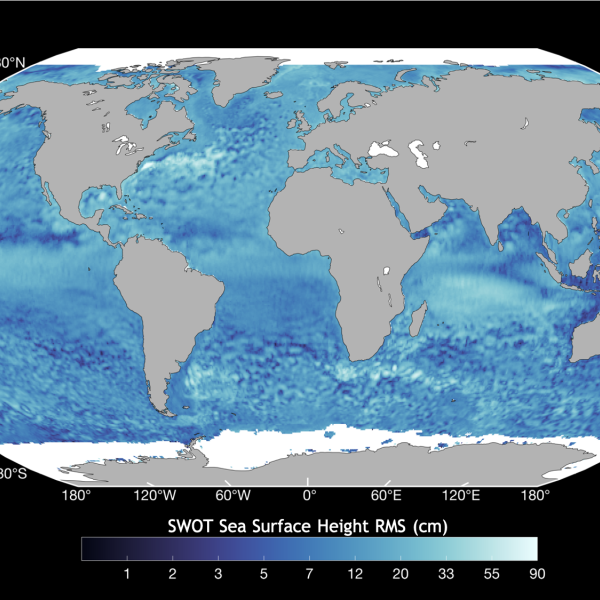
Ocean surface topography is the height of the ocean surface from the geoid, or surface on which the Earth’s gravity field is uniform. While the ocean looks perfectly flat to us from the shore, waves, tides, currents, and variations in atmospheric pressure cause variations in sea surface height across the globe. Tracking these variations helps us better understand the way ocean circulation and currents work.
Ocean surface topography is measured using a satellite altimeter. With precise satellite tracking and detailed models of the forces affecting satellite paths (like gravity and aerodynamic drag), we can calculate the precise height of a satellite above the geoid, or mean sea surface level. Then, by bouncing microwave pulses off the ocean surface and measuring precisely how long it takes for those signals to get back to the satellite, we can calculate the precise height of the ocean at any point. After taking the difference between this measurement and our theoretical geoid height, we get a highly detailed picture of sea surface topography. While taking these measurements, satellites can detect other useful information as well, like wave movements and ocean roughness. NASA's Gravity Recovery and Climate Experiment (GRACE) is one such mission gathering this kind of data.
There are many different applications for data on sea surface topography. Generally, these data help scientists better understand ocean tides and circulation systems, and monitor changes to mean sea level. By combining this with other ocean observations, like in-situ measurements from ships, floats, and buoys, scientists can test the impact of winds on ocean circulation, improve forecasts of climate events like El Niño and La Niña, and see how global sea level and currents change due to large-scale climate variations.