Wind is atmospheric motion relative to Earth's surface. Ocean winds influence waves, nutrient circulation, storm systems, and atmospheric particle transport, making wind measurement crucial for climate forecasting, fisheries management, and shipping.

Traditionally measured with anemometers (small turbine-based instruments), ocean winds are now monitored by satellite systems like the Cyclone Global Navigation System (CYGNSS). Rather than measuring air movement directly, CYGNSS uses Doppler radar to track wind-generated capillary waves—tiny ocean surface ripples that indicate wind speed.

These observations enhance climate and weather models, support severe weather preparation, track long-term climate changes, and aid maritime navigation.

Get Ocean Winds Data

Access a range of datasets and data tools to further your ocean wind research.

Remote video URL
Animation of daily wind speed measurements from the Compact Ocean Wind Vector Radiometer (COWVR) instrument during its first year of operation. COWVR was developed at the Jet Propulsion Laboratory and is installed on the International Space Station, where it has been collecting measurements since January 2022. COWVR aims to demonstrate new low-cost microwave sensor technologies for weather applications. This animation uses the first public release of the data which includes wind speed, wind direction, and moisture parameters. Credit: PO.DAAC

Learn How to Use Ocean Winds Data

Access a range of webinars, tutorials, data recipes, and data stories to enhance your knowledge of Earth Observation data.
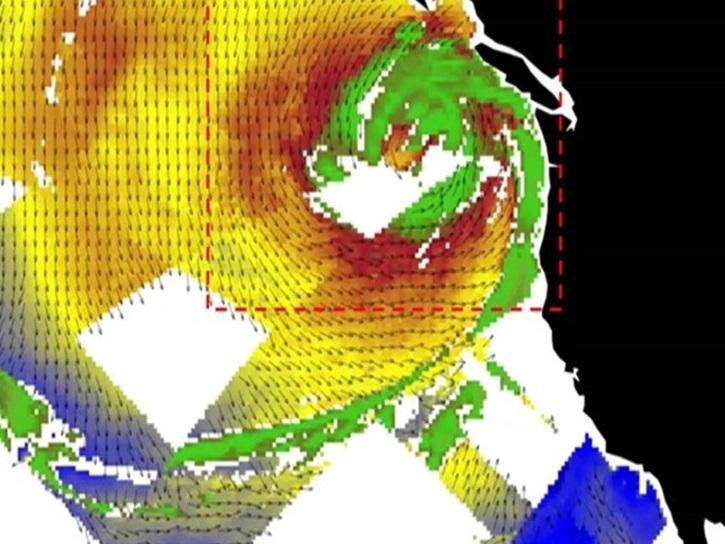
A visualization of COWVR wind speed and direction data during a bomb cyclone in November 2024.
COWVR and TEMPEST V10 Datasets Available in First Public Release
The Compact Ocean Wind Vector Radiometer (COWVR) and Temporal Experiment for Storms and Tropical Systems (TEMPEST) datasets are the first from the Space Test Program - Houston 8 (STP-H8) mission that aims to test low-cost, light-weight instruments designed for weather applications.
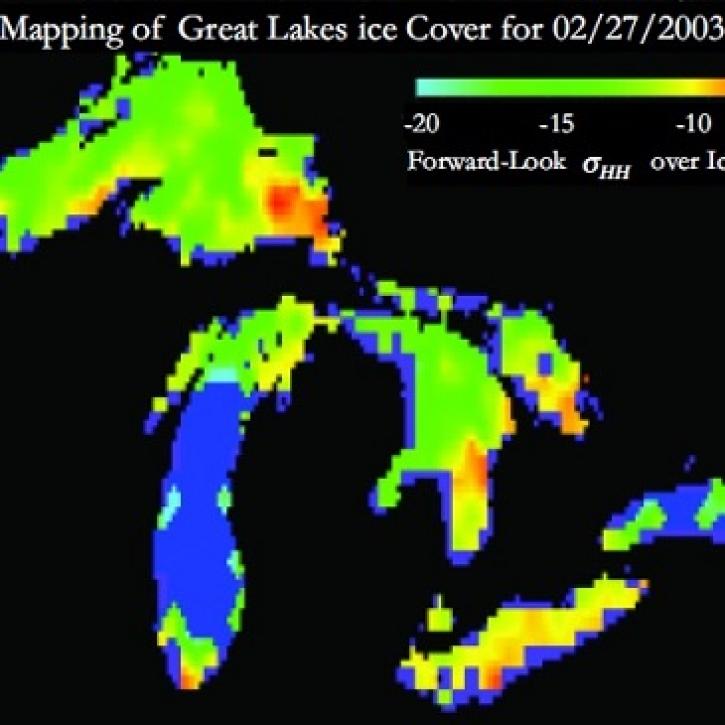
The image above shows a prototype map of the QuikSCAT ice-cover product for the Great Lakes, showing ice cover on February 27, 2003.
Monitoring Great Lakes Ice from Space
Understanding Great Lakes ice means enduring some tough conditions.
Two maps show the concentration of microplastics across the ocean, on July 29, 2017 and April 8, 2018.
Tracking Ocean Plastic From Space
Researchers are using satellite data and machine learning to map microplastic concentrations across the ocean.
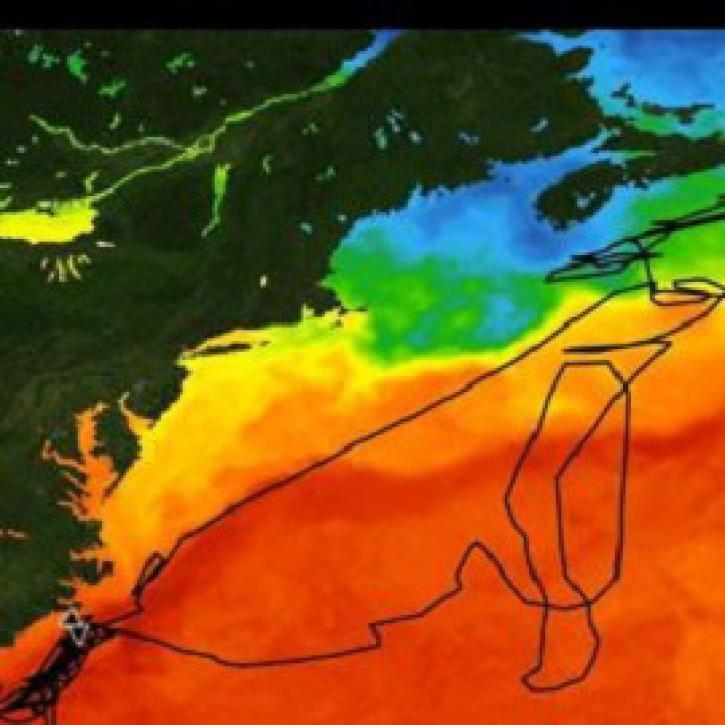
COVERAGE image showing ocean with colors indicating ocean temperatures.
NASA and CEOS Team Up to Provide New Data User Communities with COVERAGE
CEOS' online platform makes it easier for new users to find, visualize, and analyze remotely sensed and in-situ data on marine ecosystems.
Discover and Visualize Ocean Winds Data
NASA data help us understand Earth's changing systems in more detail than ever before, and visualizations bring these data to life, making Earth science concepts accessible, beautiful, and impactful.
Data visualization is a powerful tool for analysis, trend and pattern recognition, and communication. Our resources help you find world-class data visualizations to complement and enhance your research. We also have tools and tutorials to help you translate ocean winds data into compelling visuals.
Image
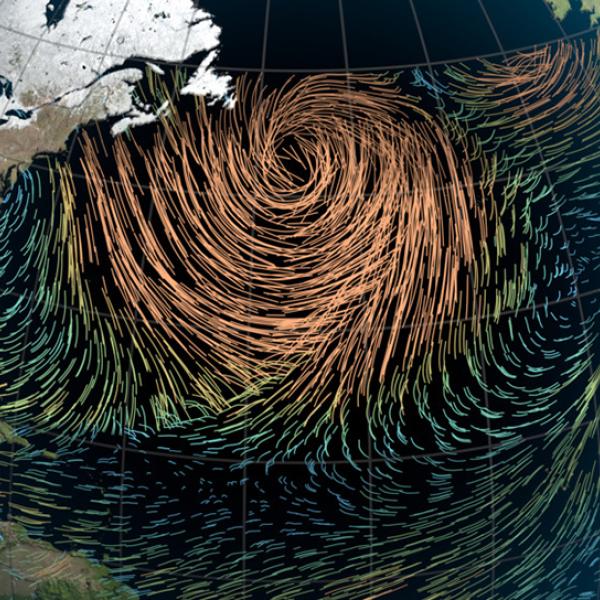
This North-at-the-top map shows portions of North and South America on the left side, the Atlantic Ocean in the middle, and Europe and Africa on the right. Over the North Atlantic is a swirl of wind represented by colored lines. The lines range from blue, green, and orange to show increasing speed. The lines are blue and green in the outer area of the swirl, and orange toward its center.
This visualization of MERRA-2 surface winds over the Atlantic Ocean and Sargasso Sea shows some unusually strong westerly winds during the winter of 2009-2010. Here the slower winds are shown in blue while the faster winds are shown in shades of red. Credit: NASA's Scientific Visualization Studio

Join Our Community of NASA Data Users

While NASA data are openly available without restriction, an Earthdata Login is required to download data and to use some tools with full functionality.

Learn About the Benefits of Earthdata Login

Frequently Asked Questions

Earthdata Forum

Our online forum provides a space for users to browse thousands of FAQs about research needs, data, and data applications. You can also submit new questions for our experts to answer.

Submit Questions to Earthdata Forumand View Expert Responses

Earthdata
Forum