We are in the process of migrating all NASA Earth science data sites into Earthdata from now until end of 2026. Not all NASA Earth science data and resources will appear here until then. Thank you for your patience as we make this transition.
Read about the Web Unification Project
Ocean Data Access and Tools
NASA data span the geophysical parameters that characterize the global ocean and the physical processes operating within its depths and at its surface. Our datasets and tools help researchers translate these interconnected data points into actionable knowledge.
Ocean Datasets
| Dataset Sort descending | Version | Platforms | Instruments | Temporal Extent | Spatial Extent | Spatial Resolution | Data Format |
|---|---|---|---|---|---|---|---|
| Miscellaneous Autonomous Profiling Explorer (APEX) floats measurements | 0 | BUOYS, MOORINGS, Water-based Platforms, AUVS, ROVS, Ships | 2004-06-17 to Present |
N: 90 S: -90 E: 180 W: -180 |
|||
| MISR L2 TOA/Cloud Albedo Product subset for the RICO region V002 | 002 | Terra | MISR | 2000-11-01 to 2005-02-01 |
N: 90 S: -90 E: 180 W: -180 |
HDF4 | |
| Mississippi (MS) Sound optical measurements | 0 | BUOYS, MOORINGS, Water-based Platforms, AUVS, ROVS, Ships | 2005-12-13 to Present |
N: 90 S: -90 E: 180 W: -180 |
|||
| MODIS Aqua Level 3 SST MID-IR 8 Day 4km Nighttime V2019.0 | 2019.0 | Aqua | MODIS | 2002-07-03 |
N: 90 S: -90 E: 180 W: -180 |
0.041 Decimal Degrees x 0.041 Decimal Degrees | netCDF-4 |
| MODIS Aqua Level 3 SST MID-IR 8 Day 9km Nighttime V2019.0 | 2019.0 | Aqua | MODIS | 2002-07-03 |
N: 90 S: -90 E: 180 W: -180 |
0.083 Decimal Degrees x 0.083 Decimal Degrees | netCDF-4 |
| MODIS Aqua Level 3 SST MID-IR Annual 4km Nighttime V2019.0 | 2019.0 | Aqua | MODIS | 2002-01-01 |
N: 90 S: -90 E: 180 W: -180 |
0.041 Decimal Degrees x 0.041 Decimal Degrees | netCDF-4 |
| MODIS Aqua Level 3 SST MID-IR Annual 9km Nighttime V2019.0 | 2019.0 | Aqua | MODIS | 2002-01-01 |
N: 90 S: -90 E: 180 W: -180 |
0.083 Decimal Degrees x 0.083 Decimal Degrees | netCDF-4 |
| MODIS Aqua Level 3 SST MID-IR Daily 4km Nighttime V2019.0 | 2019.0 | Aqua | MODIS | 2002-07-03 |
N: 90 S: -90 E: 180 W: -180 |
0.041 Decimal Degrees x 0.041 Decimal Degrees | netCDF-4 |
| MODIS Aqua Level 3 SST MID-IR Daily 9km Nighttime V2019.0 | 2019.0 | Aqua | MODIS | 2002-07-03 |
N: 90 S: -90 E: 180 W: -180 |
0.083 Decimal Degrees x 0.083 Decimal Degrees | netCDF-4 |
| MODIS Aqua Level 3 SST MID-IR Monthly 4km Nighttime V2019.0 | 2019.0 | Aqua | MODIS | 2002-07-01 |
N: 90 S: -90 E: 180 W: -180 |
0.041 Decimal Degrees x 0.041 Decimal Degrees | netCDF-4 |
SHOWING 10 OF 2180
Surface Water and Ocean Topography (SWOT) Platform
SWOT provides detailed surface topography and monitors water body changes over time. The platform enables high-resolution ocean monitoring at 15-150 km spatial scales, tracking ocean currents, coastal dynamics, storm surges, and regional sea level changes. On land, SWOT measures water storage changes in lakes, reservoirs, rivers, and wetlands, supporting river discharge estimates for water resource assessment.
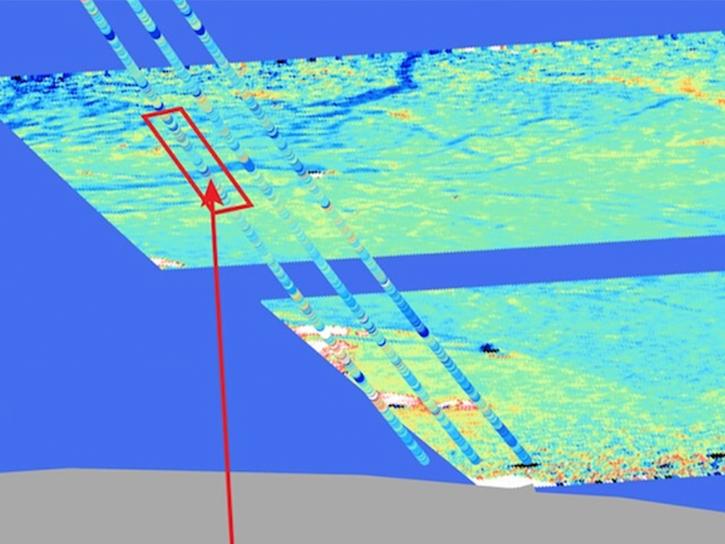
Researchers explore using SWOT data to derive two-dimensional estimates of sea ice thickness.

The Surface Water and Ocean Topography (SWOT) Swath Visualizer provides a visualization of two instruments’ coverage of Earth's surface: the Ka-band Radar Interferometer and altimeter.
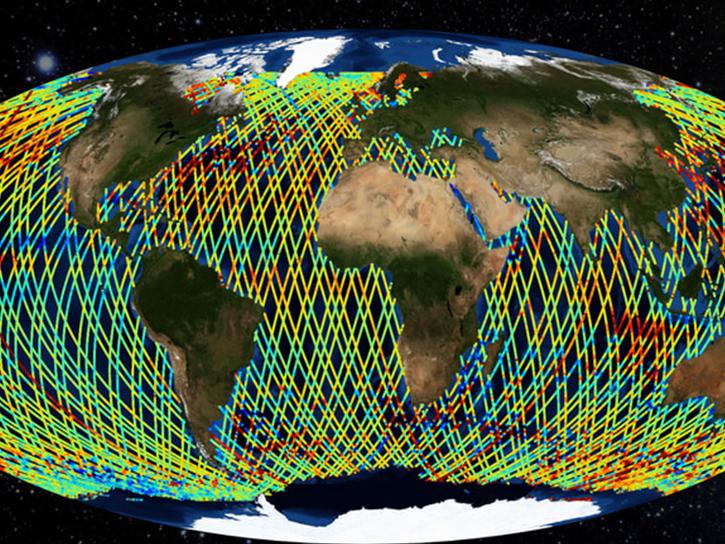
SWOT presents opportunities and challenges in characterizing sea surface height anomalies.
Ocean Data Tools
| Tool Sort descending | Description | Services | |
|---|---|---|---|
| SOTO | State of the Ocean (SOTO) is an interactive web-based tool that generates informative maps, animations, and plots that communicate and prove the discovery and analysis of the state of the oceans. | Analysis, Search and Discovery, Visualization | |
| STREAM | STREAM is a rapid water quality monitoring tool that processes satellite imagery to create maps showing chlorophyll-a, Total Suspended Solids, and water clarity at 20-30 meter resolution. | Processing | |
| SWOT Swath Visualizer | The Surface Water and Ocean Topography (SWOT) Swath Visualizer provides a visualization of two instruments’ coverage of Earth's surface: the Ka-band Radar Interferometer and altimeter. | Analysis, Data Curation, Visualization |
SHOWING 3 OF 13
Frequently Asked Questions
Earthdata Forum
Our online forum provides a space for users to browse thousands of FAQs about research needs, data, and data applications. You can also submit new questions for our experts to answer.
Submit Questions to Earthdata Forumand View Expert Responses