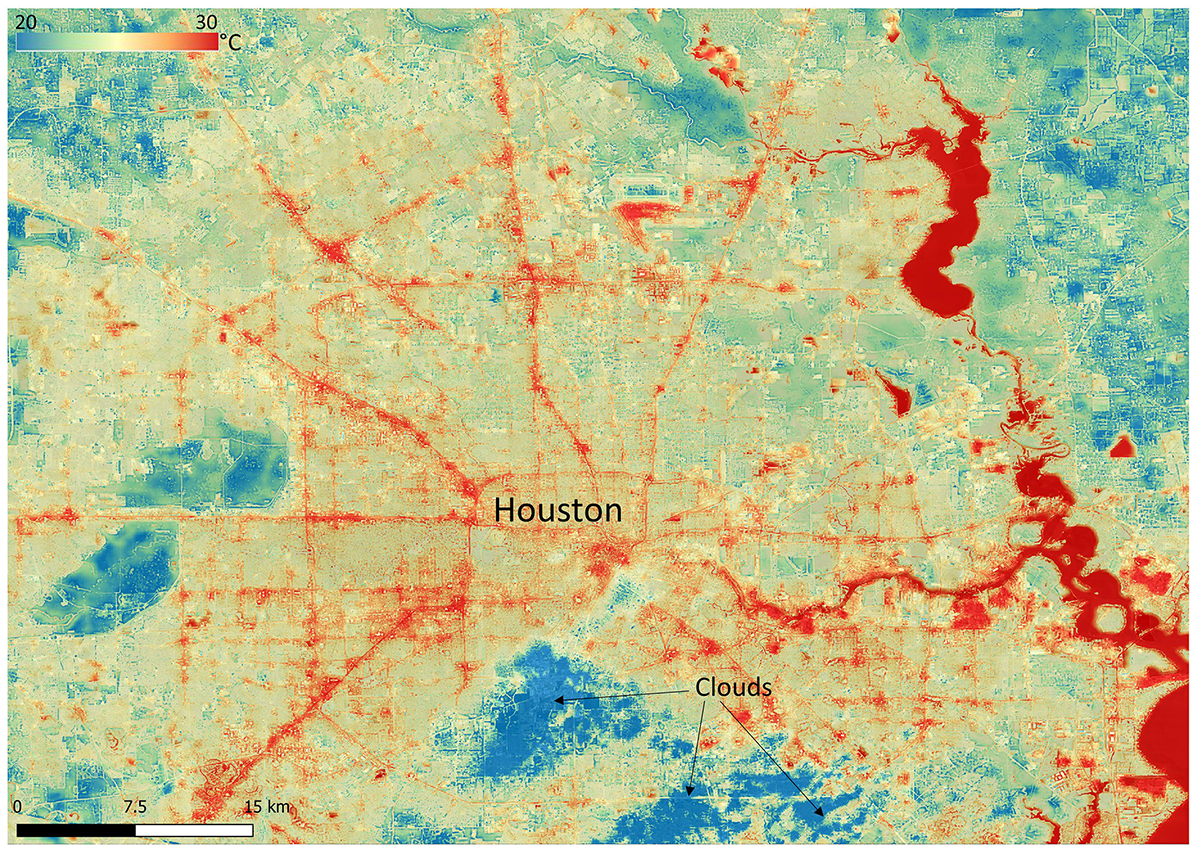
Thermal remote sensing allows us to see what optical remote sensing cannot reveal: the heat signatures of cities. As concrete and asphalt absorb sunlight and buildings trap heat, urban areas can become substantially warmer than surrounding rural landscapes—a phenomenon known as the urban heat island effect. Understanding where and when dangerous heat accumulates is critical for protecting vulnerable communities and designing more resilient cities.
NASA's Applied Remote Sensing Training (ARSET) team will offer a live, two-part online training on May 26 and June 2, 2026, that will cover the fundamentals of thermal infrared remote sensing and how it can be used to map urban heat vulnerability with data from the ECOSTRESS mission. Participants will gain practical thermal data analysis skills in R, and then apply data downscaling workflows in Google Earth Engine.
The no-cost training is open to the public and recommended for urban planners, climate adaptation practitioners, and climate researchers who work with satellite data and have basic remote sensing knowledge. Learn more and register: Introduction to Thermal Remote Sensing and Applications in Urban Heat Island Mapping.