New Geostationary Imagery Added to FIRMS

The Geostationary Ring Natural Color RGB imagery layer is an additional option for users to visualize the progression of wildfires and their effects throughout the day.

In near real-time, NASA’s Fire Information for Resource Management System (FIRMS) provides data to help users identify the location, extent, and intensity of wildfire activity. The FIRMS team is continually identifying new layer options, and recently added the Geostationary Ring Natural Color RGB imagery layer. This product, provided by European Organisation for the Exploitation of Meteorological Satellites (EUMETSAT), is a mosaic of RGB Natural Color imagery derived from five geostationary satellite instruments to provide comprehensive coverage of the globe.

Each of the five instruments that contribute to this near real-time global mosaic imagery stays locked to its associated nadir coordinates as Earth rotates on its axis. The instruments continuously image the entire Earth disk within its field of view centered at 10- to 15-minute intervals, and the layer displays the latest imagery captured by each instrument at 3-hour intervals. This update frequency provides imagery throughout the day between polar-orbiting satellite observations and is ideal for viewing changes in wildfire activity.

  • GOES-18 (GOES West) / Advanced Baseline Imager (ABI) - 0º, 137.2º W
    • Labeled GOES West in FIRMS
  • GOES-19 (GOES East) / ABI - 0º, 75.2º W
    • Labeled GOES East in FIRMS
  • Himawari-9 / Advanced Himawari Imager (AHI) - 0º, 140º E
    • Labeled Himawari-9 in FIRMS
  • Meteosat Indian Ocean Data Coverage (IODC) / SEVIRI - 0º, 45.5º E
    • Labeled MSG IODC in FIRMS
  • Meteosat 0 Degree / Spinning Enhanced Visible and Infrared Imager (SEVIRI) - 0º, 0º
    • Labeled MSG 0 deg in FIRMS
Image
Image Caption

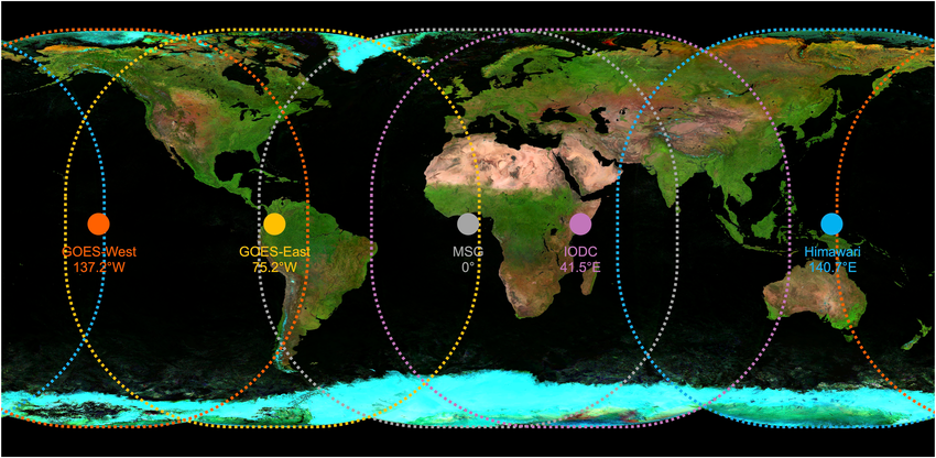
The spatial coverage of the imagery provided by each geostationary instrument included in the Geostationary Ring Natural Color RGB image composite. Credit: FIRMS

The Geostationary Ring Natural Color RGB imagery is a false color composite image. The layer assigns red, green, and blue display channels to the short-wave infrared, near infrared, and red reflectance bands for each geostationary instrument. 

  • ABI (GOES-18 and GOES-19): Near Infrared 1.6 µm, Visible 0.86 µm, and Visible 0.64 µm channels.
  • AHI (Himawari-9): Near Infrared 1.6 µm, Visible 0.86 µm, and Visible 0.64 µm channels.
  • SEVIRI (Meteosat): Near Infrared 1.6 µm, Visible 0.8 µm, and Visible 0.6 µm channels.
  • ABI (GOES-18 and GOES-19): Near Infrared 1.6 µm, Visible 0.86 µm, and Visible 0.64 µm channels.
  • AHI (Himawari-9): Near Infrared 1.6 µm, Visible 0.86 µm, and Visible 0.64 µm channels. 

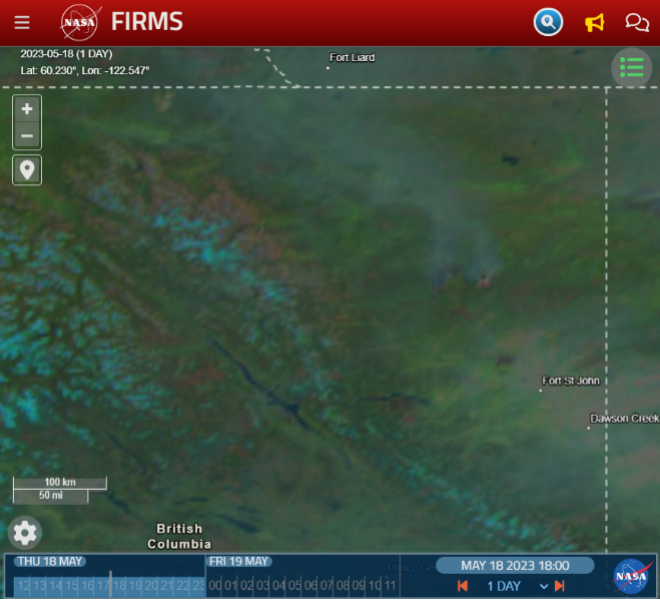
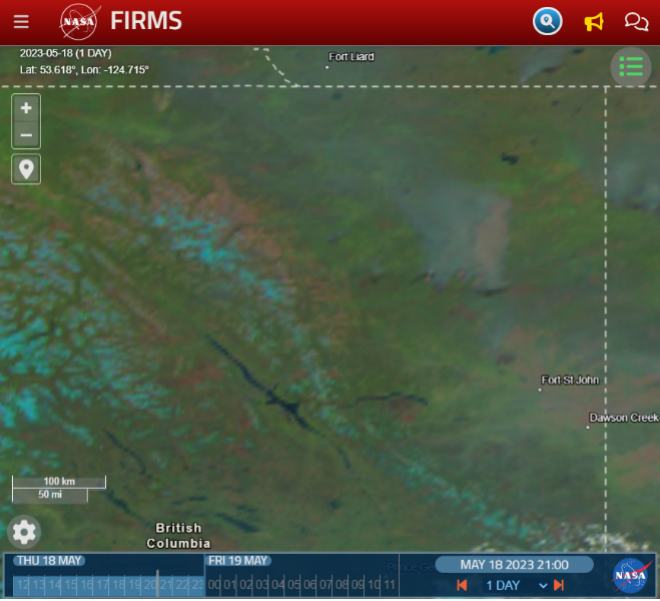
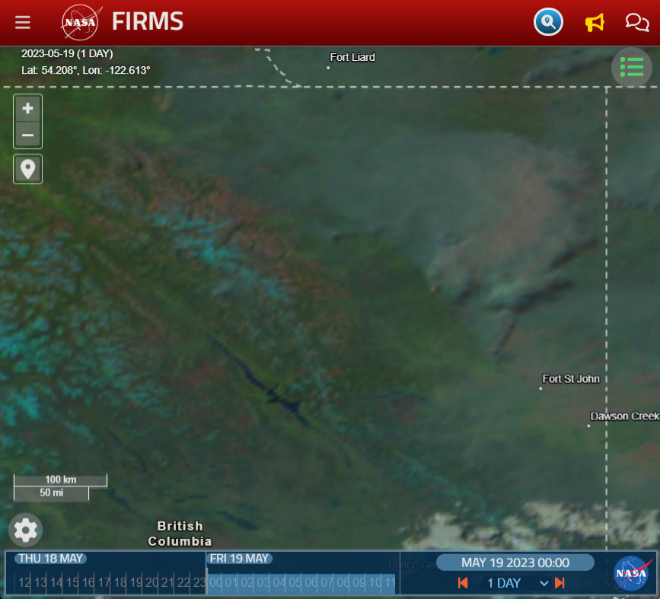
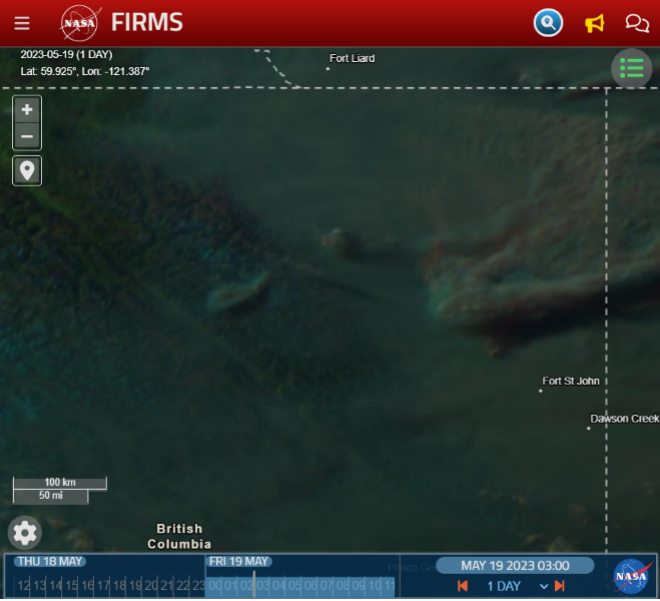
The combination of these spectral bands yields a false color composite image where observable features on the land surface and atmosphere typically appear as follows: healthy vegetation (green), burn scars (reddish-brown), bare soils/deserts (brown), clouds (white), smoke (white, gray or light brown); snow and ice (cyan), deep water bodies (dark blue), and shallower water bodies (light blue).

Image
Image Caption

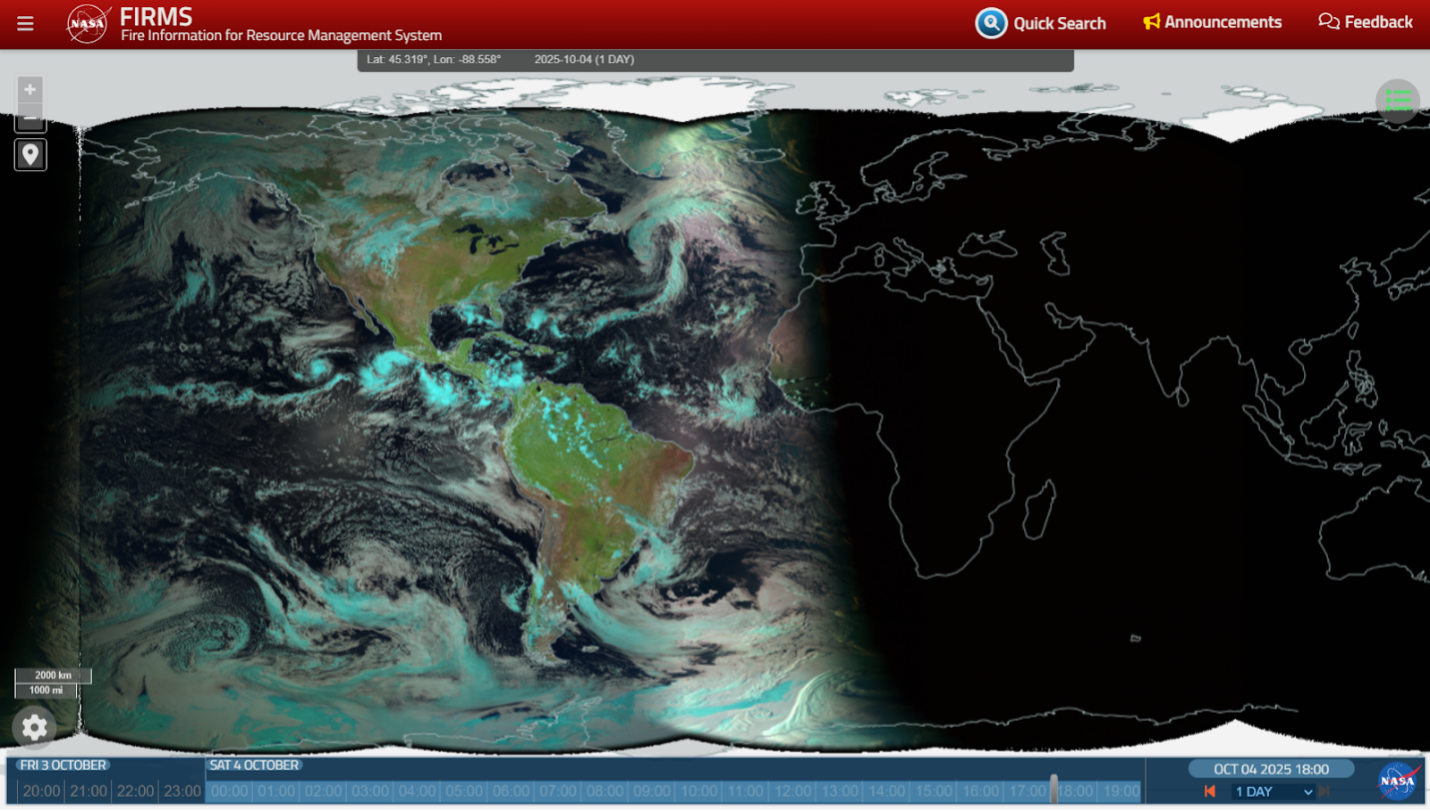
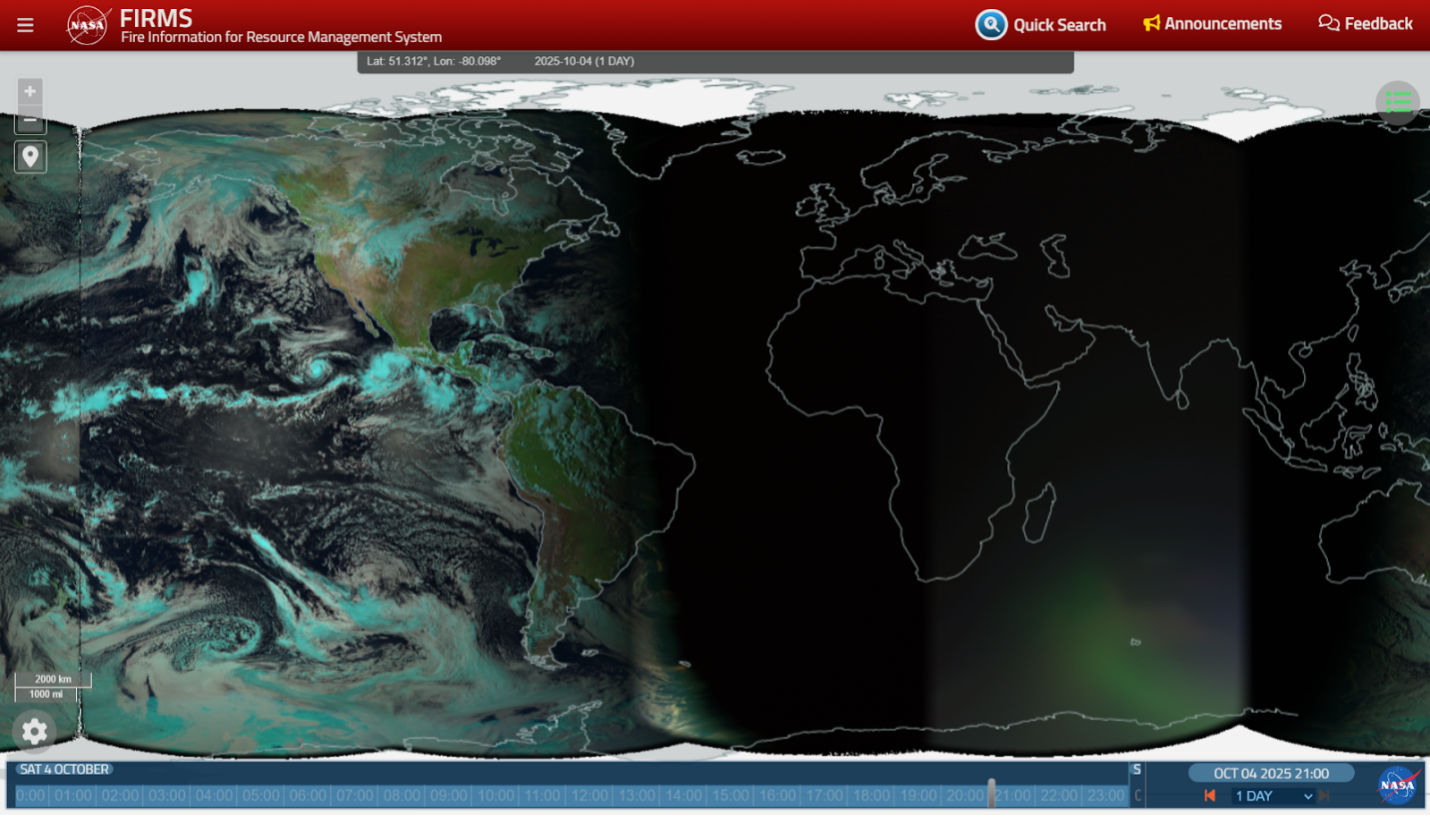
The Geostationary Ring Natural Color RGB imagery global mosaic displayed in the FIRMS map viewer. The top map displays imagery current at 1800 UTC on October 4, 2025 and the bottom map displays the updated imagery three hours later at 2100 UTC. The mosaic displays the reflectance of sunlight from bands in the visible, near infrared and shortwave infrared channels. Consequently, the mosaic appears dark on the nighttime side of the planet due to the lack of sunlight. 

Image
Image Caption

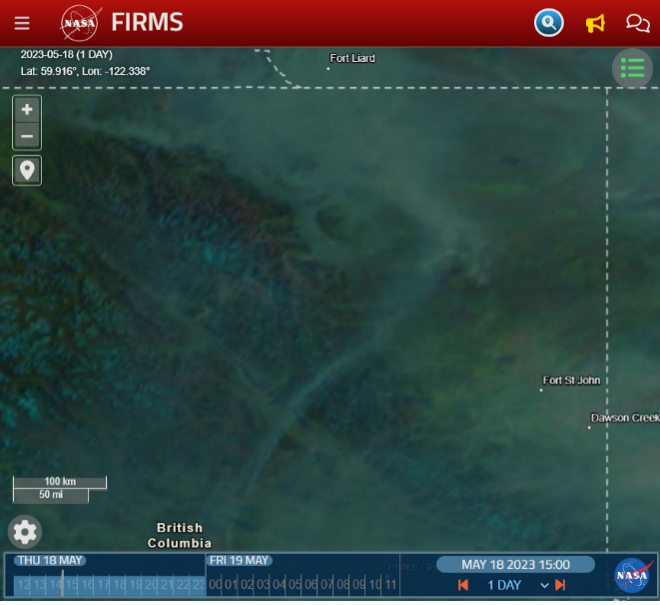
Location of Donnie Creek Fire near Peach River in northeast British Columbia.

Image
Image
Image
Image
Image

The above images show a 12-hour daytime sequence of the Geostationary Ring Natural Color RGB imagery for May 18, 2023 at 1500 UTC, 1800 UTC, and 2100 UTC; and for May 19, 2023 at 0000 UTC and  0300 UTC for the Donnie Creek Fire near Peach River in northeast British Columbia. The Geostationary Ring Natural Color RGB imagery is updated at 3-hour intervals during this 12-hour period and allows visualization of discernible changes of the fire and smoke patterns throughout the day.

Details

Last Updated

Dec. 12, 2025

Published

Dec. 11, 2025