NASA Enhances Global Flood Products: Smarter detection of flooding, and the release of a 23-year archive

NASA significantly enhanced its MODIS and VIIRS near real-time flood products, enabling users to distinguish between unusual and recurring flooding.

Distinguishing Recurring Floods

NASA recently introduced a significant enhancement to its MODIS and VIIRS near real-time (NRT) flood products, enabling more nuanced views of flooding events. The update introduces the ability to distinguish between unusual flooding and recurring flooding. 

Previously, any water detected outside its expected boundaries—such as lakes, rivers, or seas—was labelled as simply “flood.” However, many regions experience predictable seasonal or annual flooding. By identifying such recurring floods separately, the updated products allow users to quickly pinpoint unexpected flood events and assess their extent, improving situational awareness and decision-making for disaster response and planning. 

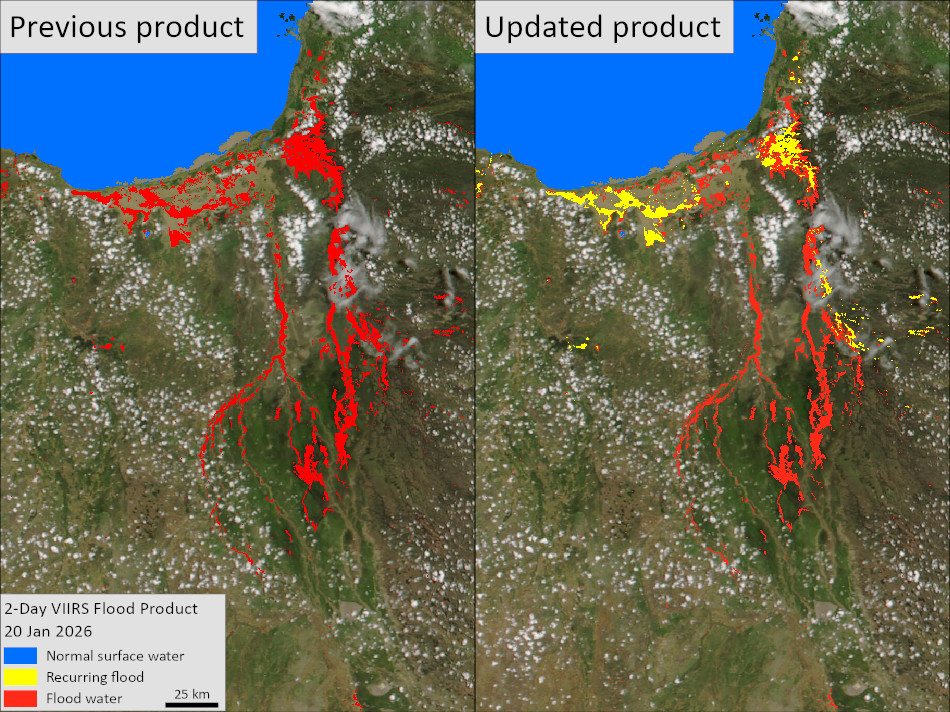
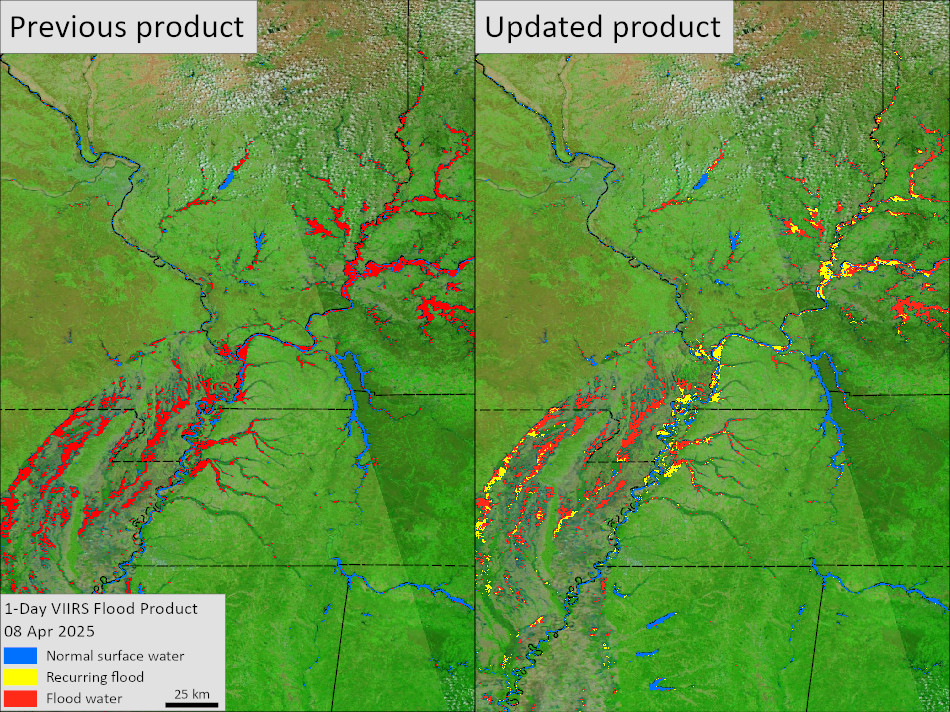
Figures 1 (Mississippi/Ohio river regions) and 2 (Queensland, Australia) below show examples of the updated product compared to the previous version. 
Image
Image Caption

Figure 1: Previous and updated mapping products show flooding in the Mississippi and Ohio river basins in April 2025. The updated product shows that although some of this flooding was routine (recurring), much of it was actually unusual, and thus perhaps of more concern. The background image is NOAA-20/VIIRS false-color reflectance from April 8, 2025.

This enhancement was made possible by the recent reprocessing of the MODIS flood product archive extending back to 2003. By analyzing flood frequency across 22 years of data, researchers developed monthly flood masks that identify areas that have experienced flooding in at least seven of those 22 years. 

This new feature was added to the product in December 2025. For full technical details, see the updated User Guide (Revision F), available on the Global Flood Product homepage.

Image
Image Caption

Figure 2: Maps in the previous and updated format show the impact of flooding in January 2026 in the area where the Norman and Flinders rivers flow into the Gulf of Carpentaria in Queensland, Australia. As the new product indicates, most of the flooding was unusual. The background image is NOAA-20/VIIRS true-color reflectance from January 20, 2026.

MODIS Flood Product Archive 2003-2025

In April 2026, the agency released a 23-year archive of MODIS flood products (2003-2025) through NASA's Level-1 and Atmosphere Archive and Distribution System Distributed Active Archive Center (LAADS DAAC). These products have been reprocessed using standard inputs for the entire period, as opposed to near-real time (NRT) inputs used during daily production. (NRT inputs take some short-cuts in order to deliver products within three hours of each satellite overpass.)

The key benefit of this reprocessing is the use of final corrected geolocation, eliminating occasional pixel-level shifts that can occur in NRT products and affect flood detection accuracy. This reprocessing also enabled the creation of a consistent archive across the entire period; previously the legacy MODIS Water Product (MWP, available from 2012), and the newer MCDWD product (available from 2021) were available. This consistency makes the archive more reliable for long-term research and analysis. Details on the differences are available: LANCE Near Real-Time Versus Standard Data Products.

Moving forward (2026 onwards), MODIS NRT products will be permanently archived in LAADS, ensuring they remain accessible beyond the usual 1-week window on LANCE NRT servers.

We welcome user feedback on these updates and are also interested in hearing how the product is being used to support different applications or research areas. Feedback can be submitted to floodmap@lists.nasa.gov.

Visit the NRT Global Flood Products homepage.

Details

Last Updated

April 10, 2026

Published

April 10, 2026