Introduction
The global water cycle corresponds to the movement of water between the land, ocean, atmosphere, and cryosphere. As water is fundamental to all life, it is of utmost importance to monitor the changes in the global water cycle, particularly the types of changes expected in a warming climate.
Previous works studied the water cycle by measuring exchanges of water between land and ocean via precipitation, evaporation and river discharge1,2 or by looking at the long-term changes in open ocean surface salinity that responds to changes in evaporation minus precipitation3,4. The coastal ocean is extremely rich in providing signals of change for the global water cycle but this region of the world has been understudied though more than 40% of the world population live within 100 km from the coast5.
Rivers provide 10% of the total freshwater input to the ocean and are critical to the coastal ocean including substantial impacts on marine ecology. An obstacle to monitoring the coastal oceans is that observations of river discharge have traditionally relied upon an aging and sparse in situ observing network, with very few river gauges6.
As the climate warms, the global water cycle is expected to change, with complex impacts7. Runoff from land is projected to increase by ~7%8 which could have a significant influence on the coastal ocean. The coastal ocean could therefore be a key place to study the global terrestrial water cycle changes and its impacts on physical and biogeochemical processes. Because rivers discharge freshwater into the ocean, they affect the salinity of the ocean. Observations of salinity from in situ platforms and satellites can be used to trace lenses of freshwater originating from rivers’ mouths (called river plumes) as they mix with ocean waters9.
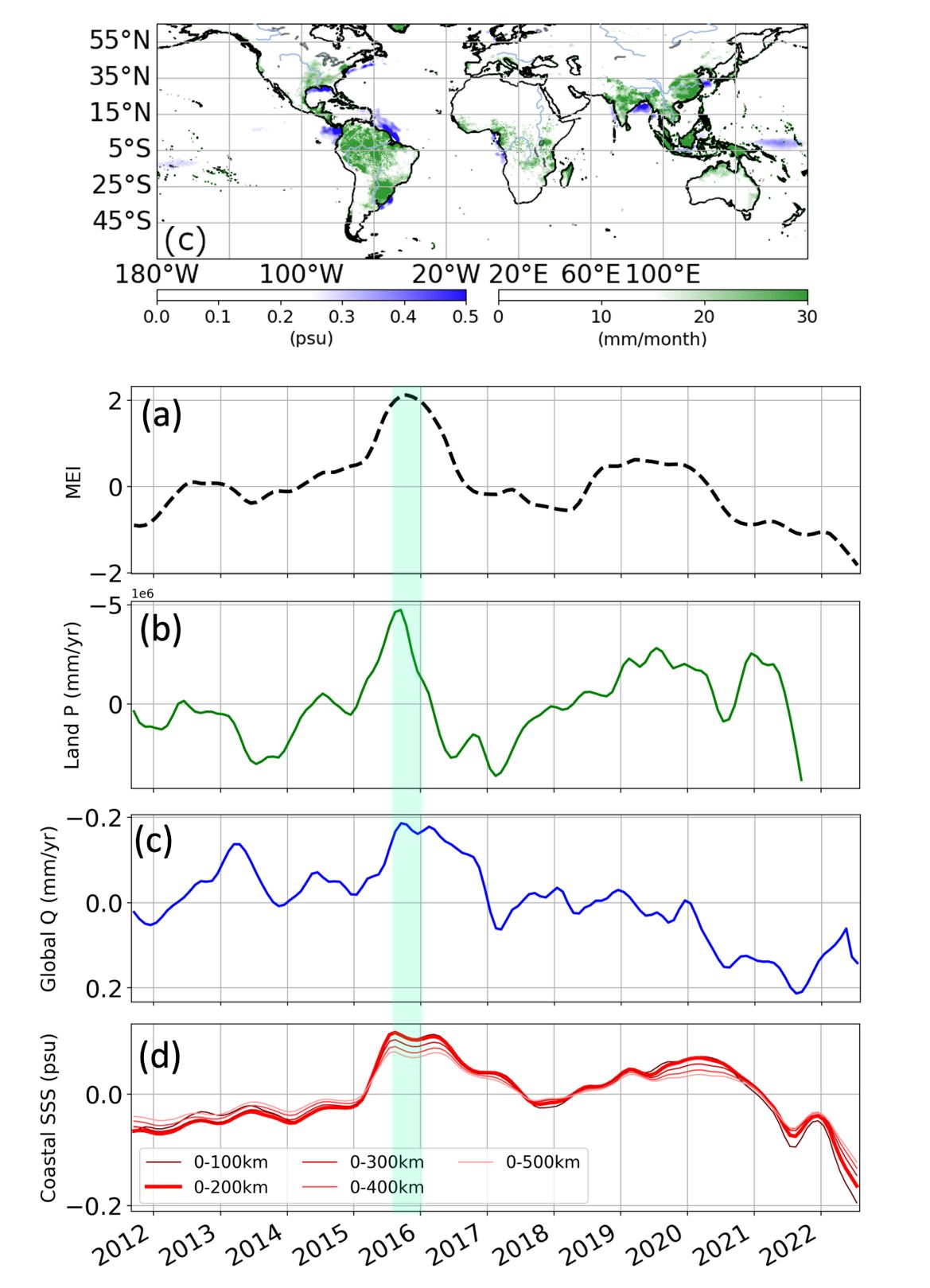
Satellite-observed high sea surface salinity (SSS) year to year variations happen at the coast (Figure 1; blue colors in the ocean) adjacent to regions on land where we see a high precipitation year to year variation (green colors on land; Figure 1). For example, the large blue region in Figure 1 off the east coast of South America is associated with outflow from two major rivers, the Amazon and Orinoco, and the huge green adjacent region on land shows where these low-salinity waters originate: rainfall in the Amazon rainforest and beyond.
Satellite Data Reveals Water Cycle Changes
Aggregated global coastal SSS observations from the NASA/SAC-D Aquarius (2011-2015), ESA Soil Moisture Ocean Salinity (SMOS; 2010-present,) and NASA Soil Moisture Active Passive (SMAP; 2015-present) missions are used here to detect variations in the large-scale cycling of water between the oceans and continents. Well-known climate events such as El Niño Southern Oscillation (ENSO) may be helping to drive these variations as these events can persist over several seasons and produce severe regional effects.
Global satellite SSS year to year variations near the coast (within 500 km from the coast) are strongly correlated with global water cycle variability driven by the El Niño-Southern Oscillation (ENSO) (measured by the Multivariate ENSO Index, or MEI) via the modulation of precipitation on land and subsequent river runoff (Figure 2).
In particular, during the 2015-2016 El Niño event, the warm phase of ENSO associated with warmer-than-average ocean temperatures in the equatorial Pacific (green shaded area in Figure 2; high MEI), there was lower precipitation on land, causing lower river discharge, and higher SSS in the coastal ocean (Figure 2). This signal in global coastal SSS in response to ENSO variability has never been shown before.
This shows that coastal SSS could therefore be used as a proxy for detection of changes that are expected in the cycling of water between the oceans and continents. Satellite SSS retrievals near the coast can be challenging due to land contamination in the satellite footprint. This result shows that it is important to improve satellite SSS retrievals near the coast, especially near river mouths.
References
1 Reager, J.T., Gardner, A.S., Famiglietti, J.S., Wiese, D.N., Eicker, A. and Lo, M.H., 2016. A decade of sea level rise slowed by climate-driven hydrology. Science, 351(6274), pp.699-703.
2 Chandanpurkar, H.A., Reager, J.T., Famiglietti, J.S., Nerem, R.S., Chambers, D.P., Lo, M.H., Hamlington, B.D. and Syed, T.H., 2021. The seasonality of global land and ocean mass and the changing water cycle. Geophysical Research Letters, 48(7). doi:10.1029/2020GL091248
3 Vinogradova, N. T., & Ponte, R. M. (2017). In search of fingerprints of the recent intensification of the ocean water cycle. Journal of Climate, 30(14), 5513–5528. doi:10.1175/jcli-d-16-0626.1
4 Durack, P. J., Wijffels, S. E., & Matear, R. J. (2012). Ocean salinities reveal strong global water cycle intensification during 1950 to 2000. Science, 336(6080), 455–458. doi:10.1126/science.1212222
5 Seas, U. R. (2011). Percentage of total population living in coastal areas.
6 Vörösmarty, C. J. (2002). Global water assessment and potential contributions from Earth Systems Science. Aquatic Sciences, 64(4), 328–351. doi:10.1007/pl00012590
7 Held, I. M., and Soden, B. J. (2006). Robust responses of the hydrological cycle to global warming. Journal of Climate, 19(21), 5686–5699. doi:10.1175/jcli3990.1
8 Huntington, T. G. (2006). Evidence for intensification of the global water cycle: Review and synthesis. Journal of Hydrology, 319(1–4), 83–95. doi:10.1016/j.jhydrol.2005.07.003
9 Fournier, S., Reager, J. T., Lee, T., Vazquez-Cuervo, J., David, C. H., & Gierach, M. M. (2016). SMAP observes flooding from land to sea: The Texas event of 2015. Geophysical Research Letters, 43(19), 10338–10346. doi:10.1002/2016gl070821