Introduction
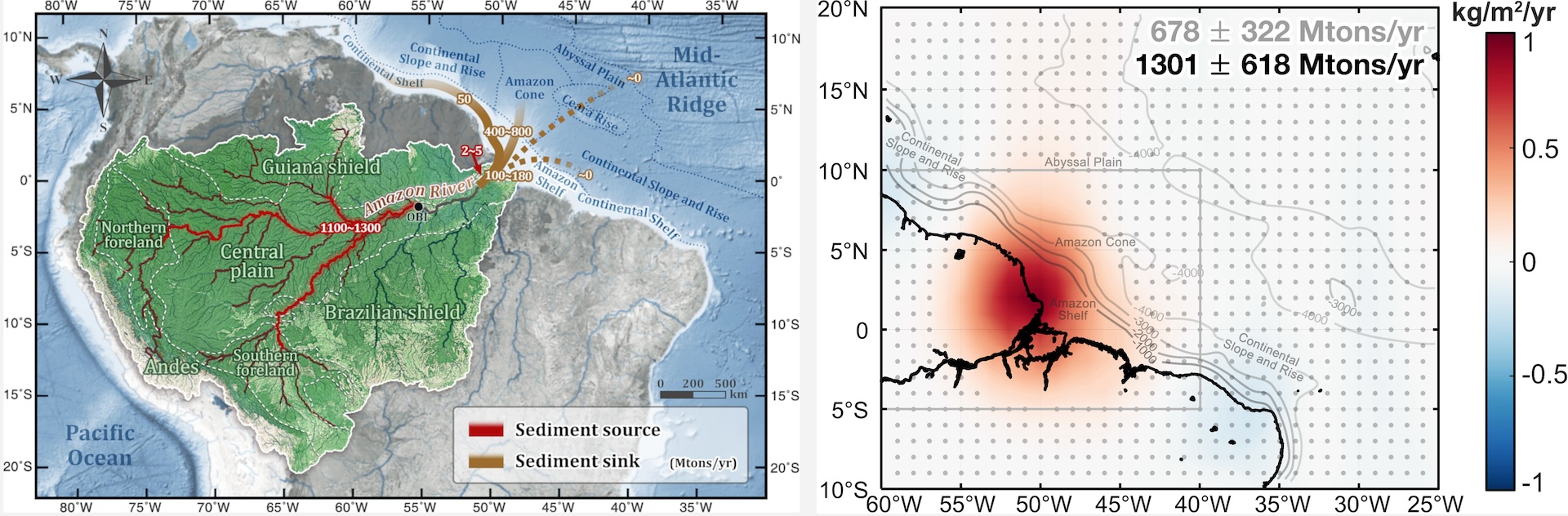
The Amazon River is the world’s largest hydrological system with a river basin covering more than 6 million square kilometers1 (Figure a). It delivers close to 20% of the global freshwater2 and roughly 1,200 million tons (Mt) of sediment to the Atlantic Ocean each year3. Sediment deposition at the coast has significant impacts on the morphology of the coast, marine ecosystems, and human livelihoods.
Accurately measuring these sediment discharges, while essential, has long been a challenge. Traditional in-situ methods fall short of providing continuous observations of sediment accumulation due to sparse coverage in space and time and economic constraints. Although the sensors are limited in their ability to "see through" clouds, satellite imagery offers valuable observations of sediment transportation and deposition.
Using GRACE/GRACE-FO to Detect Coastal Sediment Accumulation
The Gravity Recovery And Climate Experiment (GRACE) satellite mission, a collaboration of the U.S. and German space agencies (NASA and DLR), was launched in 2002, followed by the GRACE Follow-On (GRACE-FO) mission, a collaboration between NASA and Germany’s GFZ, launched in 2018. By accurately measuring month-to-month mass changes across the Earth, a recent study4 shows that GRACE and GRACE-FO can be used to detect sediment accumulation. With more than 20 years of data, subtle mass changes can now be observed. The estimated accumulation rate of sediment on the Amazon continental shelf is approximately 1,301 Mt per year for the period June 2002 to May 2023 (Figure b) which is consistent with prior estimates based on in situ measurements.
GRACE and GRACE-FO data have been extensively used by scientists to estimate changes in the Earth’s water reservoirs over land (groundwater or water stored beneath the surface), ice, and oceans. This new study adds geomorphology, the scientific study of the processes affecting the Earth’s form, to the range of GRACE and GRACE-FO mission’s applications.
To further explore GRACE data, the NASA State of the Ocean (SOTO) by Worldview data tool allows for easy review and examination.