Introduction
On Sept. 26, 2024, Hurricane Helene made landfall in the Big Bend area of the Florida Gulf Coast as a Category 4 storm1, causing coastal flooding from 15 feet of storm surge2. Coastal and inland flood records were broken; for example, in Tampa Bay, one gauge recorded a water surge seven feet above the normal high tide, with all of the area’s gauges breaking the recent local records3.
Analyzing Storm Water Inundation With SAR and Other Data
When natural disasters occur, the NASA Disaster Response Coordination System (DRCS)4 works to deliver data to stakeholders that can be used to guide decision-making. At NASA’s Jet Propulsion Laboratory (JPL), the Advanced Rapid Imaging and Analysis (ARIA) and Observational Products for End-Users from Remote Sensing (OPERA) projects frequently work with the DRCS to provide remote sensing imagery to support the disaster response efforts. OPERA systematically produces a suite of analysis-ready surface water extent data products that are useful for mapping inundation (and other surface water needs), which are available at Physical Oceanography Distributed Active Archive Center (PO.DAAC), and are derived from synthetic aperture radar (SAR) and optical data sources. These satellite data products are designed to meet the needs of U.S. Federal Agencies identified by the Satellite Needs Working Group (SNWG)5.
Major Findings
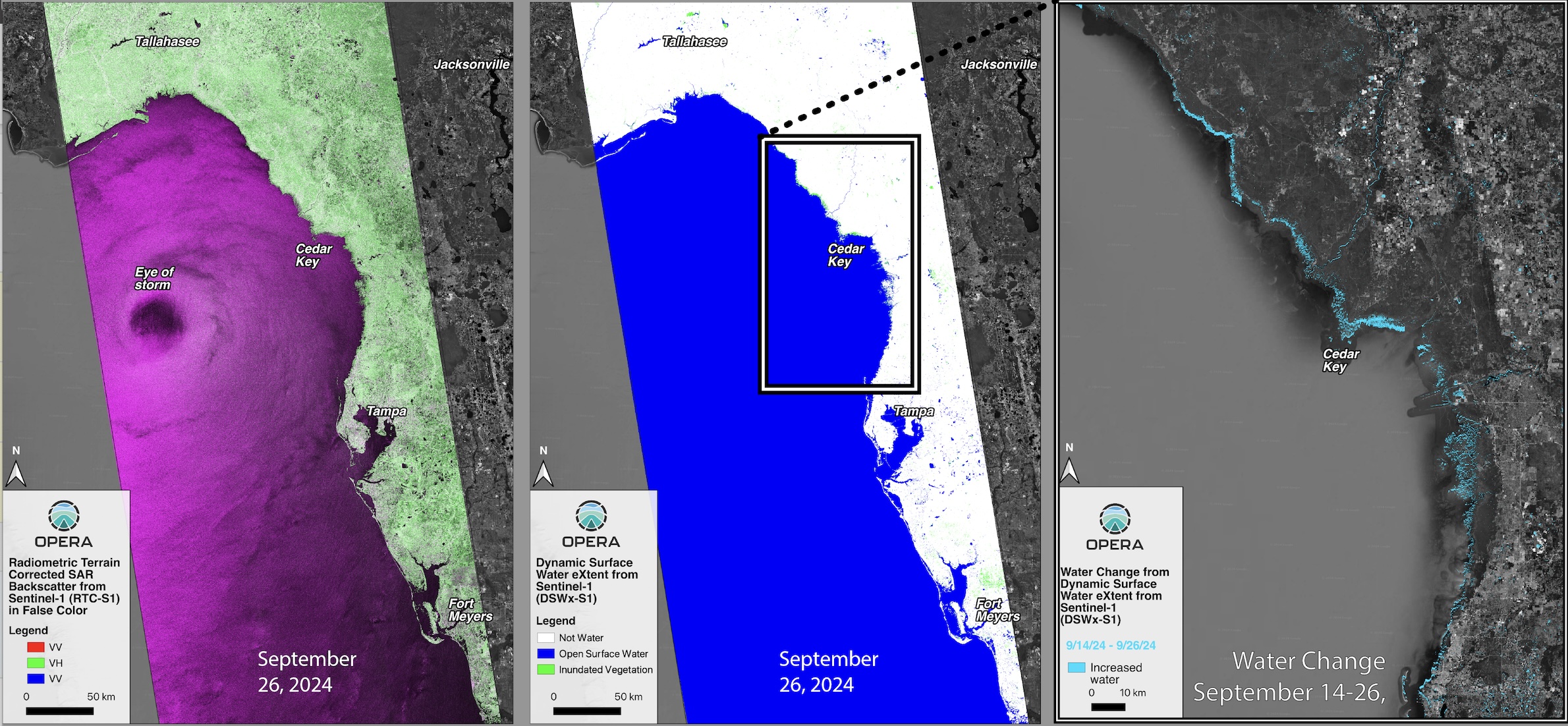
For the Hurricane Helene disaster response, the ARIA/OPERA team provided value-added radar and optical remote sensing datasets that were generated by the OPERA project. The team provided several disaster response datasets, including mosaicked OPERA Radiometric Terrain Corrected SAR backscatter from Sentinel-1 (RTC-S1) products (Figure 1, left), mosaicked OPERA Dynamic Surface Water eXtent from Sentinel-1 (DSWx-S1 data product) (Figure 1, center), and water change maps. Coastal inundation from the storm surge was mapped by differencing two DSWx-S1 images, one from Sept. 14, 2024, before the storm and the other from Sept. 26, 2024, after the storm (Figure 1, right). SAR-based water products have the key advantage of being able to ‘see’ water and the ground surface day or night and through cloud cover, which is particularly important during storms.
OPERA also produces a Dynamic Surface Water eXtent product from another data source, Harmonized Landsat Sentinel-2 (DSWx-HLS) optical data. The DSWx-HLS optical imagery has a higher temporal resolution and provides water maps on the same grid and with similar water classifications. However, depending on the event, cloud cover can often hinder the full usefulness of this type of data, as was the case with Hurricane Helene. The OPERA DSWx-HLS data can be further explored using NASA Worldview. All of OPERA’s Surface Water products are hosted at PO.DAAC.
Related Links
- OPERA Interactive Notebooks Github Repository
- PO.DAAC OPERA DSWx Data Tutorials
- New Product Provides Detailed Maps of Water In and Around Landmasses
- OPERA Data on Earthdata Search
- Exploring Water Surface Extent with Satellite Data StoryMap
- Data in Action: The Warm Waters in the Gulf of America Helped ‘Fuel’ Hurricane Helene