Introduction
Hurricane Helene made landfall in the Big Bend area of the Florida Gulf Coast as a category 4 storm late in the evening of Sept. 26, 2024.1 Although slowly weakening as it moved north, Helene caused significant damages and casualties across a large portion of the Southeast U.S., including North Carolina, South Carolina, Georgia, Florida, Tennessee, and Virginia, and will most likely rank as one of the deadliest storms to hit the U.S. in recent times.2
The Atlantic hurricane season spans from June 1 to Nov. 30 every year. Tropical Storm Helene formed in the Caribbean Sea on Monday Sept. 23, 2024, and then developed into a category 1 hurricane on Sept. 25, 2024. Helene then rapidly transformed from a category 1 hurricane to a category 4 hurricane in less than a day on Sept. 26, 2024, less than a day before landfall.1
This rapid intensification is in part due to very high ocean temperatures across the Gulf of America that act as ‘fuel’ for hurricanes.3 The storm moved over the Loop Current, a strong flow of warm water that travels from the Caribbean and loops in the eastern Gulf of America like a horseshoe before moving through the Florida Strait up the Atlantic Ocean. Because the Loop Current transports warm waters from the Tropics, storms moving over it often get enough energy from it to rapidly intensify.
Measuring Gulf Sea Temperature and Level With MUR and Sentinel-6 Data
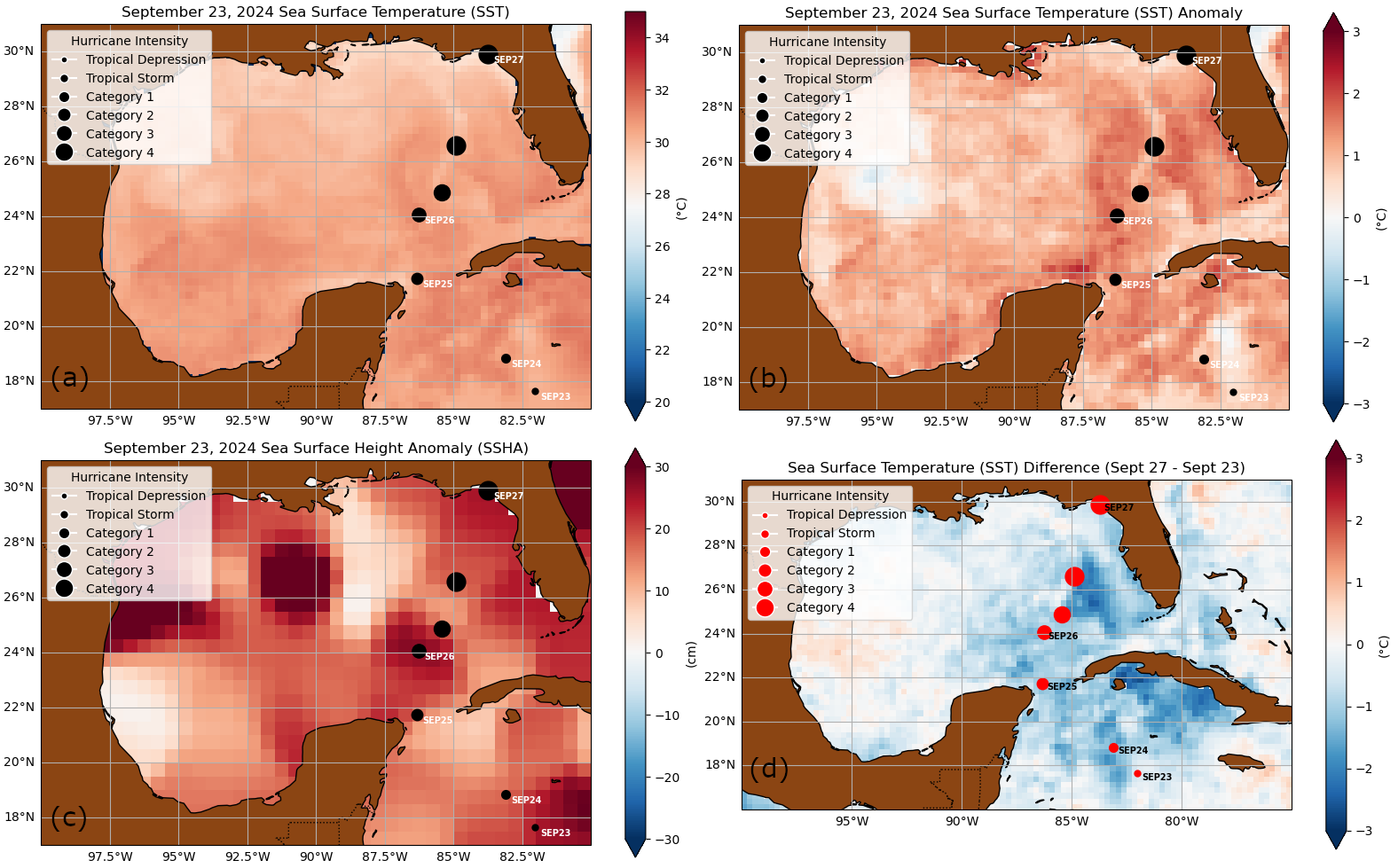
Figure a shows the sea surface temperatures (SST) from NASA's Multi-Scale Ultra-High Resolution (MUR) dataset measured by satellites in the Gulf of America on Sept. 23, 2024, right at the time when Tropical Storm Helene formed in the Caribbean Sea. The entire Gulf of America was warm, with surface temperatures above 28°C and above the 2003-2014 climatology (Figure b).
After the hurricane’s passage, colder waters from below were brought to the surface by the mixing induced by the hurricane high winds, which is called a ‘cold wake’, as shown by the blue colors (colder than before the passage of the hurricane) in Figure d over the entire eastern part of the gulf and in particular where it intensified to category 4 and on the right side of the hurricane track.
Hurricanes are not only fueled by the heat at the surface of the ocean but also by the heat that is stored at depth, below the surface, that we call ocean heat content. At present, satellites cannot directly measure the ocean temperatures below the surface. However, because when water heats up it tends to expand, the high ocean heat content can be observed in sea level data (higher ocean heat content means higher sea level due to water expansion).
Figure c shows the sea level observed by altimetry satellites such as Sentinel-6 Michael Freilich in the Gulf of America on Sept. 23, 2024, a few days before Hurricane Helene rapidly intensified. Red colors show locations where sea level is higher (warmer waters at depth) that are particularly present where the hurricane intensified from category 1 to category 2 and then category 3. At the time Hurricane Helene moved over the Gulf of America, not only the surface temperatures were significantly high, a lot of heat was also stored below the surface available to fuel the hurricane to intensify.
The National Oceanic and Atmospheric Administration (NOAA), the U.S. agency in charge of the national weather forecast, uses satellite sea surface temperature and sea level observations such as those available through the NASA Physical Oceanography Distributed Active Archive Center (PO.DAAC), along with other observations, to provide tropical cyclone track and intensity forecasts and issue advisory products.
To further explore these types of data, the NASA State of the Ocean (SOTO) by Worldview web tool allows for easy review and examination. In addition, the Jupyter Notebook allows for replication of these images.