Introduction
Greenland’s glaciers have been rapidly melting over the past several decades and are now a major contributor to global sea level rise.
Measuring Seawater Temperature and Salinity With OMG
To diagnose how the ocean is melting these glaciers from below, NASA’s Oceans Melting Greenland (OMG) Earth Venture Suborbital mission is measuring seawater temperature and salinity around the entire Greenland Ice Sheet including deep inside its iceberg-laden fjords where glaciers spill out into the ocean.
Major Findings
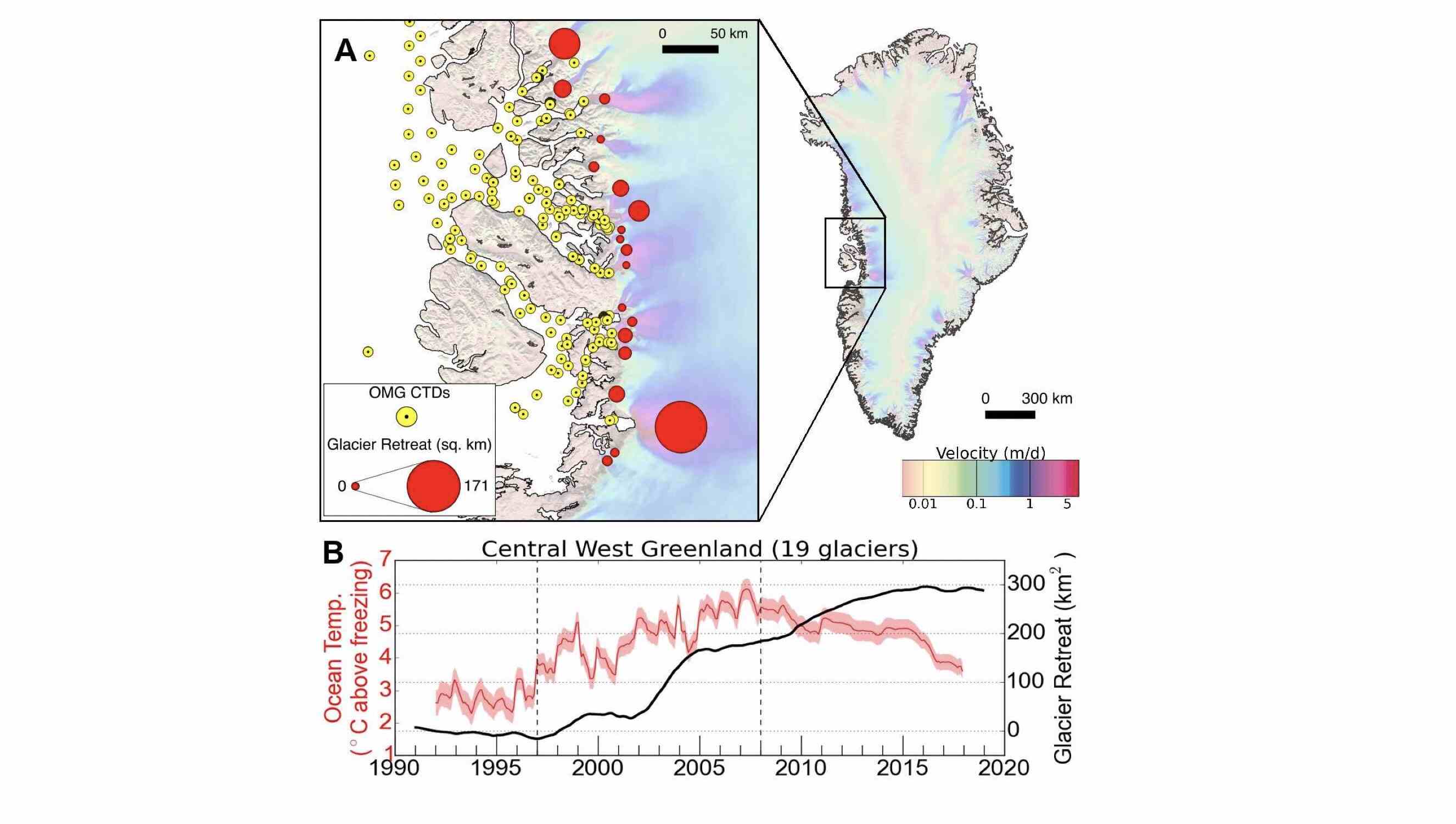
A recent study (Wood et al. 2021) used this new OMG ocean data in combination with Estimating the Circulation and Climate of the Ocean (ECCO) ocean models, remotely-sensed measurements of glacier retreat, and airborne measurements of ice thinning to investigate how subsurface ocean temperature variations have changed 226 glaciers over the past 30 years. This new research shows that glaciers in deep fjords with access to warm water, which account for about half of Greenland’s ice loss, are particularly vulnerable to ocean warming. In fact, nearly all of Greenland’s glaciers that flow into deep fjords retreated following a pattern of widespread ocean warming that began in the early 2000s.
In the figure above, the inset box (inset A) highlights Greenland’s central west coast — home of several large and rapidly flowing glaciers draining the ice sheet. Red circles indicate the magnitude of ice loss while the yellow circles show the locations of key OMG measurements that were used to calculate glacier melt from warm seawater. The plot (inset B) compares glacier retreat with ocean temperature through time, showing that retreat began after several years of ocean warming. For information on glaciers in other regions of the Greenland Ice Sheet, see Wood et al. 2021.
Related Links
- Major Greenland Glacier Is Growing
- NASA's Greenland Mission Still Surprises in Year Four
- New Greenland Maps Show More Glaciers at Risk
References
- Wood, M., Rignot, E., Fenty, I., An, L., Bjørk, A., Broeke, M. van den, et al. (2021). Ocean forcing drives glacier retreat in Greenland. Science Advances, 7(1), eaba7282. doi:10.1126/sciadv.aba7282
- Khazendar, A., and Coauthors, 2019: Interruption of two decades of Jakobshavn Isbrae acceleration and thinning as regional ocean cools. Nat Geosci, 12, 277–283. doi:10.1038/s41561-019-0329-3
- Morlighem, M., Williams, C. N., Rignot, E., An, L., Arndt, J. E., Bamber, J. L., et al. (2017). BedMachine v3: Complete Bed Topography and Ocean Bathymetry Mapping of Greenland From Multibeam Echo Sounding Combined With Mass Conservation. Geophysical Research Letters, 44(21), 11,051-11,061. doi:10.1002/2017gl074954
- Fenty, I., Willis, J., Khazendar, A., Dinardo, S., Forsberg, R., et al. (2016). Oceans Melting Greenland: Early Results from NASA’s Ocean-Ice Mission in Greenland. Oceanography, 29(4), 72–83. doi:10.5670/oceanog.2016.100