Funded principally by NASA with support from other U.S. agencies and European partners, the project involved two field campaigns and a series of cruises in regions of the Atlantic and Pacific Oceans exhibiting salinity and precipitation extremes (Figure 1). SPURS employed a suite of state-of-the-art in-situ sampling technologies that, combined with remotely sensed salinity fields from the Aquarius/SAC-D, Soil Moisture Active Passive (SMAP), and Soil Moisture and Ocean Salinity (SMOS) satellites, provided a detailed characterization of salinity structure over a continuum of spatio-temporal scales. The coupling of resulting data with physical oceanographic models is a further distinguishing feature of SPURS synthesis activities, which aim to understand underlying physical processes at work.
SPURS
The Salinity Processes in the Upper Ocean Regional Study (SPURS) project was a series of science process studies and associated oceanographic field campaigns that aimed to elucidate key mechanisms responsible for near-surface salinity variations in the oceans. In particular, SPURS sought to quantify the relative significance of circulation, evaporation, precipitation over a range of scales for representative areas of the open ocean. In so doing, it addresses the fundamental role the ocean plays in global water cycle budgets and its relationship to climate.
Principal Investigator
Partners
Data Centers
Funding Programs
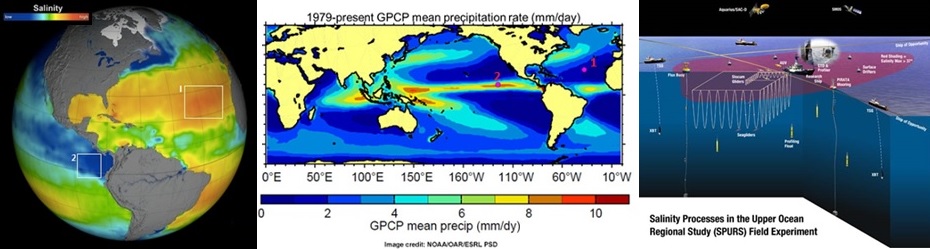
Figure 1: Left: Global annual map of surface ocean salinity from Aquarius indicating SPURS-1 and 2 campaign sampling areas within salinity maximum and minimum regions of the subtropical N. Atlantic and Eastern Tropical Pacific respectively. Middle: Global precipitation patterns showing the location of the SPURS-1 and 2 campaigns in low and high rainfall regions respectively. Right: The SPURS sensor-web illustrating the integrated use of diverse sampling platforms and instrumentation to provide coverage over a continuum of scales.
| Study Dates | Aug. 16, 2012 - Nov. 17, 2017 |
|---|---|
| Season of Study | Year round |
| Region | Subtropical North Atlantic Ocean, Tropical Eastern Pacific Ocean |
| Spatial Bounds | N: 43°N S: 5°N W: 158°W E: 14°W |
| Focus Areas | Climate Variability and Change |
| Geophysical Concepts | Ocean Properties and Processes |
| Scientific Topics | Salinity Sea Surface Salinity Salinity Processes Upper Ocean Properties |
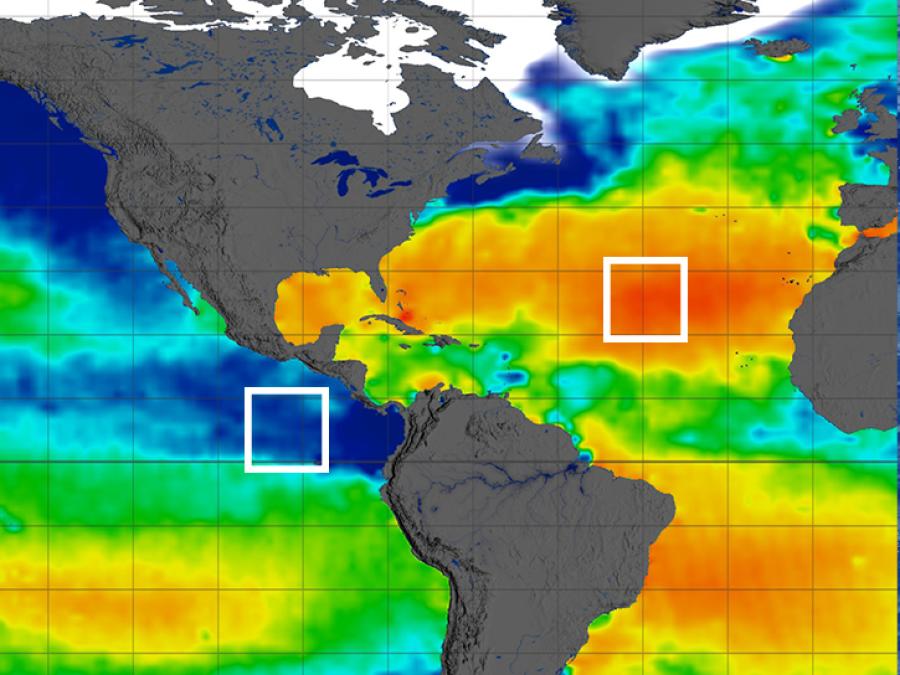
The SPURS-1 campaign involved a series of 5 cruises during 2012 - 2013 seeking to resolve the salinity structure and balance in a high salinity, high evaporation, and low rainfall region of the subtropical North Atlantic. The specific purpose of the experiment was to examine the processes responsible for maintaining the subtropical surface salinity maximum in this region. An array of advanced sampling technologies were employed providing a detailed understanding of salinity structure within a 900 x 800-mile square study area centered at 25N, 38W. The location of the SPURS-1 study site is in the salinity maximum region of the subtropical N. Atlantic with tracks for the R/V Knorr, Endeavor and Sarmiento cruises overlaid on a map of remotely sensed salinity data from Aquarius (salinity high values of 37 PSU represented in deeper orange).
Cruises
The table below summarizes the dates of the SPURS-1 cruises and research vessels involved. Full cruise reports have been issued for the U.S. cruises and the Sarmiento cruise.
Sampling Platforms and Technologies
A suite of sampling platforms and sensors were deployed during SPURS-1 providing multivariate observations, both ship-based and autonomous, Eulerian (point) and Lagrangian (trajectory), over a range of spatio-temporal scales within the campaign’s domain.
SPURS-2 was a follow-on field campaign over the period August 2016 to November 2017 aiming to better understand physical processes influencing upper-ocean salinity over the seasonal cycle in a low-salinity region of the eastern tropical Pacific (ETP) centered at 10N, 125W (Figure 1). This is a dynamic, rainfall-dominated area associated with western edge of the eastern Pacific fresh pool and intertropical convergence zone (ITCZ). It exhibits a shallow thermocline and is subject to high seasonal variability and strong zonal flows associated with the North Equatorial Current and Countercurrent. Processes operating on a continuum of scales and the challenges of sampling such a spatially heterogeneous and temporally variable region necessitated a nested survey design involving a suite of in-situ measurements from diverse sampling platforms, guided by a data-assimilating ROMS regional ocean circulation model and satellite observations from SMAP and SMOS. Instrument deployments occurred during two month-long cruises by the R/V Roger Revelle (the “Revelle”, Scripps Institution of Oceanography, University of California, San Diego). The R/V Lady Amber visited the site on a more frequent basis for light sampling and deployment and recovery of instrumentation. This approach facilitated the examination of processes influencing surface salinity variability operative at three different scales:
- Large Scale: The purpose here is to characterize processes that freshen and salinity the upper ocean in the ITCZ region and connect it to the eastern Pacific fresh pool.
- Mesoscale: A smaller observational region surrounding the central SPURS-2 site was sampled to resolve scales from 10-300 km. This scale includes eddies which act to stir the salinity field. Numerical modeling studies were especially important at this scale.
- Small-scale: The smallest scales observed are less than 10 km. Precipitation is expected to be patchy at this scale. SPURS-2 especially focuses on how intense rainfall bursts are dispersed vertically and horizontally.
Cruises
The table below summarizes the dates of the SPURS-2 cruises and research vessels involved. Full cruise reports have been issued for the Revelle cruises.
Sampling Platforms and Technologies
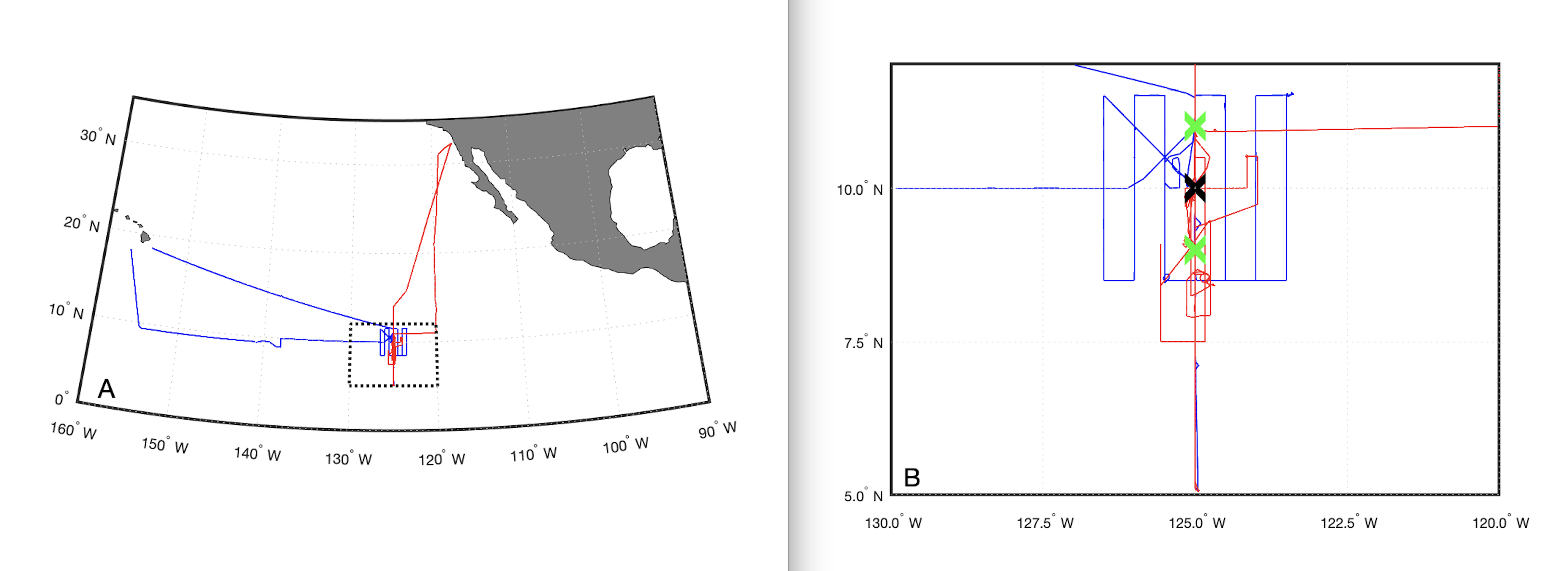
A suite of sampling platforms and sensors were deployed during SPURS-2 providing multivariate observations, both ship-based and mobile, Eulerian (point) and Lagrangian (trajectory), over a range of spatio-temporal scales within the campaign’s domain. Figure 1 illustrates the Revelle cruise tracks and SPURS-2 domain focused on the central mooring at 10N, 125W and bounded latitudinally by two Platform Instrumentation for Continuous Observations (PICO)/ Prawler moorings.
SPURS-1
- Campaign Planning Documents
- Data Documentation
- Cruise Reports
- Instrument Deployment Mapping KML
- Instrument Inter-calibration Report
SPURS-2
- Campaign Planning Documents
- Cruise Reports
- Data and Instrument Report
- Dataset DOI & Reference Table
Meeting Materials
The following resources provide additional information about the SPURS project.