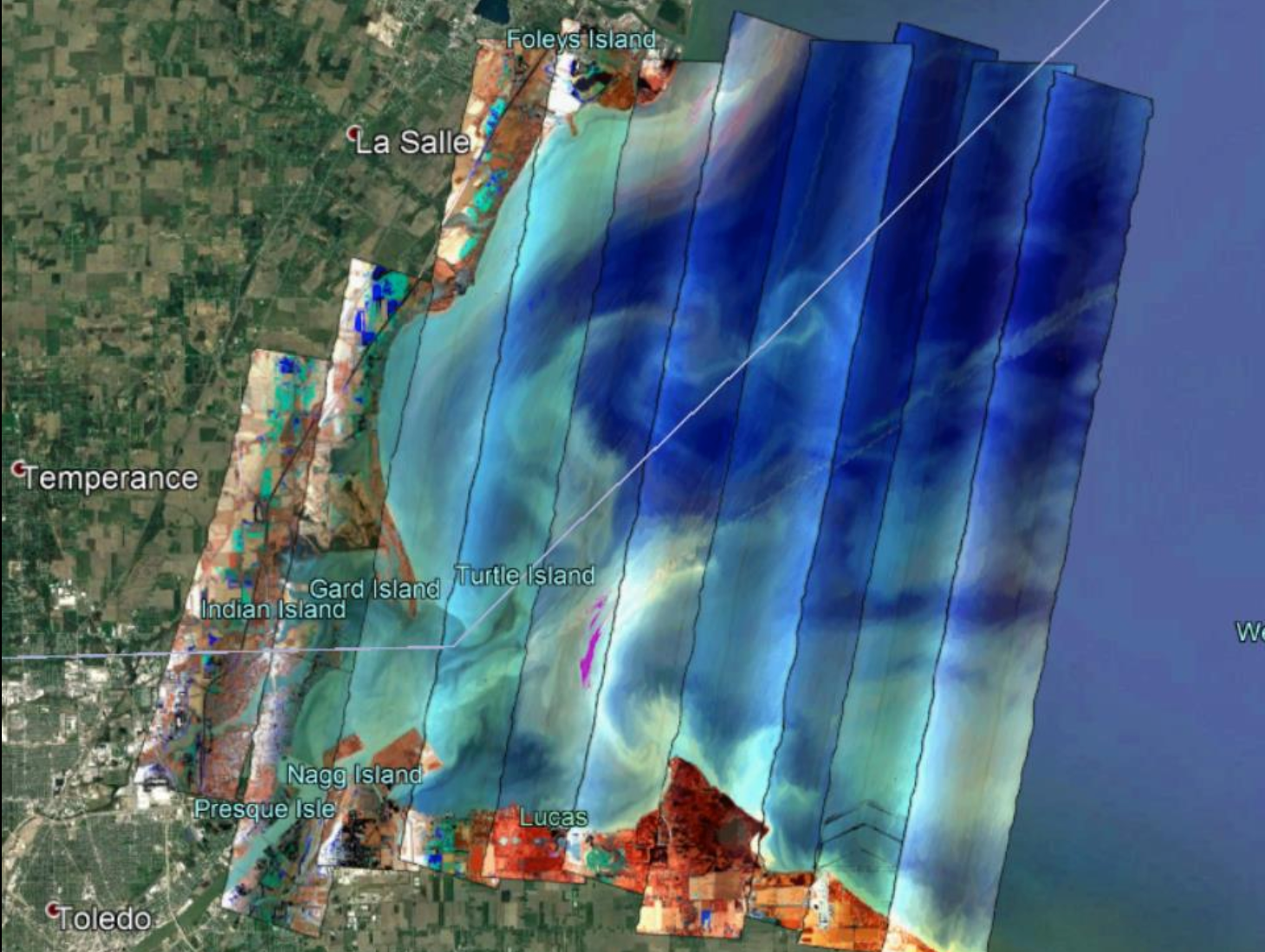
The Hyperspectral Imaging of Harmful Algal Blooms in Lake Erie (HSI-HABS) project collected visible to near-infrared hyperspectral data with a custom-made hyperspectral imager (HSI) aboard aircraft at NASA's Glenn Research Center (GRC). Data was processed to a georeferenced spectral irradiance in units W/(m2∙sr∙nm).
The spectral resolution has been resampled to 400-900 nm at 10 nm steps. The ground resolution while aircraft altitude dependent was typically 1 m per pixel.
Ground in-situ sampling data was collected from external research partners from Kent State University, University of Toledo, University of Cincinnati, Michigan Tech Research Institute, Bowling Green State University, and others. Radiometer data includes solar irradiance, ground/water radiance, and calibrated target radiance. Additionally, water samples were taken at specific waypoints and analyzed in the laboratory.
GRC Aircraft remote sensing data is readily available for western Lake Erie from 2015 to 2019. Access the HSI-HABS-RAW directory.