Field Support Group Facilities

NASA's Field Support Group manages facilities including the Ocean Ecology Lab and the Ocean Biogeochemistry Lab.

The Field Support Group (FSG) at NASA's Ocean Biology Distributed Active Archive Center (OB.DAAC) is responsible for collecting optical (inherent and apparent optical properties) and biogeochemical field data in support of NASA's satellite ocean color missions. Specifically, these data are used in operational instrument calibration, data product validation, and algorithm development activities. 

The FSG participates in cruises of opportunity that are vetted with the NASA Ocean Biology and Biogeochemistry (OB&B) Program Manager (Dr. Laura Lorenzoni) and a five-member advisory committee representing other U.S. agencies and the U.S. and international research communities. 

The FSG is also involved in the refinement of field measurement protocols for the various optical and biogeochemical properties it collects. All data collected by the FSG are quality assured and ingested into SeaBASS, the permanent archive for bio-optical data collected under the auspices of the NASA OB&B. Upon ingestion, these data become publicly accessible to the research community.
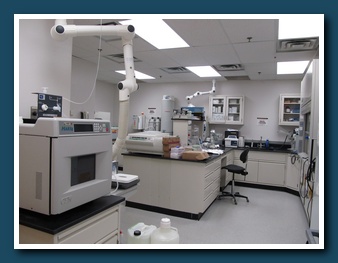
Ocean Ecology Lab

Image
Image Caption

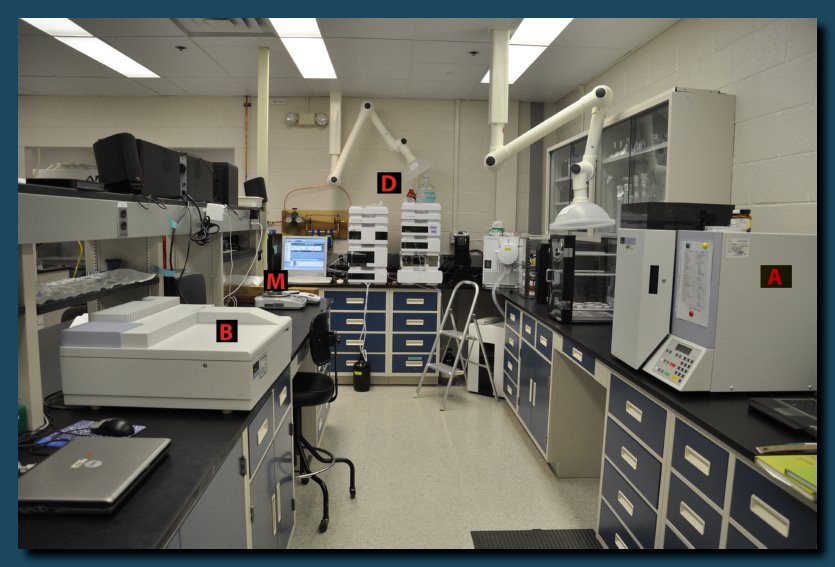
A: Perkin Elmer 2400, CHNS/O Series II elemental analyzer
Measures: Particulate organic carbon (POC), Particulate organic nitrogen (PON)
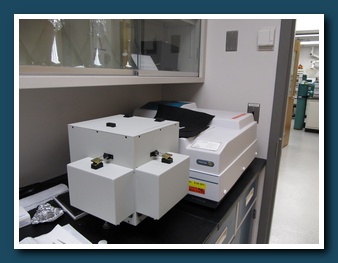
B: Perkin Elmer Lambda 35 UV/Visible spectrophotometer
Measures: Absorption (particulate ap, phytoplankton aph, non-algal particles, ad, chromophoric dissolved organic matter, acdom)
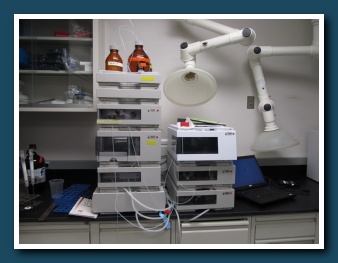
D: Agilent 1200 series Rapid Resolution HPLC system, 6130 Quadripole mass spectrometer
Measures: Phytoplankton pigments
M: Ohaus N12120 & Mettler Toledo analytical balances (±0.01g)
For: Reagent preparation

Image
Image Caption

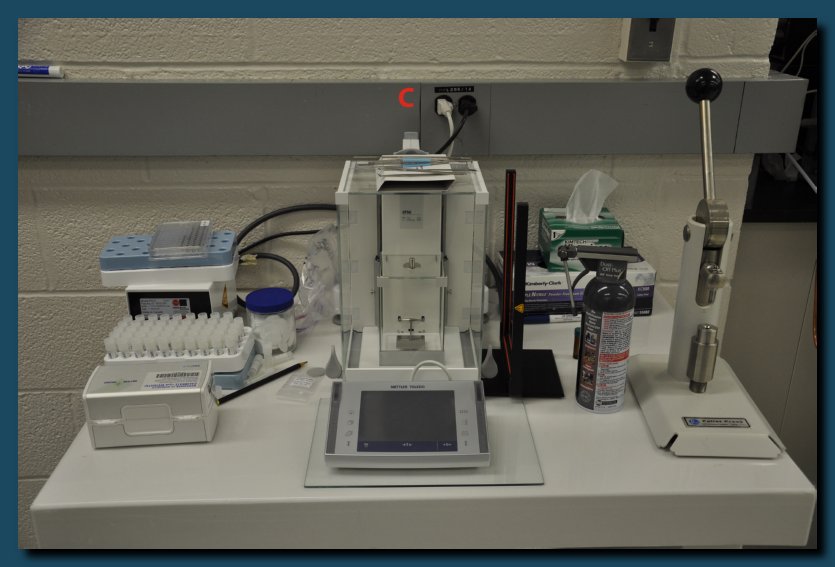
C: Mettler Toledo XP26 microbalance
Measures: Suspended particulate matter (SPM)

Image
Image Caption

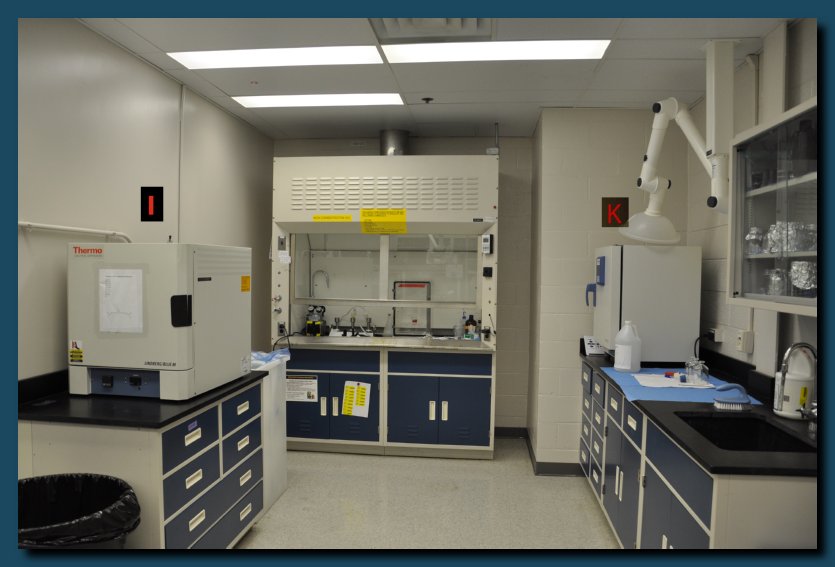
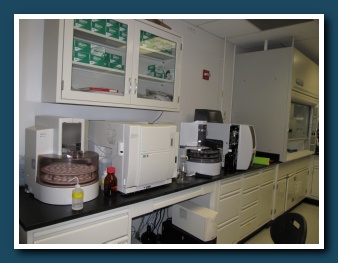
I: Lindberg/Blue M box furnace
For: Glassware combustion for carbon & CDOM sample processing
K:Thermo Heratherm OGH60 oven
For: Sample drying and processing

Image
Image Caption

E: Turner 10 AU benchtop fluorometer (2) with in vivo and extractive chl-a kit and optical kits (2) for extractive chl-a, 1 UV solid standard.
Measures: Chlorophyll-a (chl-a)
G: Revco upright -20° C freezer
For: Sample storage
H: Barnstead upright refrigerator with -20° C freezer
For: Sample storage

Image
Image Caption

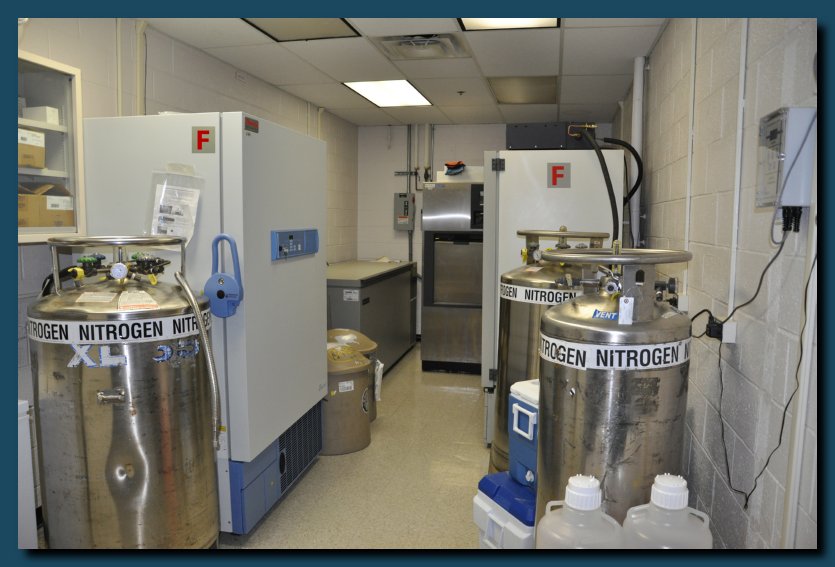
F: Revco Ultima-II -80° C freezer (2) with liquid nitrogen emergency backup system
For: Sample storage

Image
Image Caption

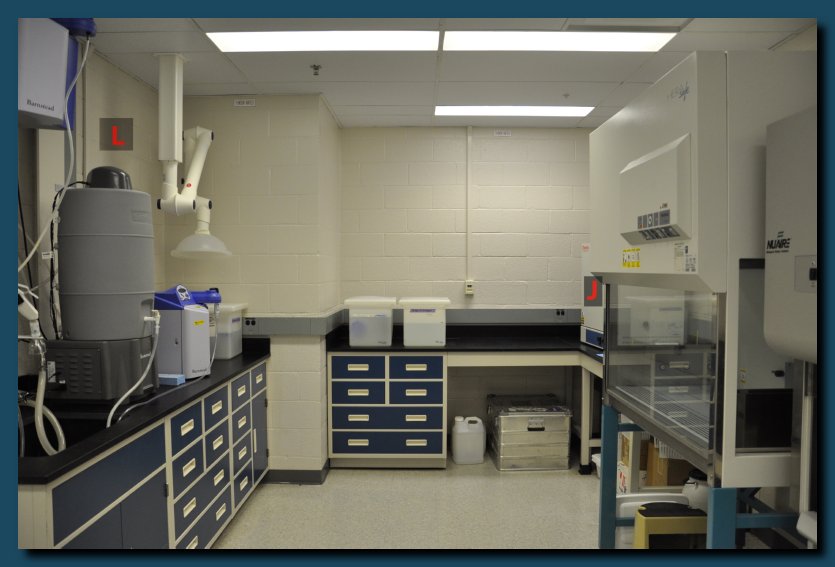
J: Lindberg/Blue M mechanical convection oven
For: Glassware drying
L: Barnstead Diamond-II Nanopure water purification system
For: Deionized water generation

Ocean Biogeochemistry Lab

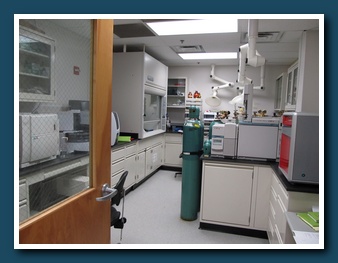
An ocean biogeochemistry laboratory was constructed for Antonio Mannino in 2002 in building 22, room C237 at NASA's Goddard Space Flight Center. The focus of the research is to study the distributions, sources, and sinks of dissolved (DOM) and particulate organic matter (POM) in the ocean to enhance our understanding of the carbon cycle. 

A primary objective is to link the optical properties of DOM and POM (such as absorption, scattering, and fluorescence) to carbon in the ocean to be able to examine the carbon cycle using ocean color satellite measurements. Development and validation of ocean color satellite biogeochemistry products are key components of the research program. All facilities and instrumentation within the Ocean Biogeochemistry Lab are available to support the activities of the Field Support Group.

Image
Image Caption

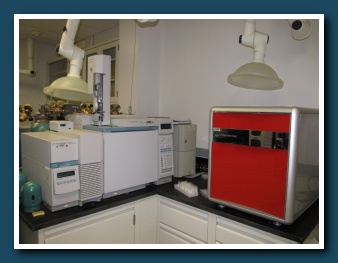
Analytical lab with:

Shimadzu TOC-V and TOC-L instruments with TN modules and autosamplers for analysis of dissolved organic carbon and total nitrogen (left)

Agilent 1100 Series High-Performance Liquid Chromatograph (HPLC) with micro-vacuum degasser, quaternary pump, thermostatted autosampler, thermostatted column compartment, fraction collector, photo-diode array and fluorescence detectors for analysis of phytoplankton pigments, mycosporine-like amino acids, proteins, amino acids, black carbon, etc. (back)

Agilent Gas Chromatograph-Mass Spectrometer 6890-5973i (GC-MS) for analysis of lignin phenols, lipids, amino acids, etc. (front center)

Elementar Vario-Micro Cube CHNS elemental analyzer for the analysis of particulate carbon, nitrogen and sulfur (red cube on right side)

Image
Image Caption

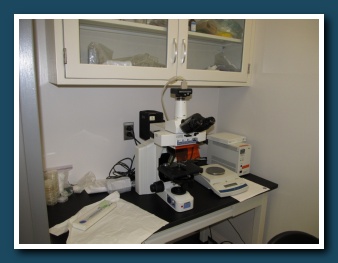
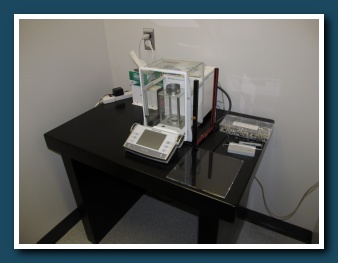
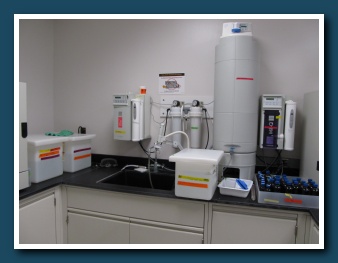
Main lab area for sample preparation and glassware/plasticware cleaning equipped with: 

Millipore Elix-10 and Milli-Q UV ultra-pure water system

CEM MARS-X microwave extraction system

Fisher ultrasonic cell disruptor

Sorvall Legend RT centrifuge

ThermoSavant SPD 1010 speedvac system

drying ovens and furnaces

Mettler Toledo AX26 microbalance with antistatic module

Nikon E600 epifluorescence microscope with digital camera and imaging software

Image
Image Caption

Optical lab with:

Ultrapath UP-UV system for analysis colored dissolved organic matter (CDOM) absorbance through long pathlengths (2 m and 0.5 m)

Image
Image Caption

Optical lab with:

Cary 100 UV-Vis spectrophotometer with internal and external integrating spheres (right photo) for analysis of CDOM and particle absorbance.

Image
Image Caption

Analytical lab with:

Shimadzu TOC-V system (left) and TOC-L system (right)

Image
Image Caption

Analytical lab with:

Agilent 1100 Series HPLC

Image
Image Caption

Analytical lab with:

Agilent GC-MS (left) and Elementar Vario-Micro Cube (right)

Image
Image Caption

Main lab with:

Nikon E600 epifluorescence microscope

Image
Image Caption

Main lab with:

Mettler Toledo AX26 microbalance with antistatic module

Image
Image Caption

Main lab with:

Millipore Elix-10 and Milli-Q UV ultra-pure water system

Image
Image Caption

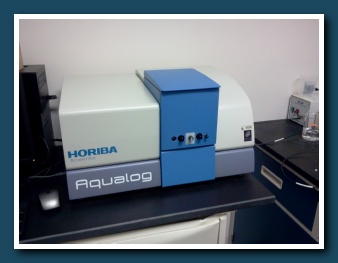
Horiba Aqualog instrument for simultaneous measurement of CDOM fluorescence (excitation-emission matrices) and absorbance