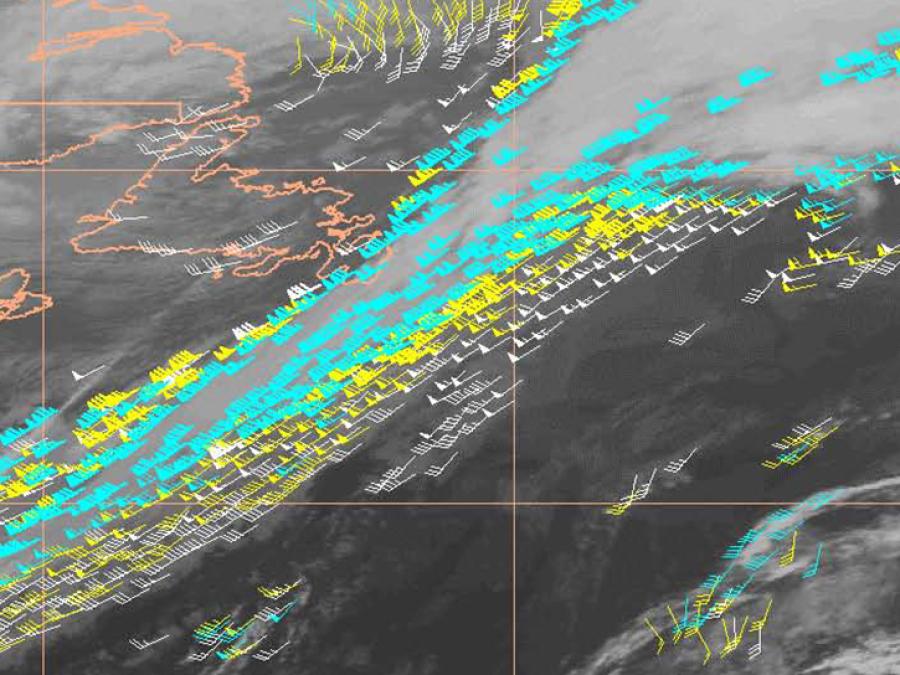
GOES image of mid troposphere rapid scan Atmospheric Motion Vectors (AMVs) during ATReC observation period 12, day 1, 13 November 2003
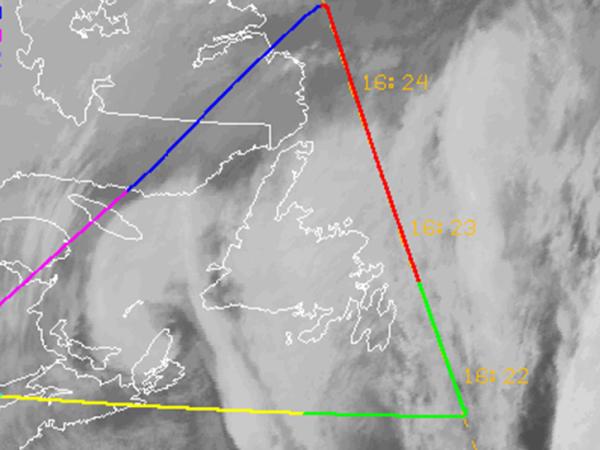
ER-2 track on GOES visible image, 3 December 2003
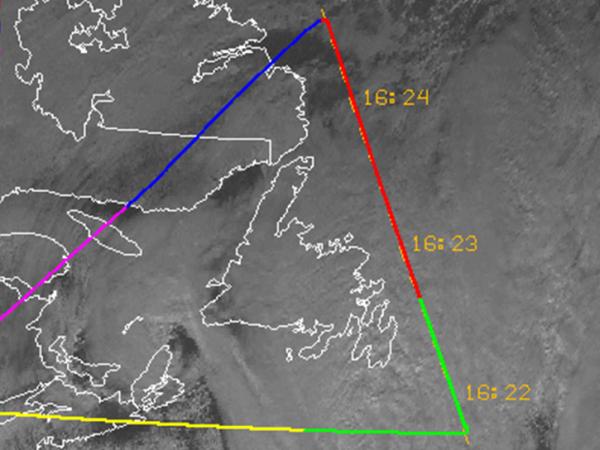
ER-2 track on GOES infrared image, 3 December 2003

ATOST

Atlantic - THORpex Observing System Test

The Atlantic – THORpex Observing System Test (ATOST) was a test field campaign conducted as a part of an extensive international research program that sought to provide information for use in meteorological forecasting to allow for better responses to severe weather events. 

ATOST contributed to the EUMETNET Composite Observing System (EUCOS) Programme and The Observing System Research and predictability experiment (THORpex), which both sought to test the hypothesis of whether having additional observations over oceanic storm tracks and other remote areas would improve errors in meteorological forecasting. THORpex was a 10-year Global Atmospheric Research Programme established by the World Meteorological Organization’s Weather Research Program.

Data Centers

ASDC

ATOST ran from October through December 2003, as one of three THORpex Observing System Tests (TOSTs) conducted in that year. These TOSTs served to test different types of observing systems in preparation for the THORpex Global Prediction Campaign. The TOSTs included the experimental and operational use of remote sensing and in-situ observing systems, and analyzed the impacts of the use of these systems on data assimilation and forecast creation. 

ATOST was conducted in winter due to the high potential for severe weather events in the season and the resultant high potential for human impacts from those severe weather events, such as damage to people or property. The geographic focus of ATOST was on the North Atlantic Ocean and Europe.

ATOST relied on data from an extensive set of platforms, including 600 aircraft provided through the EUMETNET Aircraft Meteorological Data Relay, 13 European ships, and additional radiosonde ascents from European, Eastern U.S., and Canadian stations. Various research aircraft, such as the DLR Falcon, two NOAA P3’s, the NOAA G-4, and the NASA ER-2, provided dropsondes. The European Group on Ocean Stations deployed drifting buoys. Satellite observations, such as those from the EUMETSAT Meteosat-6 and NOAA GOES, were incorporated into ATOST as well.

ASDC houses measurements conducted during ATOST from the Enhanced MODIS Airborne Simulator (eMAS), an airborne scanning spectrometer aboard the NASA ER-2 aircraft used to acquire high spatial resolution imagery of cloud and surface features.

  • Test and perform real-time adaptive control of multiple observations using multiple platforms in order to inform future studies and identify potential areas for development in sampling strategies
  • Predict and study sensitive areas where additional observations would be necessary
  • Develop strategies and requirements for potential new observing systems
  • Provide starting data in order to conduct impact studies in the future
  • Observe extra-tropical transitions of tropical cyclones to improve future predictions
PlatformInstrument
ER-2Enhanced MODIS Airborne Simulator (eMAS)