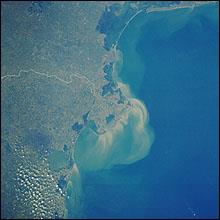
Estuaries tend to be highly productive areas, where the larvae of many fish species spend their first part of their life cycle. Furthermore, estuaries frequently have high concentrations of organisms that are utilized by fish for food, such as shrimp. Estuaries can also have numerous bottom-dwelling (or benthic) organisms such as oysters, crabs, clams, and scallops. These crustaceans and mollusks, many of which are called filter-feeders because they filter the water of the estuary to remove digestible particles. Thus, pollutants in the particles can be concentrated in their tissues. Because these organisms are frequently food for other marine organisms (or humans) pollutants in these sediments can be transferred up the food chain.
Another interesting aspect of estuaries is their chemical behavior. As fresh water mixes with salt water, dissolved metals (particularly iron) will form microscopic particles called flocculants, or flocs. Because they have a large surface area due to their diffuse "fluffy" nature, flocs can also adsorb pollutants. As they settle, they will also take harmful materials with them into the sediments. Thus, estuaries can act as filters for water entering the sea, but these areas will therefore be particularly sensitive to many types of pollution discharged into rivers.
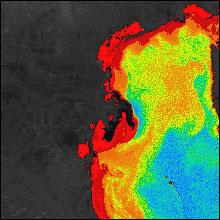
Estuaries are usually quite shallow, tend to have very turbid water, and are surrounded by land. Most estuaries thus pose difficult problems for ocean color data acquisition. However, they are also highly productive areas, which makes them of significant interest to biological oceanographers. In most images of estuaries, such as numerous CZCS images of the Chesapeake Bay, the algorithm that calculates the pigment concentration fails due to a combination of productivity, suspended sediments, and shallow water. So most estuaries appear red on the CZCS false color scale, indicating high pigment concentrations, which may or may not be true. (In the CZCS image of the Po River plume, the reflectivity of the sediments was so high that the data processing algorithm interpreted part of the plume as land, which appears black in the image.)
Optical water type classification
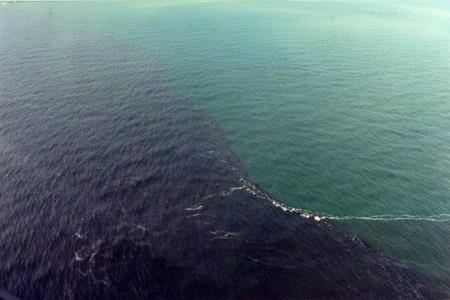
Scientists who study ocean optics have classified water into two basic optical types: Case 1 and Case 2, as defined by Morel and Prieur. Case 1 waters are usually in the open ocean, are very clear, and have low primary productivity. Case 2 waters are usually found near the shore, and have highly variable clarity due to a combination of higher productivity and suspended particulates. Determining accurate measurements of photosynthetic pigments in Case 2 waters is a significant challenge to ocean color scientists. Another aspect of Case 2 waters is the water depth, as light reflecting off the bottom in shallow water creates an optically-bright area. Because of these factors, extracting the pigment (and chlorophyll) signal in Case 2 waters is a complex problem. Due to the higher productivity in coastal areas, it is an important problem to solve.
If the volume of a river is particularly large, for rivers such as the Mississippi or Amazon, turbid sediment plumes can be transported long distances before dissipating. After huge 1993 floods in Iowa and Missouri, the plume of sediment disgorged from the Mississippi River could be observed from space using data from the Advanced Very High Resolution Radiometer (AVHRR). The plume of sediment extended almost 300 km from the Mississippi River delta in Louisiana. Ocean color data could be used to observe similar phenomena.