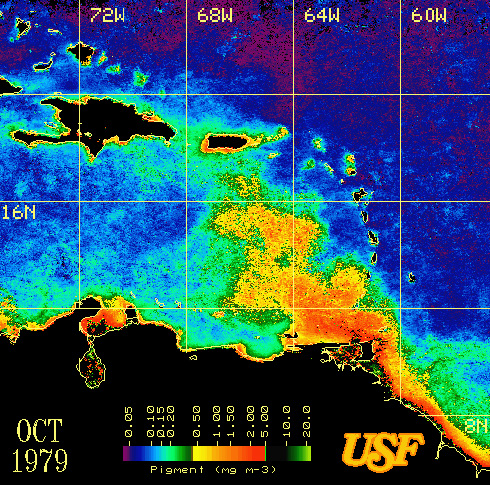
The Orinoco River delta is located along the coast of Venezuela, where the river flows into the southern Caribbean Sea just east of Trinidad and Tobago. The drainage basin of the Orinoco comprises most of the countries of Venezuela and Colombia, and part of the northern region of Brazil.
During the rainy season, the fresh water of the Orinoco flowing into the Caribbean Sea is carried to the northeast by the predominant currents flowing along the South American coast. The river outflow is enriched in nutrients, and because it is less dense than seawater, the fresh water remains at the surface, breaking up into lenses of less saline water. The nutrients in the river waters stimulate phytoplankton growth, so that a plume of higher productivity waters can be observed emanating from the Orinoco delta into the Caribbean Sea.
Note: While increased phytoplankton productivity was initially thought to be the main cause of the higher concentrations of photosynthetic pigment in the Orinoco River plume, more research indicated that the situation was not so simple. Another factor is that the river carries high concentrations of colored dissolved organic matter (CDOM). CDOM can mimic photosynthetic pigments, as it also absorbs light similarly to chlorophyll. The research, using water samples and satellite observations with instruments more sensitive than CZCS, showed that the plume is a mixture of phytoplankton, whose growth is induced by higher nutrient concentrations, and CDOM.
The image shown here illustrates the extent of the Orinoco River plume. It is evident from this image that the seasonal productivity increase due to the discharge of the river extends over much of the southern Caribbean Basin. Near Venezuela, some of this productivity is carried over the Cariaco Trench, which due to a high input of organic matter, is an anoxic ("no oxygen") basin. The anoxic characteristics of the Cariaco Trench make it ideal for the preservation of organic material, so that the seasonal changes in productivity due to the Orinoco River discharge are recorded in the sediments of the Cariaco Trench. The study of the sediments in the basin, and the seasonal variation in the flux of organic matter, allows detailed research into the climatic history of this region of the ocean.