Gulf Stream Rings

Chapter 7 of CZCS Classic Scenes

Classic CZCS Scenes 

Chapter 7: Gulf Stream Rings 

In the image of the Gulf Stream that illustrated the previous chapter, several circular features above and below the Gulf Stream itself were particularly conspicuous. These features are referred to as Gulf Stream rings or eddies, and they are important aspects of the physical oceanography of the western North Atlantic Basin. 

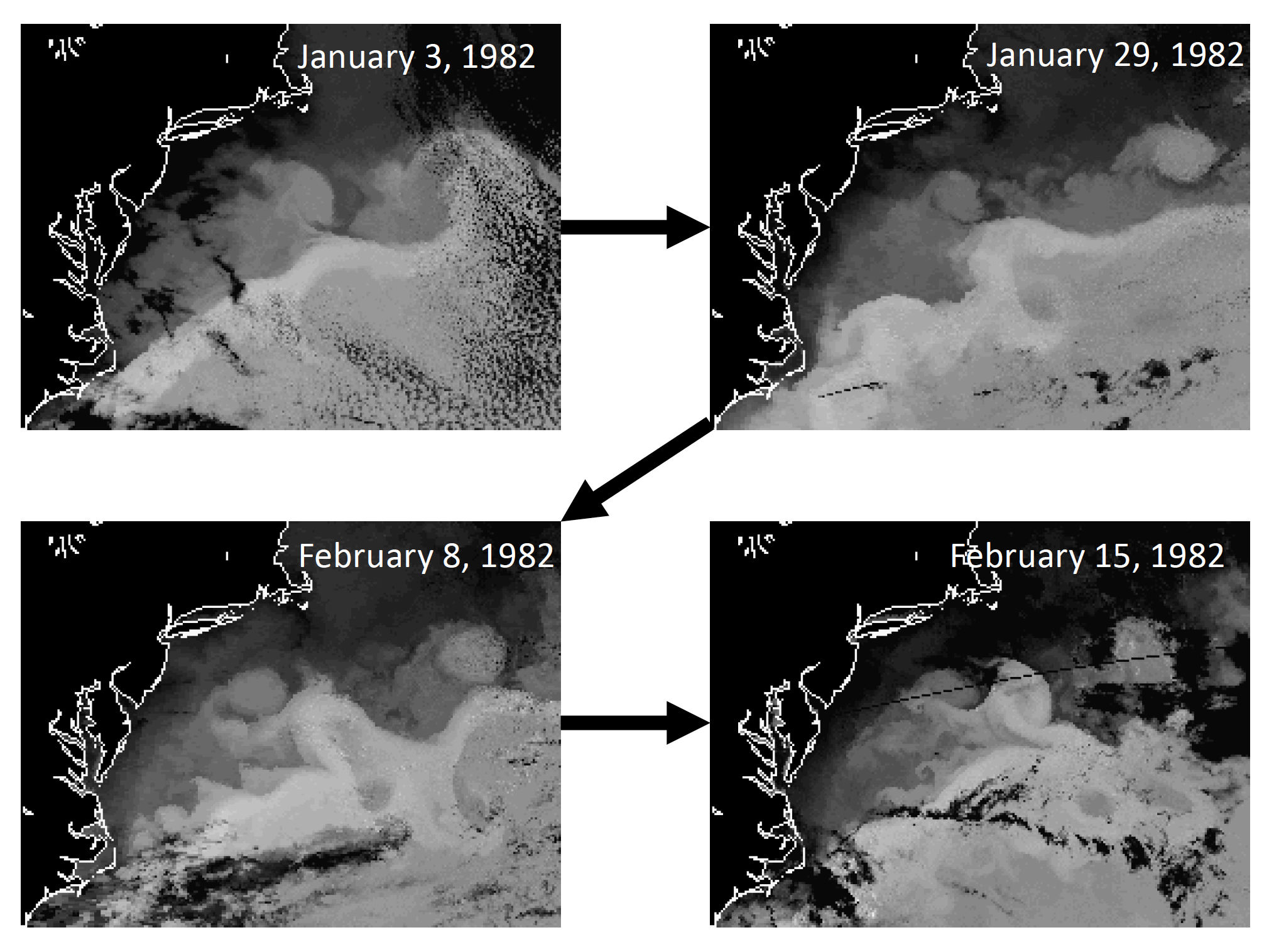
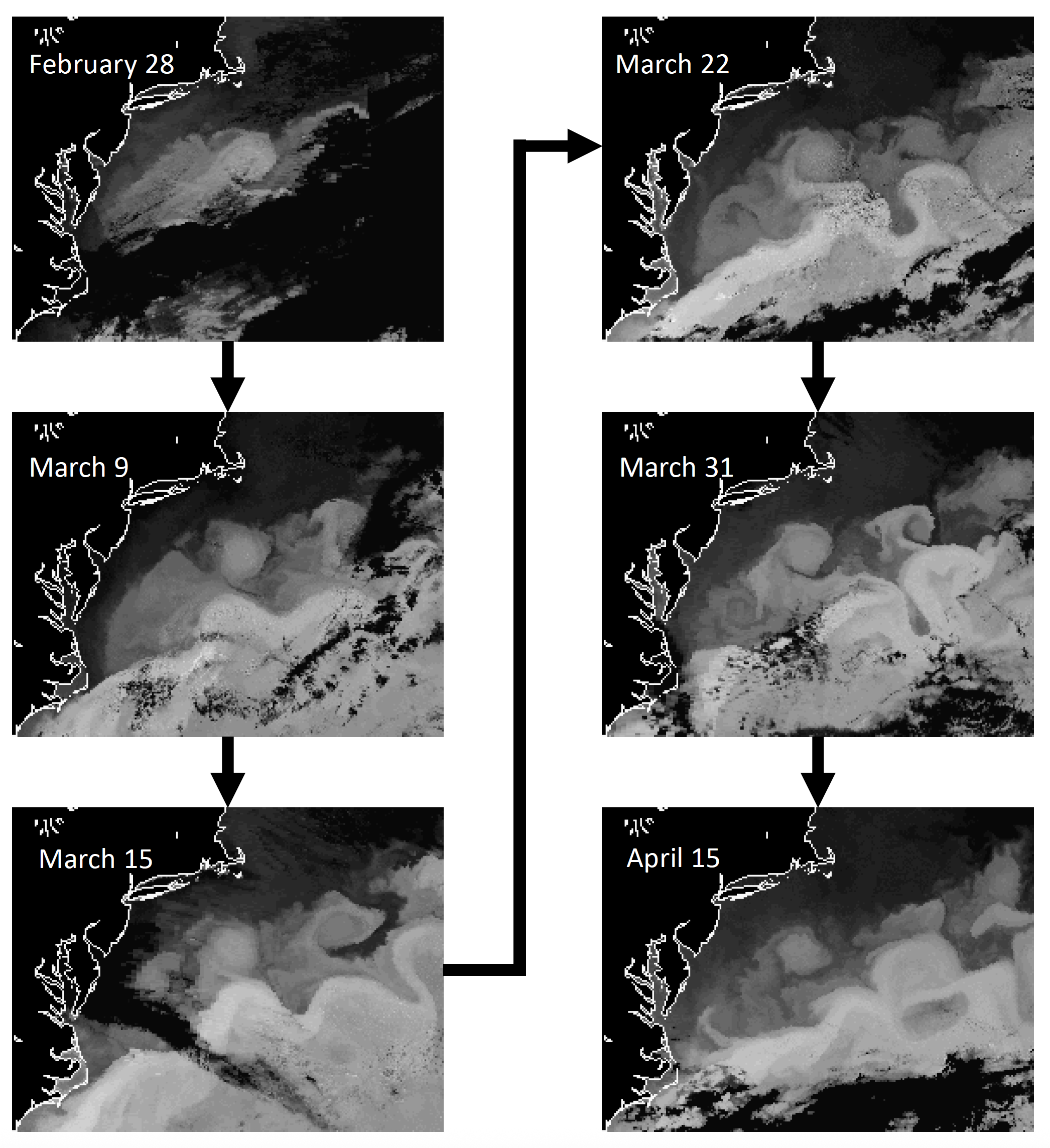
Rings form when a meander in the Gulf Stream becomes a loop, lengthens and constricts upon itself, then "pinches off" and separates from the current. Meanders can form in both northward and southward directions, and the formation of these features can be observed regularly in sea surface temperature data. If the meander projects southward, into the Sargasso Sea, the center of the loop is composed of colder, more productive water from the continental shelf. If a ring forms by this process, it is termed a "cold core" ring, because the center of the ring will be a captured portion of cold water surrounded by warm water circulating in a counterclockwise direction. In contrast, if the loop forms northward, a portion of warm Sargasso Sea water is entrained in the center, and the feature will be termed a "warm core" ring, with a center of warm water surrounded by cold water circulating in a clockwise direction. The formation of both cold-core and warm-core rings in the same period of time as the CZCS image is shown in the sequence of AVHRR data below
Image
Image Caption

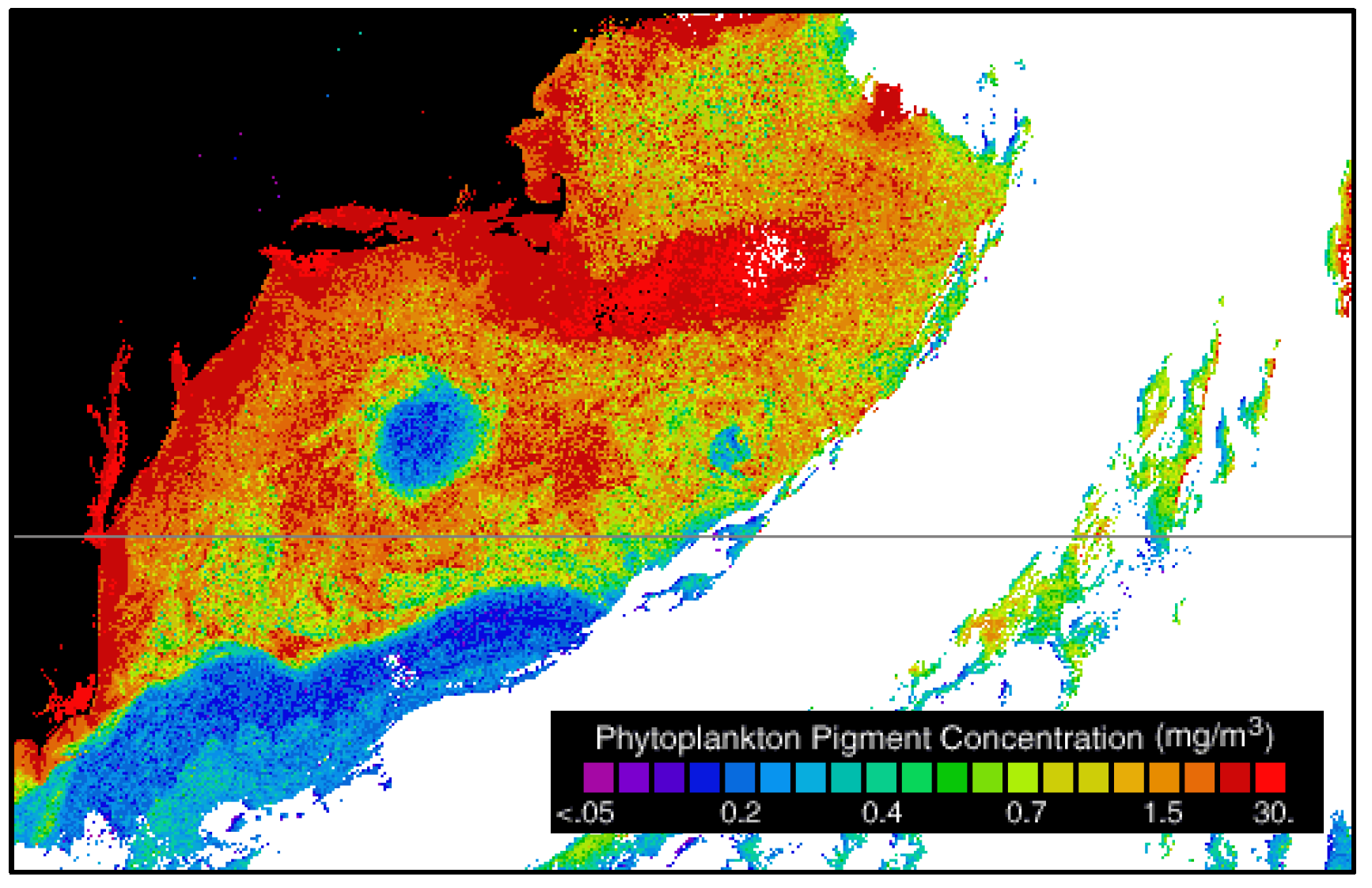
CZCS image of the Gulf Stream obtained on April 1, 1982, showing a prominent warm-core ring. This same ring can be seen in the image shown in chapter 6. Note that the central core waters have low pigment concentrations.

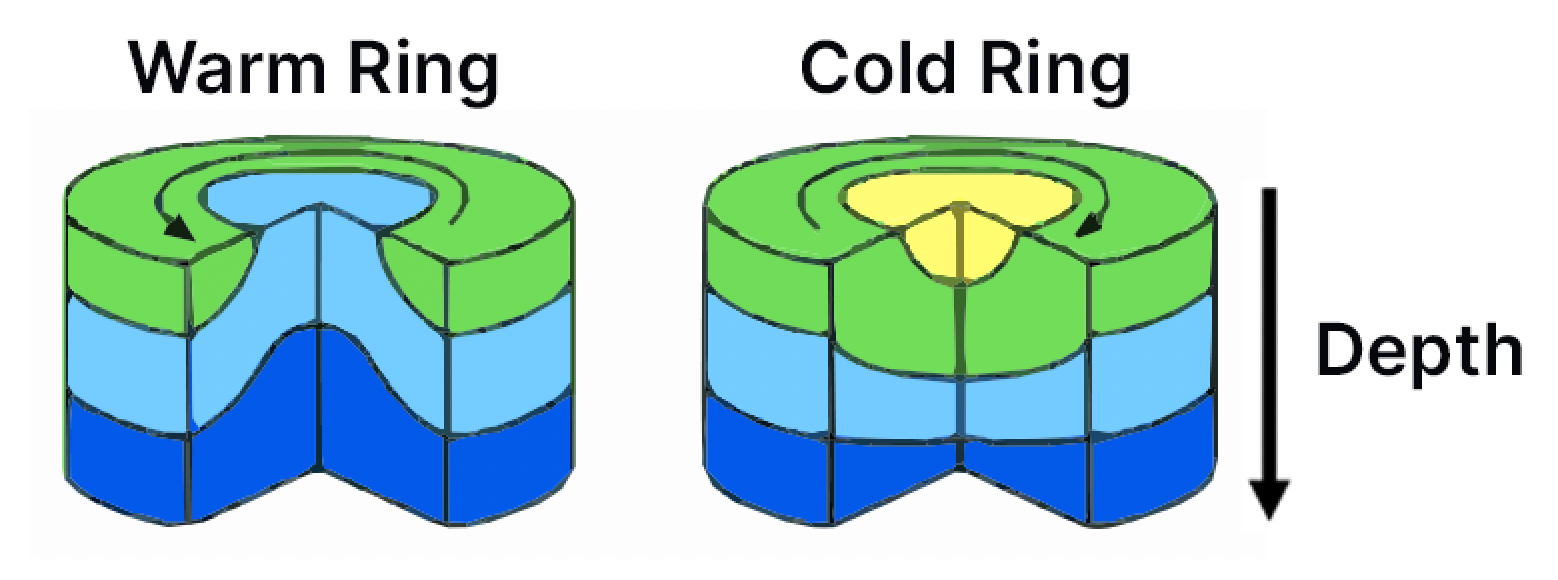
In general, the rings are about 100-300 km in diameter, and they extend to considerable depths. They should be visualized as concentric cylinders, rather than simply surface features. Rings are examples of mesoscale phenomena in the oceans, features that are smaller than the scale of an entire ocean basin (such as the North Atlantic), but which are still quite large and influential. The scale and persistence lifetime (which can be from months to a few years) of Gulf Stream rings were well-suited to the temporal and spatial resolution of the CZCS. 

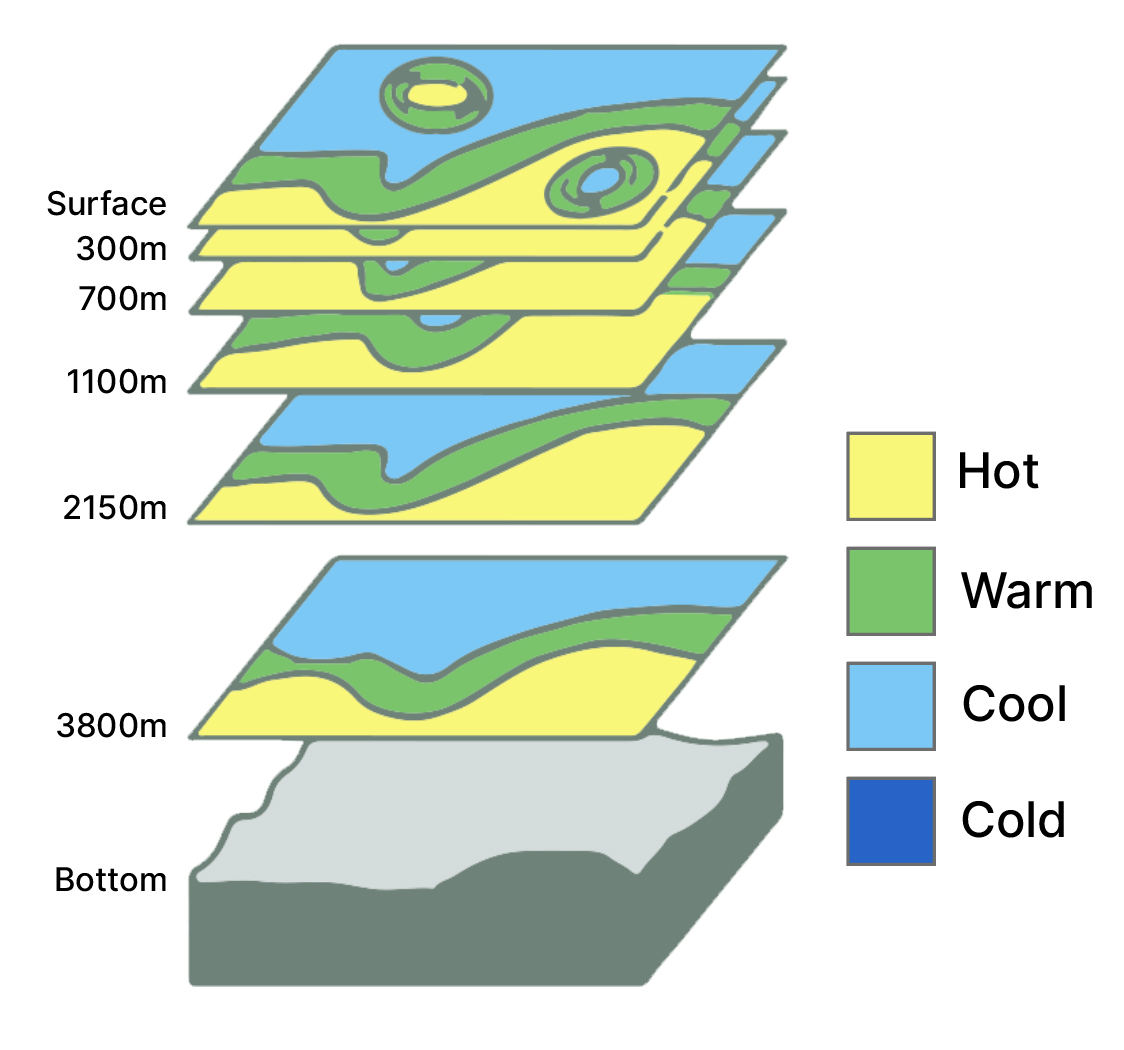
This figure shows a three-dimensional diagram of warm- and cold-core rings in relation to the Gulf Stream, with the warm-core rings north of the Gulf Stream and the cold core rings south of the Gulf Stream.

Image

This diagram shows the cylindrical structure of the rings and the relationship of the core to the temperature structure deeper in the ring.

Image

The biology of these rings has been the subject of a concerted research effort. This work examined how the communities of plankton (both phytoplankton and zooplankton) changed as the ring aged. The physical characteristics of the ring also changed -- the water in the core slowly mixed with the surrounding circulating ring, modifying to become warmer or colder depending on the type of ring. The mixing occurred from the bottom toward the top, so that the depth of the core became shallower. As this happened, the biological communities, which were initially very segregated between warmand cold-water communities, began to interact as well. The slow changes in the characteristics of the rings also show the interplay between the physics and biology of the oceans.

An interesting aspect of global oceanography can be seen if the Gulf Stream rings are compared to the prominent ring seen in the image of Tasmania in Chapter 1. Just like hurricanes in the Northern and Southern Hemispheres, ring systems in the Southern Hemisphere rotate in the opposite direction of those in the Northern Hemisphere. Thus, the ring off the eastern coast of Tasmania is a cold-core ring rotating clockwise, the same direction of rotation as a warm-core ring in the Northern Hemisphere. 

Rings (or eddies) are commonplace features in all ocean basins. The image of Tasmania shows one striking example (a closer examination may reveal many more). Rings serve as ways in which water from one basin can be transported into another basin, maintaining the thermohaline, i.e., temperature and salinity, balance in each ocean basin. In one sense, eddies act similarly to the way hurricanes act in the atmosphere, transporting energy away from intense zones of mixing. One of the most intense zones of mixing in the oceans, off the southern end of the African continent, will be the subject of Chapter 9. 

However, there is a small feature in the image of the Gulf Stream, located right next to the coast near New York City, that also deserves attention. This small feature will be discussed in the following chapter. 

The sequence of images below, from January to early March 1982, shows the formation of a warm-core ring similar to that in the CZCS image.

Image

The sequence from mid-March to mid-April shows the subsequent rapid development of a cold-core ring south of the Gulf Stream. Compare the March 31 AVHRR image with the CZCS image, and note the difference in the visibility of the two rings north of the Gulf Stream. All of the images were acquired in 1982.

Image