We are in the process of migrating all NASA Earth science data sites into Earthdata from now until end of 2026. Not all NASA Earth science data and resources will appear here until then. Thank you for your patience as we make this transition.Read about the Web Unification Project
ESDIS Weekly Metrics: March 2, 2026
Image
Note:
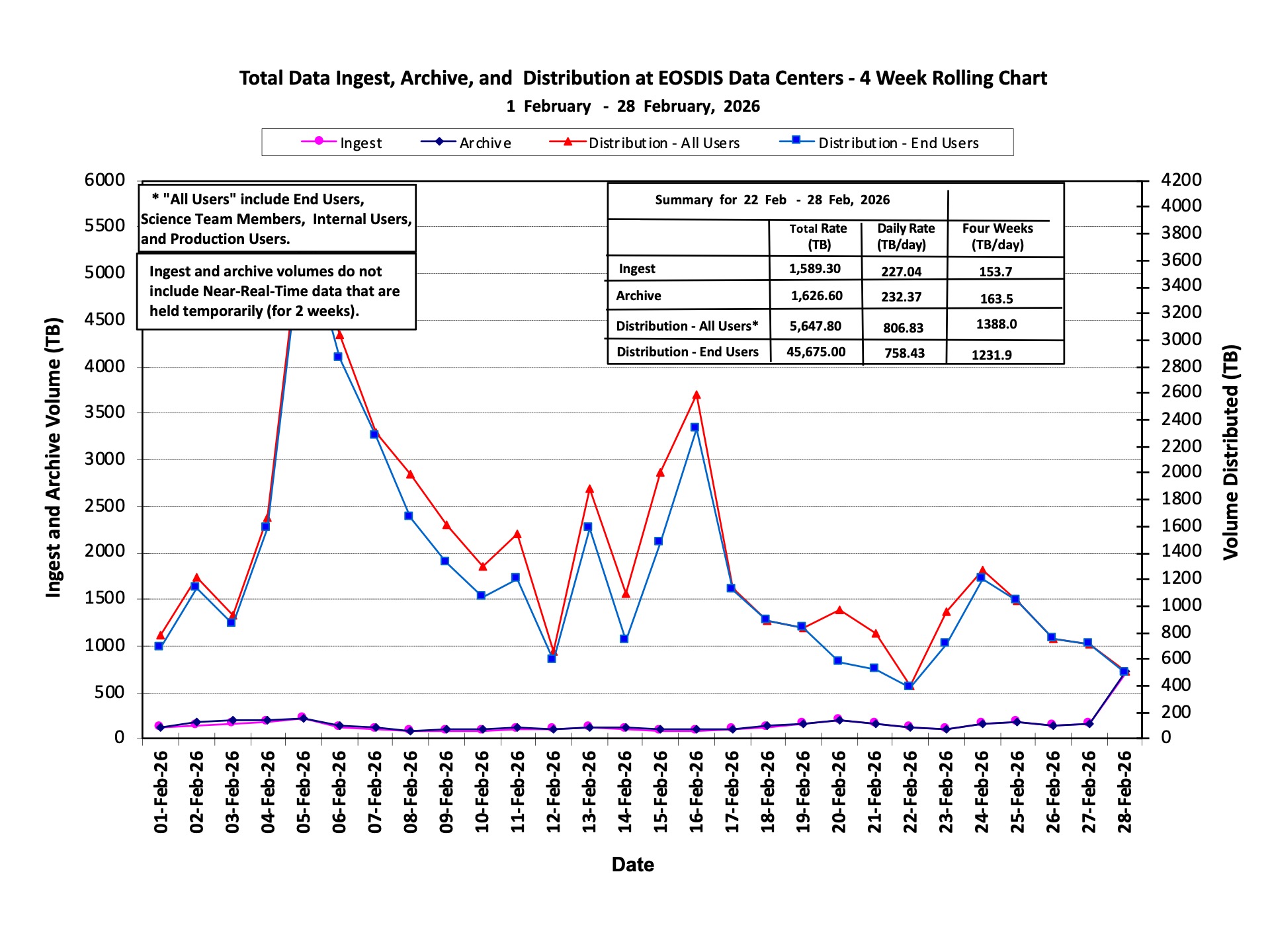
The volume distributed to end users per day, as a running average over the last 4 weeks, is 7.537 times the volume added to the archive per day.
Image
Note:
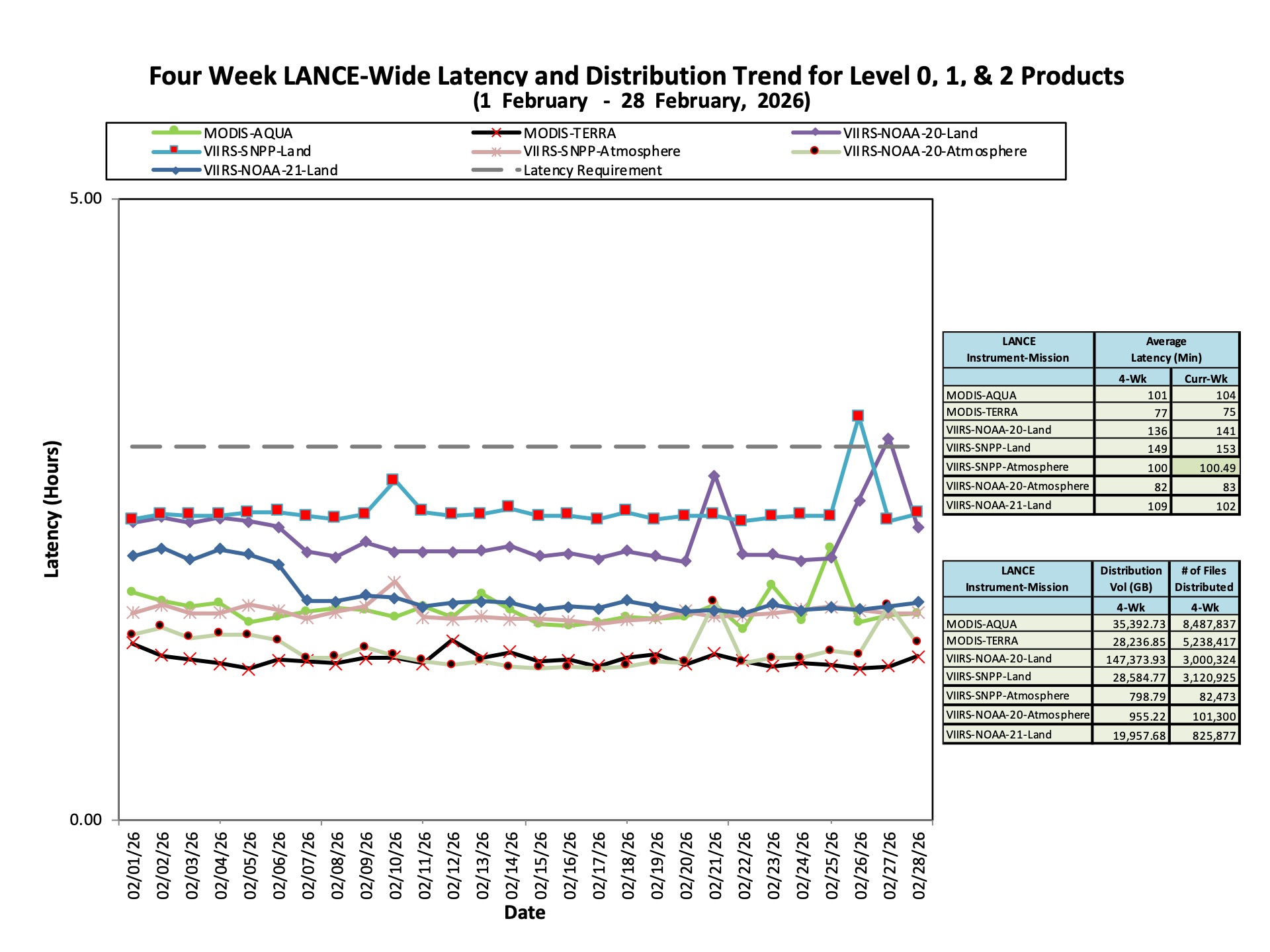
Higher product latencies for:
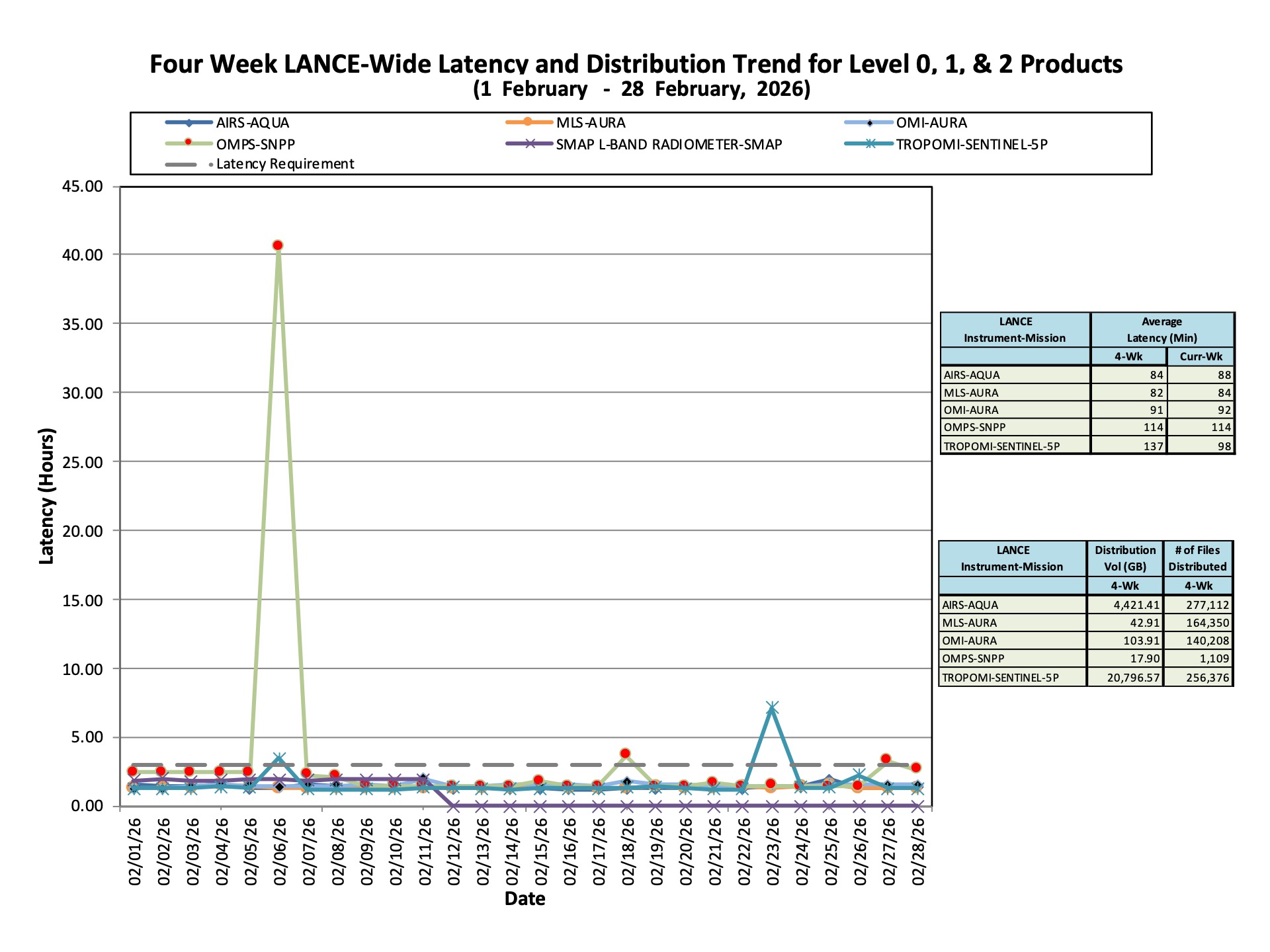
OMPS-SNPP, on 18 February 2026, due to a file system problem.
TROPOMI-SENTINEL-5P, on 23 February 2026, due to a few failures.
VIIRS-SNPP-Land, on 26 February 2026, due to a slight delay in some ancillary inputs.
OMPS-SNPP, on 27 February 2026, is being investigated.
VIIRS-NOAA-20-Land, on 27 February 2026, due to a slight delay in some ancillary inputs.
Image
Image
Note:
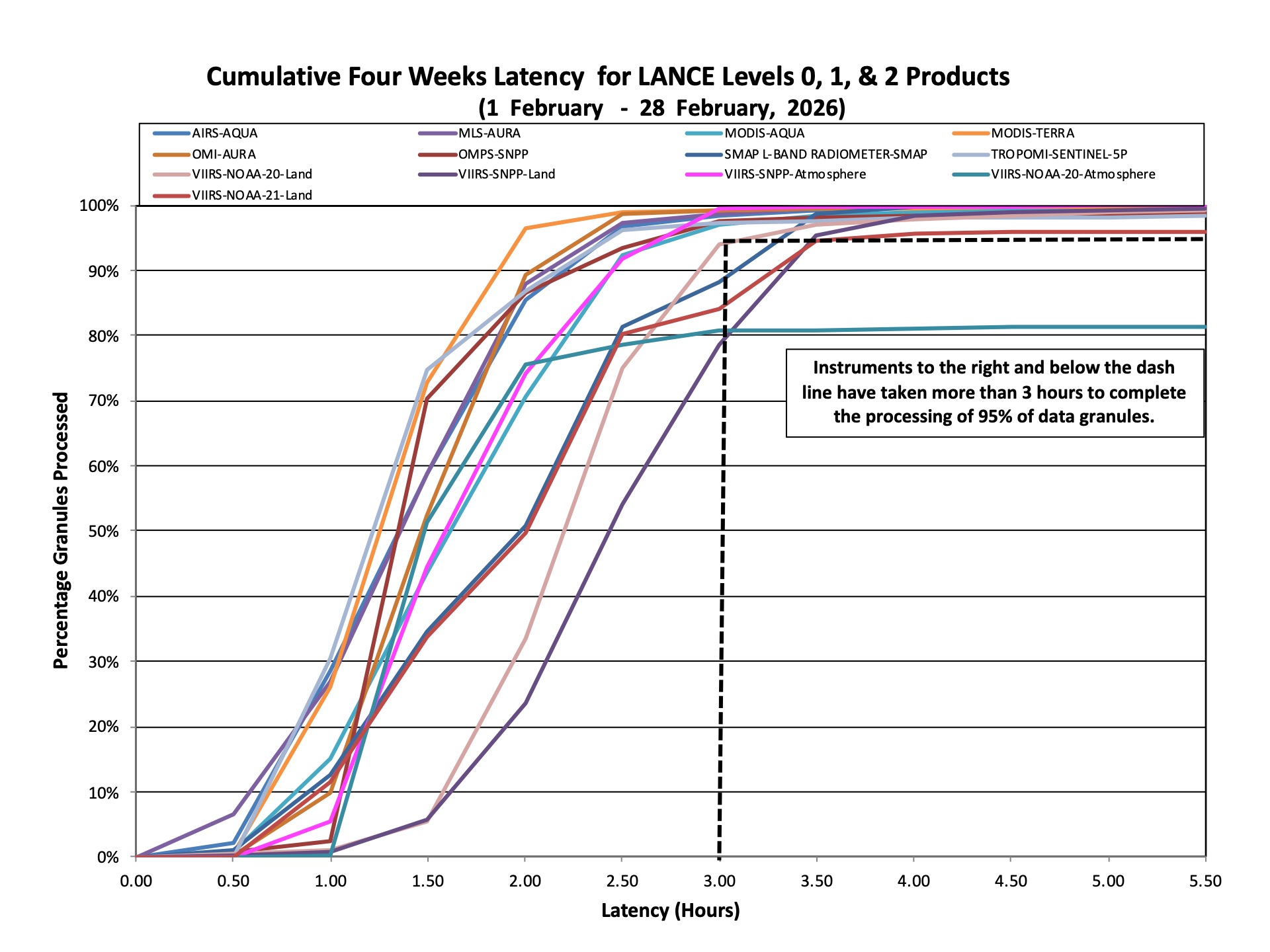
Latency for a data granule is defined as the time taken from the midpoint between the start and end of acquisition of the data for that granule to the granule’s being ready on-line for users to download.
Duration covered by the data for a granule is defined differently for six different instruments (e.g., MODIS granules are 5 minutes long while OMI NRT granules are 13 to 136 minutes long).
Over the last four weeks, over 95% of NRT data requests for all instruments except for five instruments (SMAP L-BAND RADIOMETER-SMAP, VIIRS-NOAA-20-Land, VIIRS-SNPP-Land, VIIRS-NOAA-20-Atmosphere, and VIIRS-NOAA-21-Land) were satisfied within 3 hours. SMAP L-BAND RADIOMETER-SMAP, VIIRS-NOAA-20-Land, VIIRS-SNPP-Land, VIIRS-NOAA-20-Atmosphere, and VIIRS-NOAA-21-Land over 88%, 94%, 79%, 81%, and 84% of the NRT data requests were satisfied within 3 hours, respectively.