Background
NASA has collected nearly 180 petabytes of Earth science data over the past five decades of satellite observation. That number is accelerating toward 600 petabytes by the early 2030s. If our systems cannot scale to meet that growth, we risk becoming invisible in the workplaces that matter most: where researchers are doing science. This strategy defines how we use AI to close that gap before it closes us out.
The Earth Science Data Systems (ESDS) program exists to make NASA's free and open data interactive, interoperable, and accessible for research and societal benefit. Our primary goal since 1994 has been to maximize the scientific return from NASA's missions and experiments. We process instrument data into Earth System Data Records, actively manage the archive as a national asset, set the standard for efficient production and stewardship of science-quality data, and lead the research and technology development that keeps our data systems ahead of mission needs.
That mission has not changed. What has changed is the scale of the challenge. The processing pipelines, discovery interfaces, and analytical workflows that serve our community were built for a different era.
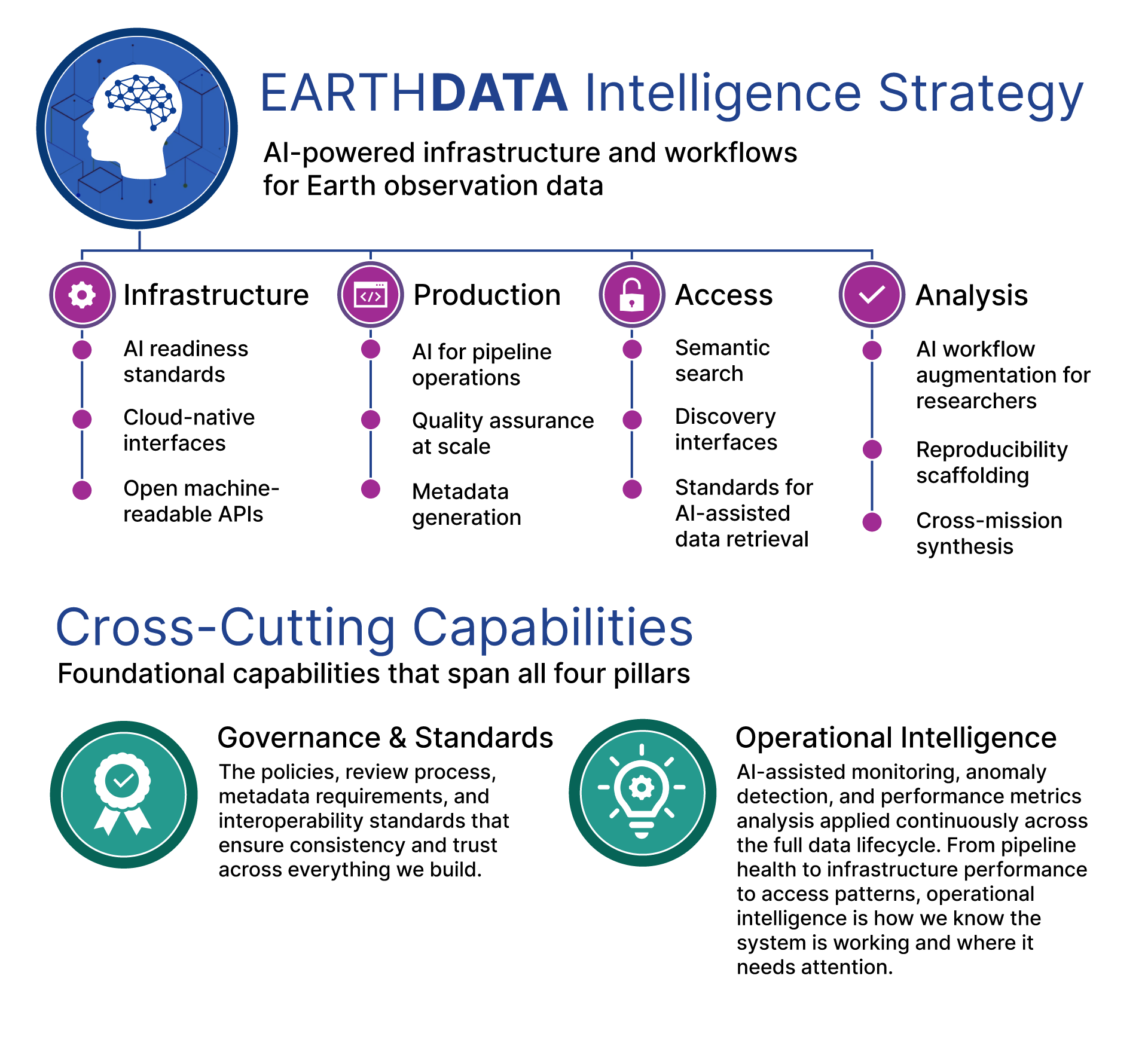
This strategy defines how ESDS applies artificial intelligence (AI) to close that gap. We aim to apply AI across the full data lifecycle from production and curation, through discovery and access, to analysis and insight. At every stage, the goal is the same: shrink the time between data collection and scientific understanding.
This document is an internal organizing framework as much as it is a public strategy. All ESDS AI-focused work should find its home in one of the four pillars of this strategy: infrastructure, production, access, and analysis. Teams should be able to articulate how their efforts advance both this AI strategy and broader program goals. Our choices about where to invest, partner, and govern should reflect these priorities.
AI infrastructure and service providers will shift. Costs, alliances, and market dynamics are unpredictable. This strategy is designed to be durable precisely because it is not tied to any specific vendor or platform. We are building capabilities and practices that will scale as our system’s architecture evolves, while building fluency and institutional knowledge within the current team.