We are in the process of migrating all NASA Earth science data sites into Earthdata from now until end of 2026. Not all NASA Earth science data and resources will appear here until then. Thank you for your patience as we make this transition.
Read about the Web Unification Project
Surface Temperature Data Access and Tools
NASA has surface temperature datasets that help researchers characterize how warm air is over land and water. Access a range of data and data tools such as AppEEARS, HEG: HDF-EOS to GeoTIFF Conversion Tool, and GOES-5 Weather Maps to make the most of surface temperature data.
Surface Temperature Datasets
| Dataset Sort descending | Version | Platforms | Instruments | Temporal Extent | Spatial Extent | Spatial Resolution | Data Format |
|---|---|---|---|---|---|---|---|
| BOREAS Derived Surface Meteorological Data | 1 | FIXED OBSERVATION STATIONS, METEOROLOGICAL STATIONS | THERMOCOUPLES, HUMIDITY SENSORS, WIND MONITOR, BAROMETERS, NET RADIOMETERS, PYRANOMETERS, RAIN GAUGES, ULTRASONIC DEPTH GAUGE, INFRARED THERMOMETERS, Pyrgeometer, LICOR QUANTUM SENSOR | 1994-01-01 to 1996-12-31 |
N: 56.25 S: 53.42 E: -97.23 W: -106.32 |
ASCII | |
| BOREAS Follow-On FLX-01 NSA-OBS Tower Flux, Meteorological, and Soil Temp. Data | 1 | FIXED OBSERVATION STATIONS, FIELD INVESTIGATION | EDDY CORRELATION DEVICES, RAIN GAUGES, THERMOCOUPLES, NET RADIOMETERS, LICOR QUANTUM SENSOR | 1996-10-31 to 1999-01-01 |
N: 55.8801 S: 55.8801 E: -98.4814 W: -98.4814 |
CSV | |
| BOREAS Follow-On FLX-04 Tower Flux and Meteorological Data from NSA Burn Site | 1 | FIXED OBSERVATION STATIONS | IRGA, NET RADIOMETERS, LICOR QUANTUM SENSOR, THERMOCOUPLES | 1999-08-11 to 2000-09-30 |
N: 60 S: 48 E: -90 W: -111 |
CSV | |
| BOREAS Follow-On HMet-01 Level-2 GOES-8 1996 Shortwave and Longwave Radiation | 1 | GOES-8 | GOES-8 Imager | 1996-02-12 to 1996-10-23 |
N: 60 S: 50 E: -92 W: -111 |
BSQ | |
| BOREAS Follow-On HMet-02 Area and Regional Hourly Gridded Met. Data, 1994-1996 | 1 | METEOROLOGICAL STATIONS, GOES-7 | TEMPERATURE SENSORS, WIND MONITOR, RAIN GAUGES, PRESSURE SENSORS, VAS | 1994-01-01 to 1997-01-01 |
N: 60 S: 48 E: -90 W: -111 |
Binary | |
| BOREAS Follow-On HMet-03 Hourly Meteorological Data at Flux Towers, 1994-1996 | 1 | FIXED OBSERVATION STATIONS | THERMOCOUPLES, ANEMOMETERS, BAROMETERS, HUMIDITY SENSORS, RAIN GAUGES, PYRANOMETERS | 1994-01-01 to 1996-12-01 |
N: 56 S: 53 E: -98 W: -106 |
CSV | |
| BOREAS Follow-On HMet-04 1996-1998 NSA Meteorological Data | 1 | METEOROLOGICAL STATIONS | BAROMETERS, NET RADIOMETERS, PYRANOMETERS, LICOR QUANTUM SENSOR, RAIN GAUGES, TEMPERATURE PROBES, ULTRASONIC DEPTH GAUGE, WIND MONITOR, TEMPERATURE SENSORS, HUMIDITY SENSORS, INFRARED THERMOMETERS | 1994-01-01 to 1999-01-01 |
N: 60 S: 48 E: -90 W: -111 |
CSV | |
| BOREAS Follow-On MOD-01 Regional Daily Averaged Gridded Met. Data, 1994-1996 | 1 | METEOROLOGICAL STATIONS, GOES-7 | TEMPERATURE SENSORS, PRESSURE SENSORS, WIND MONITOR, RAIN GAUGES, VAS | 1994-01-01 to 1997-01-01 |
N: 60 S: 48 E: -90 W: -111 |
Binary | |
| BOREAS HYD-02 Estimated Snow Water Equivalent (SWE) from Microwave Measurements | 1 | DHC-6 | INFRARED RADIOMETERS, MR, PYRANOMETERS, TEMPERATURE SENSORS, WIND MONITOR, HYGROMETERS | 1994-02-06 to 1994-02-13 |
N: 56.25 S: 53.42 E: -97.24 W: -106.3 |
CSV | |
| BOREAS HYD-03 Subcanopy Meteorological Data | 1 | METEOROLOGICAL STATIONS | WIND MONITOR, Pyrgeometer, HUMIDITY SENSORS, TEMPERATURE PROBES, INFRARED THERMOMETERS | 1994-02-06 to 1996-03-08 |
N: 53.99 S: 53.63 E: -104.69 W: -106.2 |
ASCII |
SHOWING 10 OF 969
Featured Surface Temperature Observation Method: AIRS
The Atmospheric Infrared Sounder (AIRS) aboard the Aqua satellite is a hyperspectral instrument that makes daily global measurements of infrared energy reflected by Earth's surface and atmosphere. The data is used to create three-dimensional water vapor and temperature profiles throughout the atmosphere. Meteorologists and other scientists use the data to make weather forecasts and as part of the historical global temperature record.

This API allows users to visualize Atmospheric Infrared Sounder data using a Common Metadata Repository search result.

Learn how to access and visualize Atmospheric Infrared Sounder (AIRS) grid data from NASA's Goddard Earth Sciences Data and Information Services Center (GES DISC) in Python.
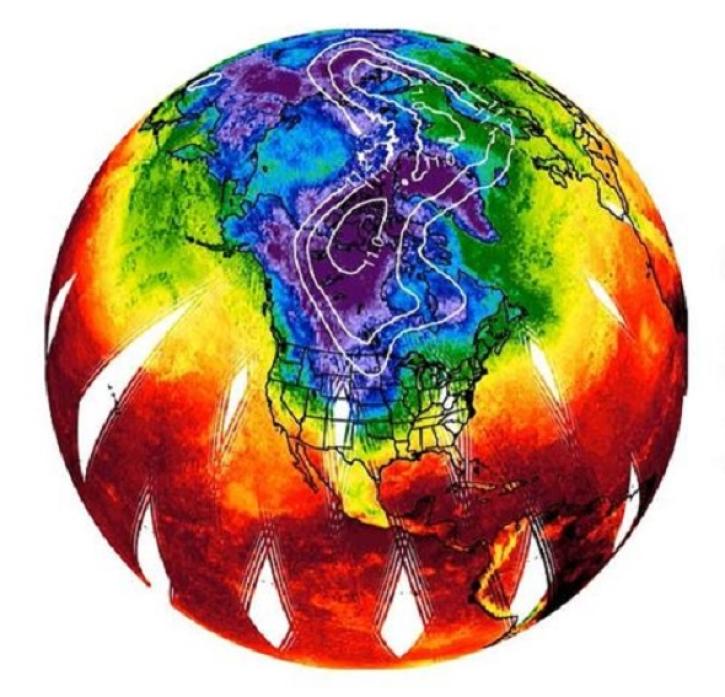
Next-generation instruments aboard Joint Polar Satellite System spacecraft provide continuity to the AIRS project that began in 2002.
11 MIN READ
Frequently Asked Questions
Earthdata Forum
Our online forum provides a space for users to browse thousands of FAQs about research needs, data, and data applications. You can also submit new questions for our experts to answer.
Submit Questions to Earthdata Forumand View Expert Responses