Mission purpose
The primary objective of the Tropospheric Emissions: Monitoring of Pollution (TEMPO) mission is to improve our understanding of air quality and its impacts. By measuring the sunlight reflected and scattered by the Earth's surface and atmosphere, TEMPO's ultraviolet and visible light sensors can detect ozone, nitrogen dioxide, formaldehyde, aerosols, and other airborne constituents important for understanding air quality and the chemistry of Earth's atmosphere.
As it provides near real-time (NRT) data and comprehensive atmospheric composition measurements, TEMPO can improve air quality forecasting and aid in quantifying how air quality affects human health, vegetation, and agriculture.
The instrument flies in geostationary orbit at 91˚ W longitude (about 22,000 miles/36,000 kilometers above Earth's equator) to maintain a continuous view of North America. TEMPO's light-collecting mirror can make a complete east-to-west scan of the continent hourly during daylight hours. Additional technical details may be found on the TEMPO instrument page.
Layer information
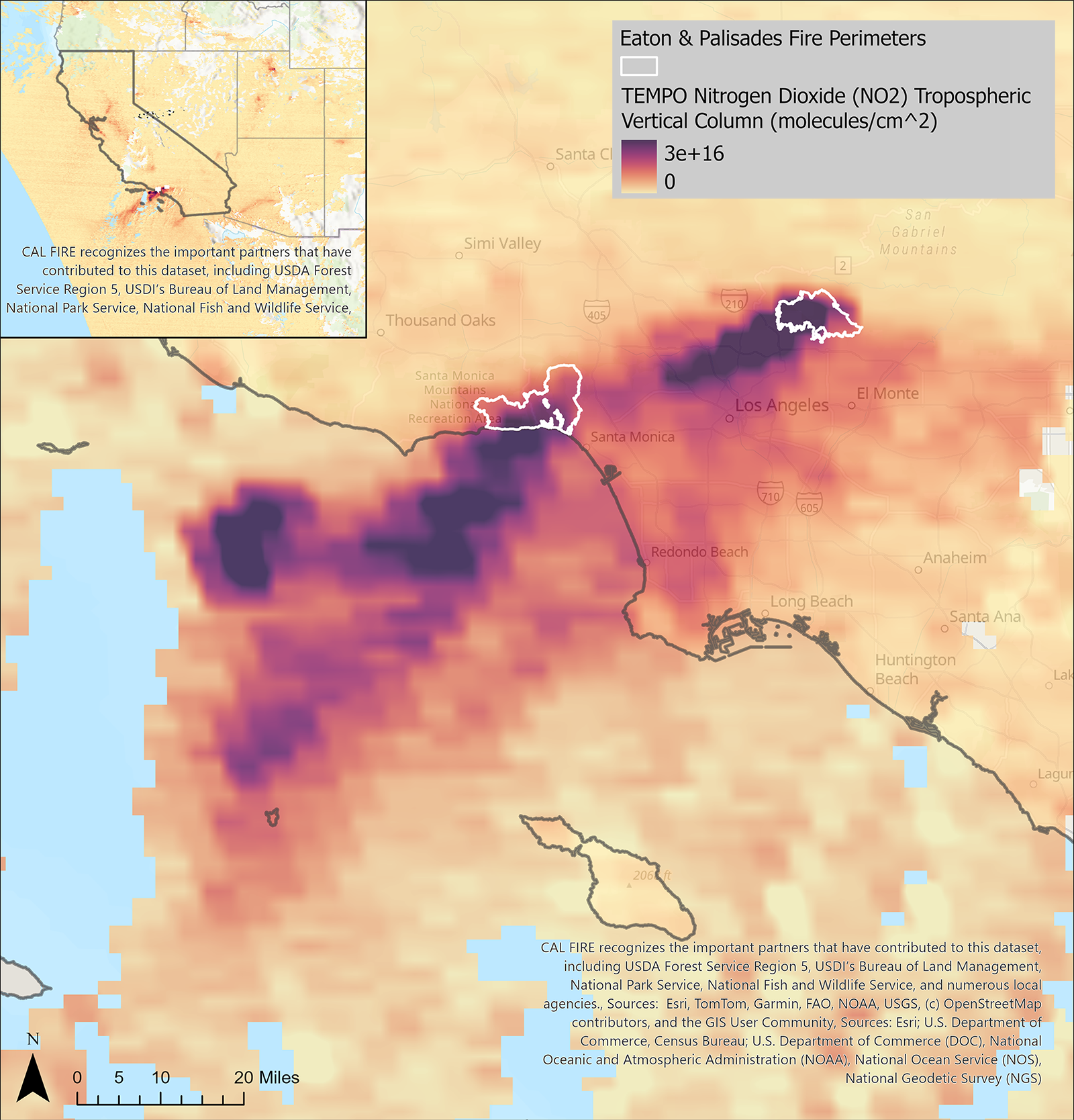
Currently, three pollutants measured by TEMPO are available as ArcGIS image services: nitrogen dioxide vertical column troposphere, formaldehyde vertical column, and ozone total column. These services are split into TEMPO Version 03 (V03) and Version 04 (V04) data, as the TEMPO V04 algorithms address known issues in the V03 data, improving data quality. While qualitative analyses and general trends may remain similar between both versions, merging versions for quantitative analysis is discouraged.
The TEMPO science team is currently reprocessing the V03 data into V04 data, and these data will be added to the V04 services as they become available. In addition, there are services for the TEMPO Nitrogen Dioxide Vertical Column NRT, Formaldehyde Vertical Column NRT, and Cloud Fraction NRT data.
All of the TEMPO ArcGIS services display the level 3 data and have been pre-filtered per the TEMPO science team’s user guide recommendations to create analysis-ready data for users. That is, the services retain the data values (as opposed to browse imagery), so these services can be utilized for data analysis. These services are available in both NASA’s Earthdata GIS portal, as well as ESRI’s data catalog, Living Atlas of the World.
Highlight of capabilities
The TEMPO image services can be used to view the imagery, query the data for values, and perform temporal analyses and aggregations. In addition, each of these services has a publicly accessible endpoint with built-in API functionality that can be called programmatically, such as in Python codes or in custom-built mappers.
The ArcGIS image service layers have the same filtering and colormaps as the corresponding TEMPO imagery in NASA’s Worldview, allowing for joint applications. Worldview can provide quick browse images and additional TEMPO variables, and the ArcGIS services provide data values for robust analyses. TEMPO images are available via the Worldview interface, as well as via NASA's Global Imagery Browse Services (GIBS) API. This API includes methods to access multiple visualization service endpoints (e.g., OGC Web Map Tile Service and OGC Web Map Service), including guidance for accessing via Geographic Information System (GIS) applications and Python.
The TEMPO NRT products are useful for applications with low-latency requirements. NRT processing optimizes radiance calibration, image navigation and registration, and cloud and trace gas retrievals for rapid processing, while ensuring that product quality is sufficient for most NRT applications. The TEMPO NRT image services are updated hourly with any new scans received during a rolling two-day period.
TEMPO NRT products are funded by NASA and are a deliverable of the Satellite Needs Working Group (SNWG), an interagency effort of the U.S. Government dedicated to identifying and addressing Earth observation needs across U.S. civilian federal agencies.