The Colorado River is one of the most famous rivers in the United States, in part because of the Grand Canyon and other iconic landscapes it and its tributaries have created. The river is also notable because its water provides the American Southwest with large reservoirs, notably Lakes Mead and Powell. Millions of people in this desert region rely on the Colorado River for water, and it is also critical for local agriculture.
Increasing demands for the Colorado River’s water, combined with changing weather patterns in the region, have led to noticeably lower water levels in its major reservoirs. These declines are easy to see as “bathtub rings” on the shorelines of Lakes Mead and Powell. The marks of high water levels in the lake, compared to where the current reservoir levels stand, indicate that every drop of this vital resource is being used.
Using Satellite Observations to Monitor Aquifers
Flowing underneath the desert surface are important aquifers that also provide water for the people, industry, and agriculture of the region. The Colorado River and its reservoirs are not sufficient to meet the regional demand for water, so groundwater has been extracted from the aquifers, causing the aquifers to lose water at an increasing rate during the past 20 years. Unlike the reservoirs, this loss is not easily perceptible on the surface.
However, the loss in volume can be detected by satellites in space. By measuring the change in the force of gravity in the region caused by the decreased amount of water in the reservoirs and aquifers, researchers can estimate the volume of water removed.
In a recent study published in Geophysical Research Letters (Abdelmohsen et al. 2025), a research team used gravity data from NASA’s Gravity Recovery and Climate Experiment (GRACE) and GRACE Follow-On (GRACE-FO) to determine how much water has been withdrawn from Colorado River Basin aquifers since 2002. This study also used data from a second NASA source, the North American Land Data Assimilation System (NLDAS), to confirm that the estimates made with GRACE gravity data were accurate.
The results indicate that the reservoirs and the aquifers have lost a combined 52 cubic kilometers of water since 2002. The reduction of groundwater was 65% of that total, about 34 cubic kilometers. Such a loss is not sustainable, and the risk of running out of freshwater is potentially serious.
Gravity Data from GRACE and GRACE-FO
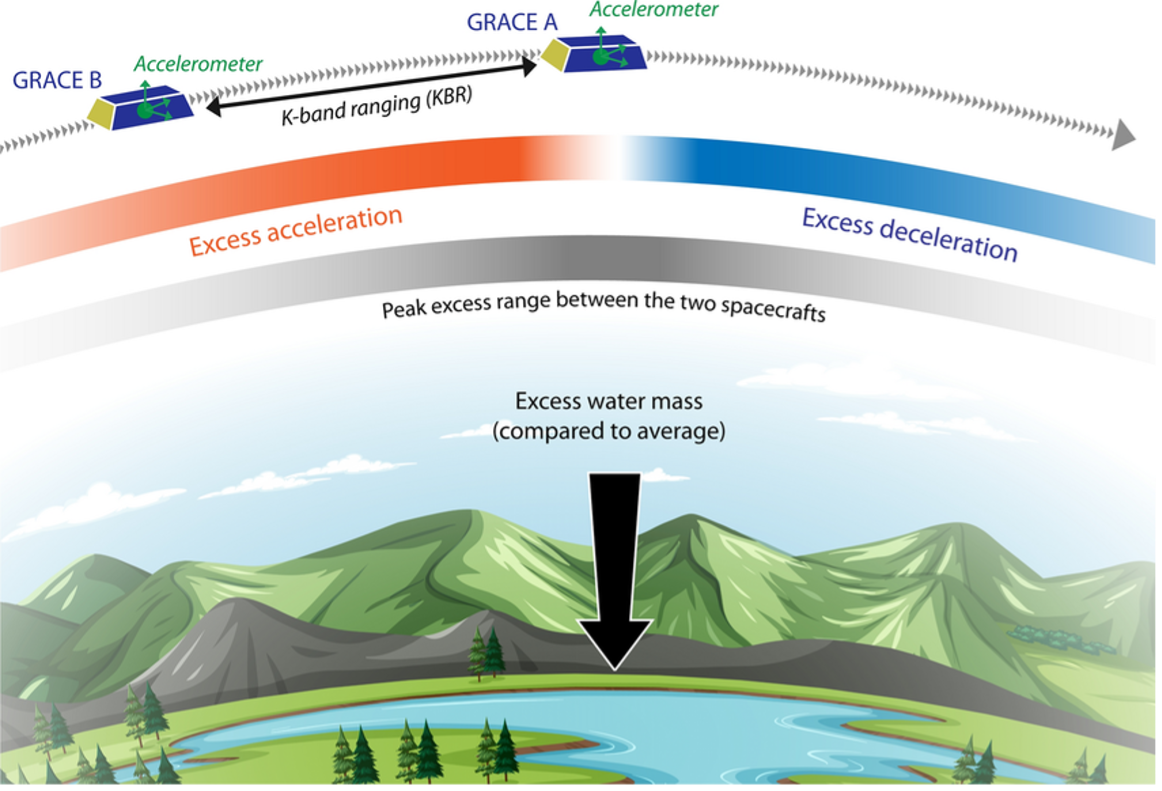
The GRACE missions are remarkable, both for the data they provide and the technology that is employed to acquire the data. The concept is simple: two trapezoid-shaped satellites orbit in tandem, with about 220 kilometers between them. Radio (microwave) signals determine the precise distance between the two satellites, with Global Positioning System (GPS) antennas indicating their orbital positions.
As Earth’s gravitational field varies under the satellites as they orbit, the distance between the two satellites will vary as they are either pulled away from each other or pushed slightly toward each other. By taking repeated measurements over numerous orbits, researchers can precisely derive Earth's gravity field from the small variations in the distance between the satellites.
There are two main reasons to measure Earth’s gravity field. One, a precise determination of the gravity field generates baseline data that can be used to measure the variation in the height of the surface of Earth. For example, such measurements can be used to determine how much a large earthquake has changed the height of Earth’s land surface, including the official altitude of mountain peaks.
Two, measuring the Earth’s gravity field allows researchers to measure variations of Earth's gravity, which is the measurement used to assess the Colorado River Basin Aquifers. As the amount of water in a given region varies, Earth’s gravity in that region will change as the mass of water increases or decreases. This variation indicates changes in water storage on the surface of Earth, and underneath the surface as well. That’s where the “climate” part of the GRACE mission name comes from.
The figure below (from Humphrey, Rodell, and Eicker 2023) shows how this works.