Cloud Cover Conundrum: New Study Helps Improve Cloud Predictions in Atmospheric Models

In computer models that simulate Earth’s atmosphere, scientists evaluated their upgraded cloud simulation capabilities against satellite observations.

Computer weather forecast models are essential for helping people make plans and for saving lives and property during severe events. Some of the most popular models come from National Oceanic and Atmospheric Administration’s (NOAA) Geophysical Fluid Dynamics Laboratory (GFDL). The GFDL models are considered among the best in the world and famous for their use forecasting hurricanes. The GFDL and other models get better all the time because they are continuously tested and improved. 

GFDL scientist Dr. Huan Guo and her colleagues recently studied the performance of two versions of their atmospheric models incorporating sophisticated satellite simulators against real satellite data. The simulators mimic how different space-based instruments would view the model’s simulated atmosphere. The approach allows the models to produce data that is similar in nature to actual satellite data for easy comparison. 

For their analysis, the researchers compared model cloud data with Moderate Resolution Imaging Spectroradiometer (MODIS), CloudSat, and other real-world Earth observation data from NASA. The review of atmospheric models showed that while they accurately capture many aspects of global cloud behavior, some longstanding issues in the details persist.

Dr. Huan Guo is leading an effort to upgrade how clouds are represented in GFDL's global models, primarily focusing on how clouds are represented at the microphysical level, which describes the properties and behavior of drops of water as they evolve within clouds. By identifying areas where models and observations are not in agreement, the team can refine future models to accommodate for biases that may affect weather predictions and our understanding of atmospheric processes. 
Satellite Simulators Reveal Hidden Problems

While analyzing two of their models, the researchers uncovered two main issues with how computer models simulate Earth's clouds: an already known "too few, too bright" cloud bias in which the model produces too few clouds that are overly reflective, and a newly-discovered issue that overestimates high-altitude ice clouds and underestimates low-altitude liquid clouds.

"In both the model and the satellite retrieval there's a lot of assumptions, parameterizations, and definitions that differ between the two," says Ryan Kramer, atmospheric scientist at GFDL and former scientist at NASA and the University of Maryland, Baltimore County (UMBC) Goddard Earth Science Technology and Research II (GESTAR II). "The model and the satellite are looking at the same cloud in two different ways, with two different sets of definitions — like speaking two different languages. These satellite simulators translate the model cloud information into specific satellite cloud information, so you have a more apples to apples comparison. The simulator essentially tries to mimic the retrieval that the satellite is doing. Colleagues built these satellite simulators for a bunch of different satellites, and we implemented them in our climate models."

The simulators work by taking the model's 3D cloud data and processing it the same way satellite instruments would, including their blind spots and measurement limitations. This "apples to apples" comparison reveals where the models truly differ from reality versus where apparent differences might be due to measurement techniques. In this case, the satellite simulators revealed problems with the models that might otherwise stay hidden.

The “Too Few, Too Bright” Bias

One of the models developed by the research team is the sophisticated AM4-MG2 model, which applied the two-moment Morrison-Gettelman cloud microphysical parameterization with prognostic precipitation (MG2) to the existing Atmosphere Model version 4.0 (AM4.0). This improved on the previously-used AM4.0 by applying a scheme that included the detailed microphysical processes that determine how clouds form. 

While AM4.0 and AM4-MG2 are very similar – they have the same dynamics, radiation, and convection schemes – they have different methods of predicting cloud properties at the microscale. The research team compared their AM4.0 and AM4-MG2 atmospheric models with observations based on simulations from five satellite instruments — the Moderate Resolution Imaging Spectroradiometer (MODIS), International Satellite Cloud Climatology Project (ISCCP), The Cloud-Aerosol Lidar and Infrared Pathfinder Satellite Observation (CALIPSO), Multi-Angle Imaging SpectroRadiometer (MISR), and CloudSat — spanning from 2000 to 2020.

NASA Distributed Active Archive Centers like the Level-1 and Atmosphere Archive and Distribution System (LAADS DAAC) provide datasets for these instruments that are tailor-made for comparison to model satellite simulators, such as the Level 3 Cloud Feedback Model Intercomparison Project (CFMIP) Observation Simulator Package (COSP) cloud properties suite of satellite data products for MODIS. What they discovered supported an already widely-accepted bias: the models produce far fewer clouds than satellites observe, and the clouds the models created were much brighter and more reflective than real observations.

"Clouds play an important role. You've probably seen this from a plane, when you look down at the tops of clouds, it's really, really bright," says Kramer. "To increase the amount of reflection out to space from the Earth, you can add more clouds, or you can make the clouds brighter. The goal is to make sure the amount of total energy being reflected out to space by the clouds in the model is correct. What we find is we're getting the total reflection pretty accurate, but for the wrong reasons. We don't have enough clouds, which is less reflection. And the clouds the models do have are too bright, which is more reflection. Essentially these biases cancel out. We get the overall energy balance, but to some extent for the wrong reasons."

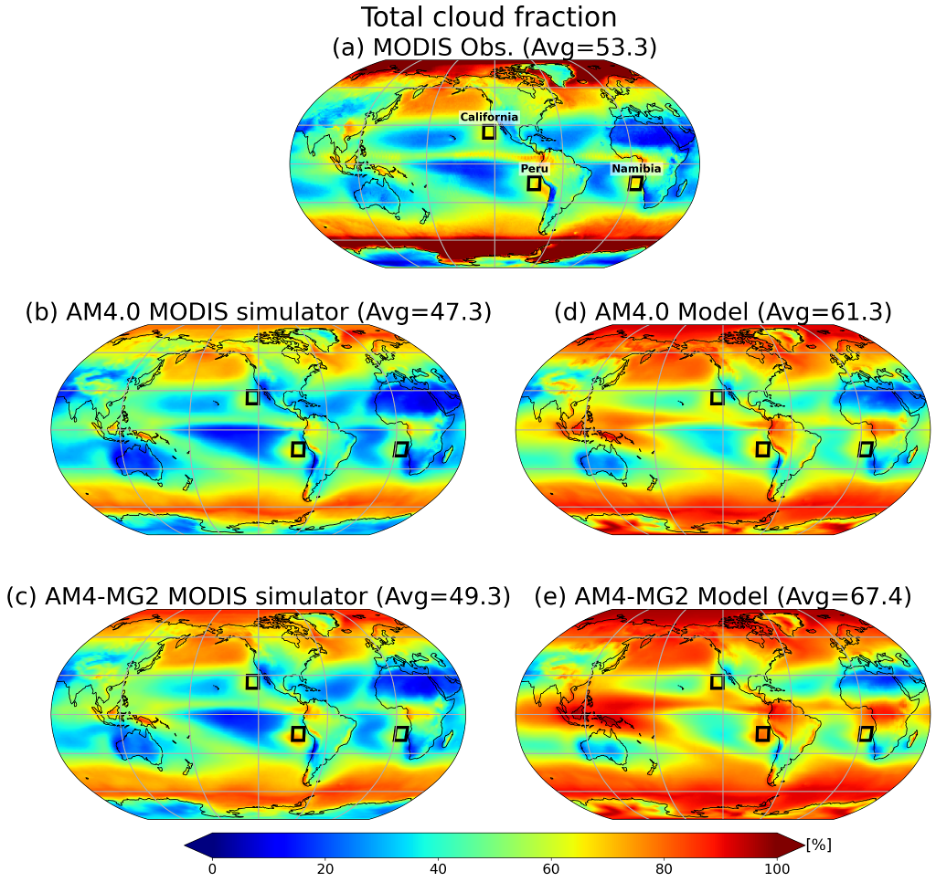
Specifically, the models underestimated low-level cloud coverage, like marine stratocumulus clouds, by more than 10% globally. These clouds form over oceans near continental coastlines and play a crucial role in Earth's energy balance by reflecting sunlight back to space. 

The newer AM4-MG2 model showed improvements over its predecessor AM4.0, better representing these important cloud systems along the western coasts of continents. This enhancement comes from more sophisticated mathematical representations of the physical processes within clouds. However, when cloud coverage exceeds 20%, the simulated clouds reflect substantially more solar radiation than satellites observe in nature.

Image
Image Caption

Total cloud fraction from the MODIS observation (top), output from the MODIS simulators running within AM4.0 (middle left) and AM4-MG2 (middle right), and the AM4.0 (bottom left) and AM4-MG2 (bottom right) direct model outputs without simulators. 

The black boxes mark the subtropical stratocumulus regions near California [120oW-130oW, 20oN-30oN], Peru [80oW-90oW, 10oS-20oS], and Namibia [0oE-10oE, 10oS-20oS]. Global averages are shown in parentheses. Credit: LAADS DAAC

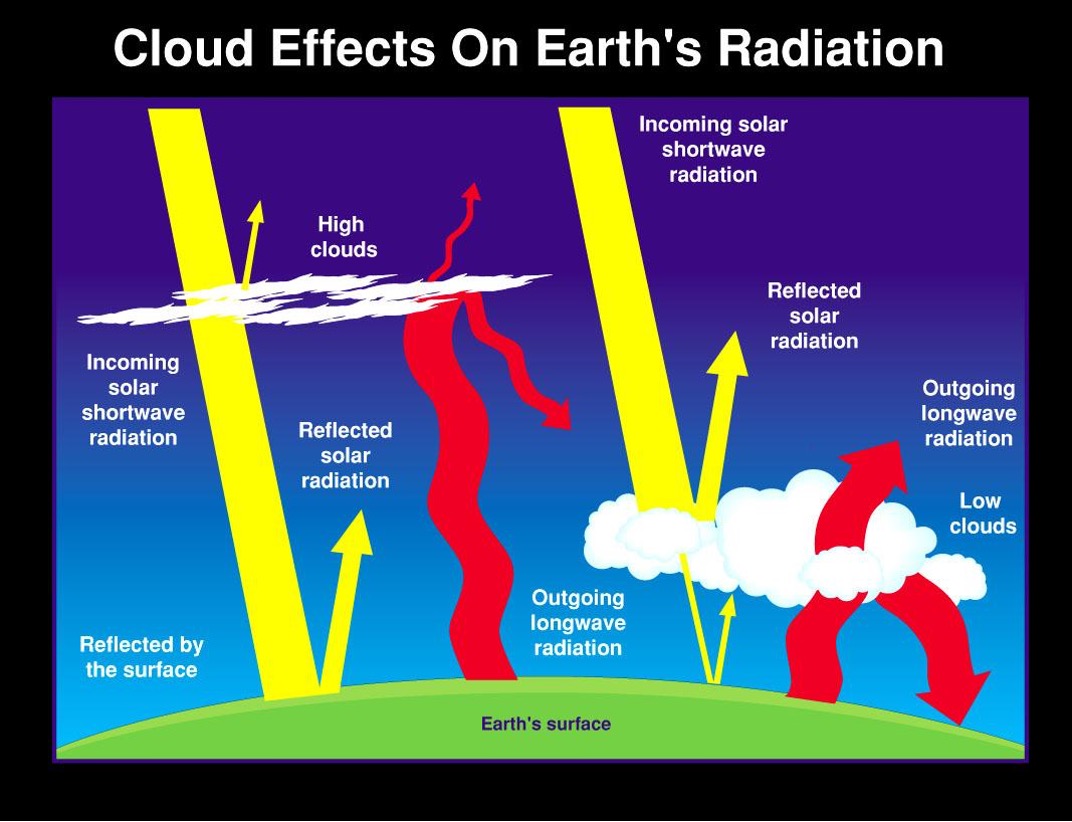
Clouds play an important role in Earth’s climate: they reflect and trap sunlight, which influences Earth’s temperature. They also reflect sunlight back to space (a cooling effect) and trap sunlight (a warming effect). This balance of reflected and trapped light is how Earth maintains its temperature. Improving how the GDFL models depict clouds would make its forecasts even more accurate.

Image
Image Caption

This graphic shows how different types of clouds affect Earth's temperature in different ways. High clouds (like wispy cirrus clouds) act like a blanket - they let most of the sun's heat through to warm the ground, but then trap that heat when it tries to escape back to space, making Earth warmer overall. Low clouds (like thick, puffy cumulus clouds) work more like a mirror - they block and reflect a lot of the sun's heat before it can reach the ground, which keeps Earth cooler. Credit: NASA Earth Observatory

The Precipitation Problem

The researchers found their simulations create rain and drizzle too early in the cloud formation process, when clouds are still too small to produce precipitation. This may also be due in part to the “too few, too bright” bias. Clouds tend to be brighter as they become thicker with water droplets. So, if models assume clouds are brighter than they are, they also incorrectly predict that clouds are further along in the cloud formation process and assume that it is raining prematurely. 

“After the rain the sky becomes clear. The cloud dissipates. Also, precipitation timing impacts the water cycle. This impacts hydrology in addition to the cloud lifespan,” says Dr. Guo. Additionally, as Ryan Kramer notes, “Biases in the precipitation that's affecting the clouds also means we'll probably have biases in the representations of flooding and surface precipitation processes.”

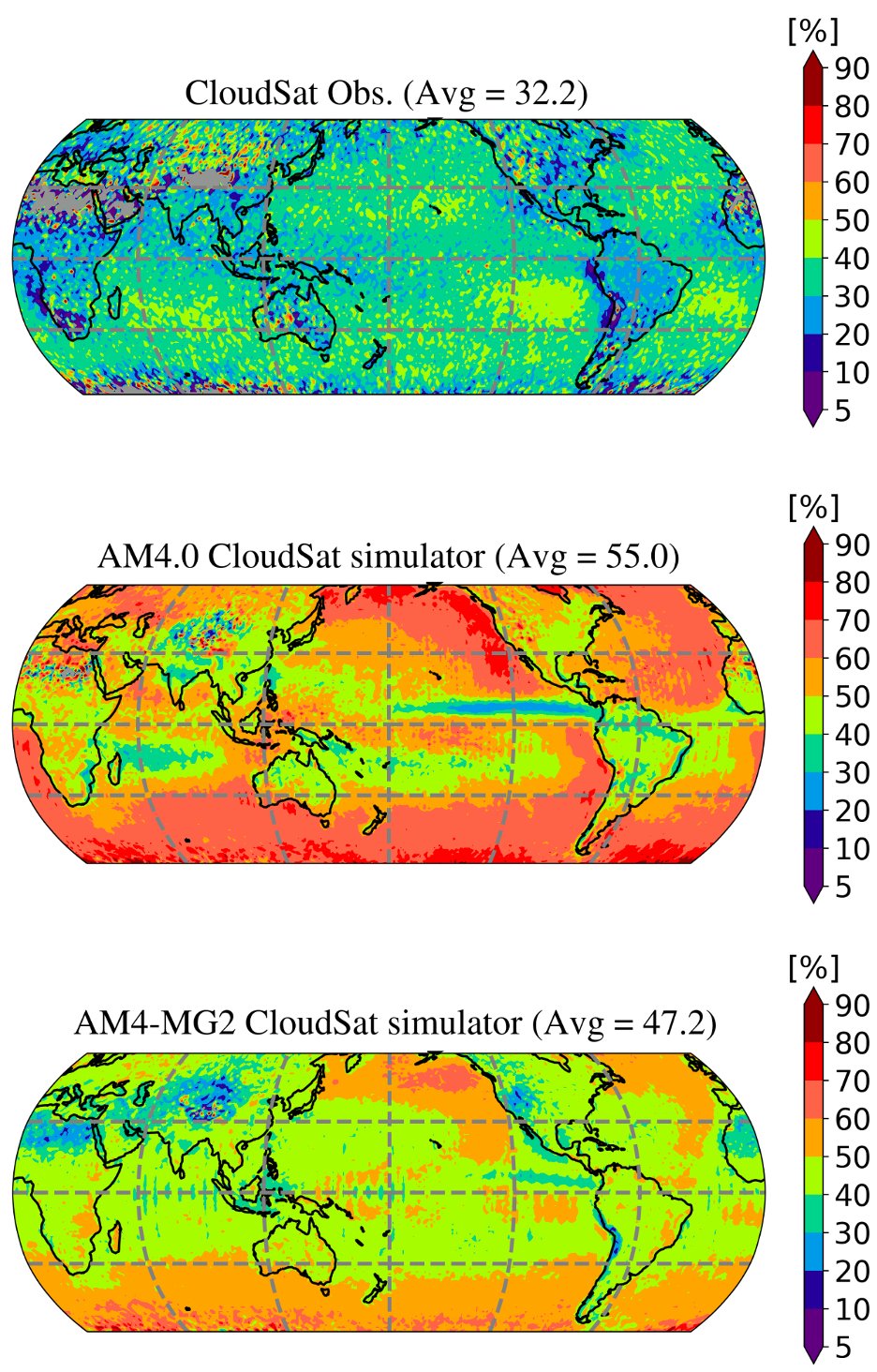
Satellite observations show that most clouds don't precipitate — more than 50% do not produce rain. But in the models, drizzling clouds dominate, occurring about 20% more frequently than observed. This premature precipitation removes water from the atmosphere before extensive cloud fields can form, further impacting weather prediction accuracy.

Image
Image Caption

Occurrence frequencies of drizzling clouds from CloudSat observations (top) and from CloudSat simulators running within AM4.0 (middle) and AM4-MG2 (bottom). Spatial averages over 60°S–60°N are shown in parentheses. Credit: LAADS DAAC

The team traced this problem to the mathematical representations of how tiny water droplets in clouds grow large enough to fall as rain, a process called autoconversion. When they tested different formulations of this process, they found dramatic changes in how often and how quickly precipitation developed.

The Ice-Liquid Balance Problem

The study also revealed issues with cloud composition. Both models consistently generate too many high-altitude ice clouds while producing insufficient low-level liquid clouds. In the atmosphere, the balance between liquid water droplets and ice crystals in clouds affects everything from precipitation patterns to how much sunlight gets reflected to space.

The models successfully simulate the general temperature ranges where liquid and ice can coexist — from about -40°C to 0°C (-40°F to 32°F). However, they struggle with the specific details of this transition, particularly in the mixed-phase region where both water droplets and ice crystals exist together — which are particularly important in polar regions.

Earth’s Energy Balance 

Despite these significant cloud biases, both atmospheric models produce reasonably accurate estimates of Earth's overall energy exchanges associated with clouds. This occurs because the two main errors partially compensate for each other — having fewer clouds is balanced by those clouds being unrealistically bright.

This compensation raises an important question: while the models might correctly predict global average energy budgets, could they be achieving accurate results through incorrect physical processes? This matters for regional weather predictions and understanding how the atmosphere might respond to changing conditions.

Looking Toward Better Predictions

The study is a great test case for how satellite simulators can help evaluate the performance of computer models and detect areas for refinement. By using the simulators to create “apples to apples” comparisons of the modeled clouds with satellite observations, the researchers more clearly identified deficiencies in the modeled clouds within climate models. 

Correcting these biases will make how the models characterize clouds more realistic. In a greater sense, the work will represent another important step in the continuous quest of Guo and others to improve climate and weather predictions and enhance our understanding of precipitation patterns around the world. 

Details

Last Updated

Jan. 27, 2026

Published