Historical Data in Action: Western Europe’s Storm of the Century

We used data from the Modern-Era Retrospective analysis for Research and Applications, Version 2 (MERRA-2) to re-examine back-to-back December 1999 storms.

Introduction

In December 1999, Storms Lothar and Martin brought strong winds to many parts of western and central Europe, including France, Belgium, Luxembourg, Germany, Switzerland, and Italy. Lothar struck the region between December 25-27, with Martin immediately following on December 27-28, giving residents no time to recover between these two intense windstorms. 

More than 200 million cubic meters (m3) of forest and woodland were destroyed by the back-to-back storms. The destruction of forests was amongst the most severe ever recorded in Europe, causing billions of euros in damage and large disruptions to the region’s timber industry. In France, damage to the historic grounds (including rare tree and plant species) at Versailles provided a very public glimpse of the damage suffered across the region. The widespread damage caused by Lothar and Martin is referred to by some Europeans as the "storm of the century."  

Data from the Modern-Era Retrospective analysis for Research and Applications, Version 2 (MERRA-2) have been used to re-examine this famous storm. MERRA-2 includes meteorological reanalysis data available dating back to 1980, making it one of the more useful NASA datasets for historical analysis. Visualizations from NASA's Giovanni and Panoply Data Viewer also help us understand the meteorology surrounding storms Lothar and Martin.

Storm Lothar and Storm Martin

Lothar originated in a weak disturbance off the U.S. East Coast on December 24, before accelerating towards France and rapidly intensifying into a powerful cyclone. The storm struck northern France late on December 25 into the early morning hours of December 26 before moving through central Europe. Due to its small size, Lothar resembled something more like a mesoscale convective vortex than a large-scale system. Size aside, it still packed quite a punch as it marched into Europe. 

Lothar’s extremely fast movement across the North Atlantic was particularly noteworthy. According to an editorial from the Royal Meteorological Society, observers at the Jersey Airport (south of the United Kingdom, off the Normandy coast of France) recorded a pressure drop from 996 to 966 hectopascals (hPa) in a four-hour period (0000 UTC to 0400 UTC on December 26). The pressure subsequently rose back to 994 hPa just five hours later (0900 UTC on the same day). (See Blancq, F.W.L. & Searson, J.A., 2000.) The German Weather Service also reported pressure values as low 961 hPa as Lothar passed over that country. The pressure changes demonstrate how quickly the storm arrived and departed, and reflect the very short time Lothar needed to cause destruction. 

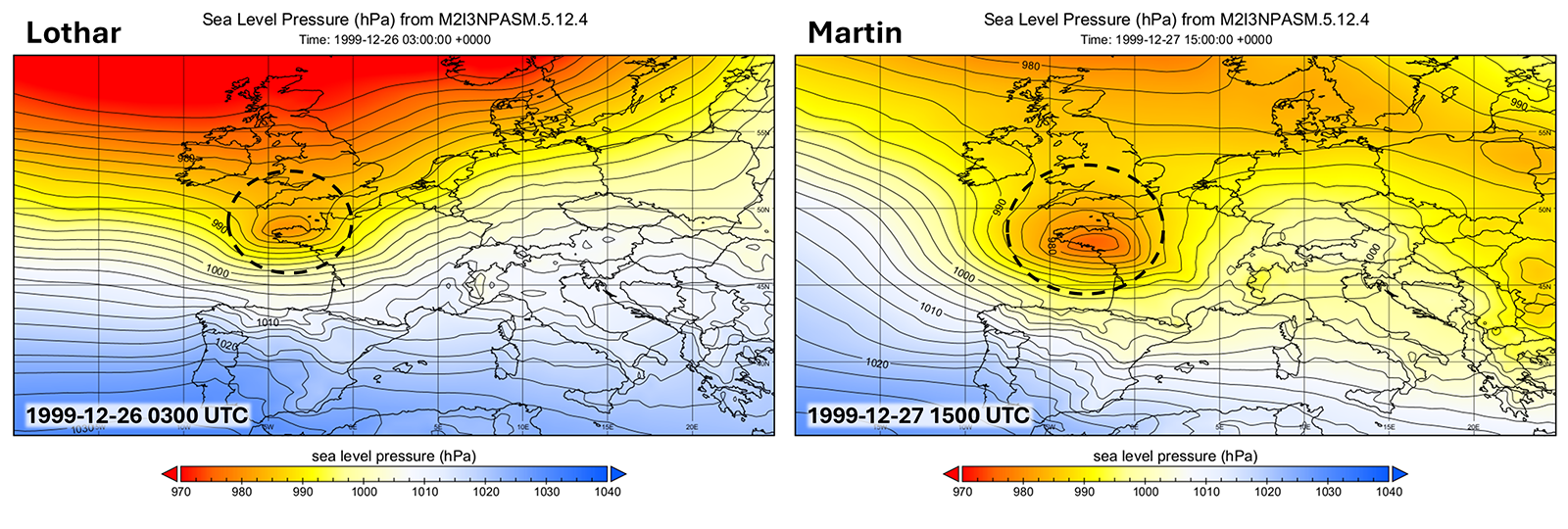
Storm Martin developed off of France on December 27, where it rapidly intensified before moving across the country towards Switzerland and Italy on December 28. Figure 1 shows maps of sea level pressure in hectopascals as Lothar and Martin made landfall on the northwest coast of France on December 26 and 27.
Image
Image Caption

Figure 1: This two-panel plot shows 3-hour averaged sea level pressure from the M2I3NPASM collection (MERRA-2) for Storm Lothar (0300 UTC on December 26, 1999) and Storm Martin (1500 UTC on December 27, 1999). Sea level pressure in hectopascals (hPa) is shaded corresponding to the color palette, with isobars shown every 2.5 hPa from 970hPa to 1040hPa. Black dashed circles represent the general location of the storms. Graphics generated using Panoply.

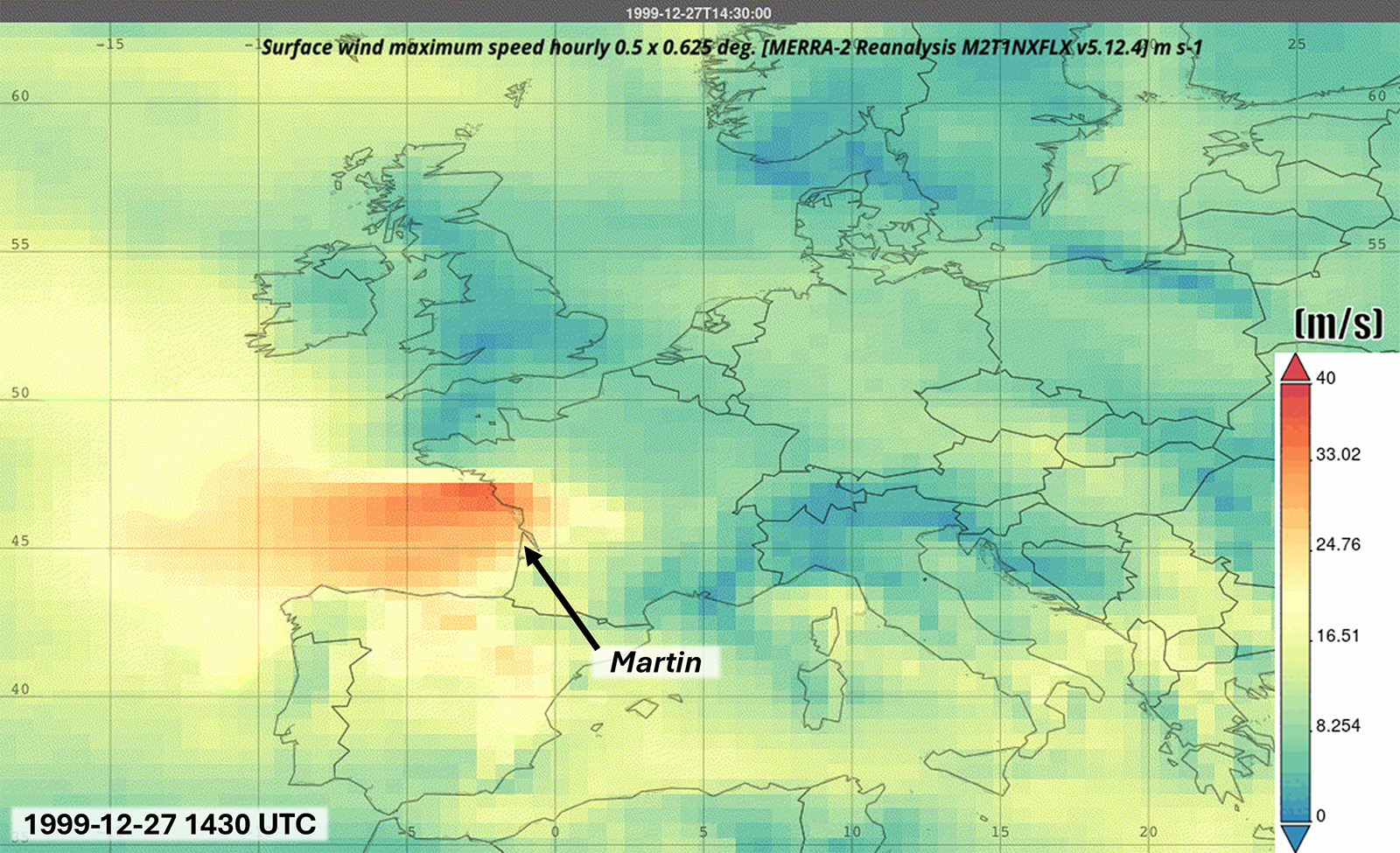
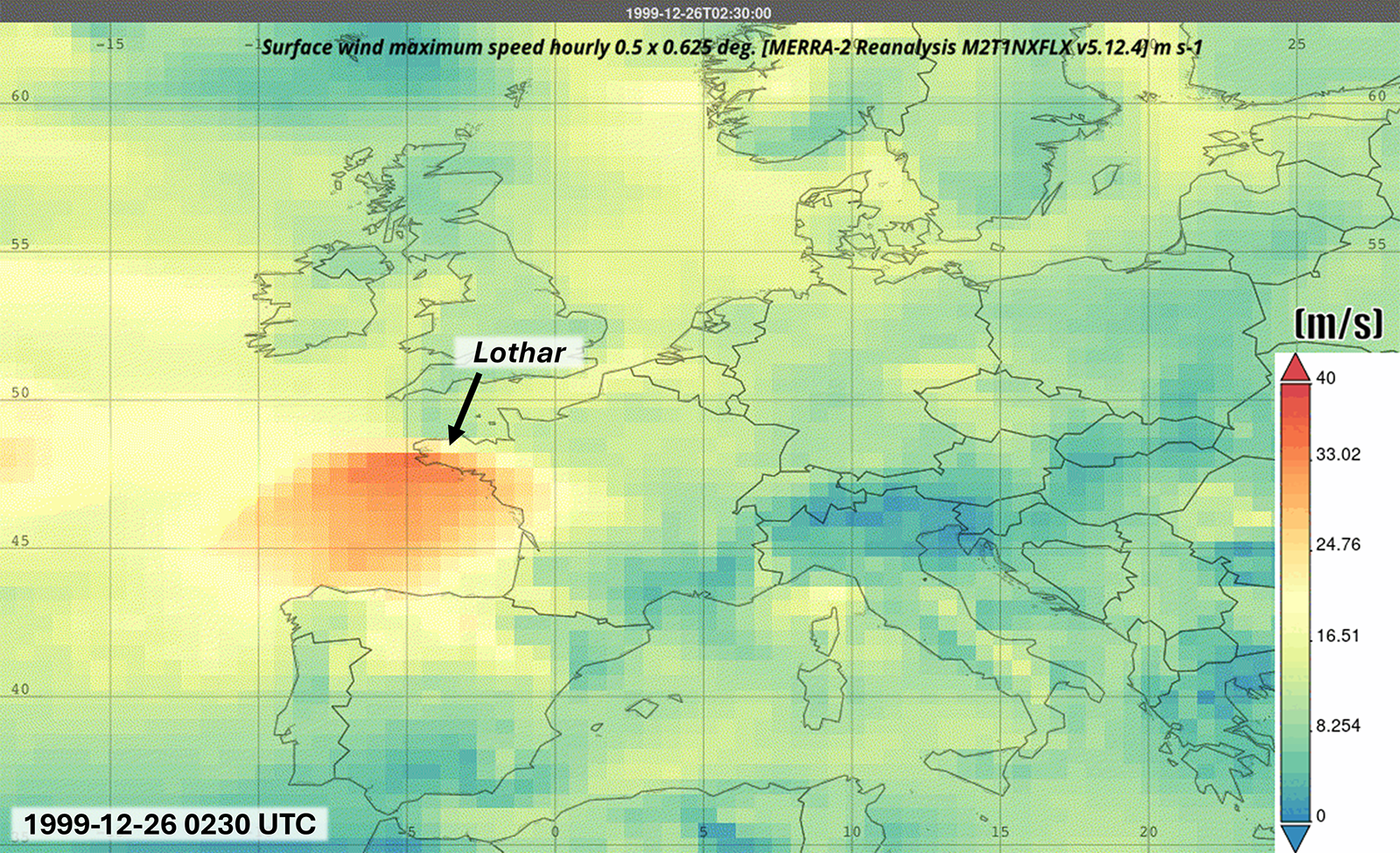
Figure 2 shows MERRA-2 wind speeds exceeding 40 m/s (~140 km/hr) when Lothar made landfall in France — comparable to a category 1 or 2 hurricane. The wind speeds of Martin were intense as well, especially across coastal areas of France, where speeds also exceeded 40 m/s (Figure 3). 

However, the storms' attributes and impacts diverged a bitt as they moved inland. Long after landfall, Lothar's wind speeds remained in excess of 150 km/hr well into Germany and surrounding countries. Even greater wind speeds (200+ km/hr) were reported at higher elevations. With Martin, winds lost some intensity as the storm moved inland. Maximums reached 35 m/s (~130 km/hr) in parts of Switzerland, Italy, and surrounding countries.

Image
Image Caption

Figure 2: The map shows maximum hourly wind speeds for Storm Lothar from the M2T1NXFLX collection (run in MERRA-2). Speeds are shown in meters per second. The image is sampled from an animation created using NASA’s Giovanni and the MERRA-2 SPEEDMAX variable.

Image
Image Caption

Figure 3: The map shows maximum hourly wind speeds for Storm Martin from the M2T1NXFLX collection (run in MERRA-2). Speeds are shown in meters per second. The image is sampled from an animation created using NASA’s Giovanni and the MERRA-2 SPEEDMAX variable.

What’s the Meteorology surrounding Lothar and Martin? 

Lothar garnered more attention and thus has been studied a bit more than Martin.

A study of Lothar by Wernli et al. (2002) noted that the presence of an intense jet streak across the North Atlantic — a core of fast winds in the upper atmosphere — and anomalously high sea surface temperatures (SSTs). Both promoted the rapid intensification of the storm.

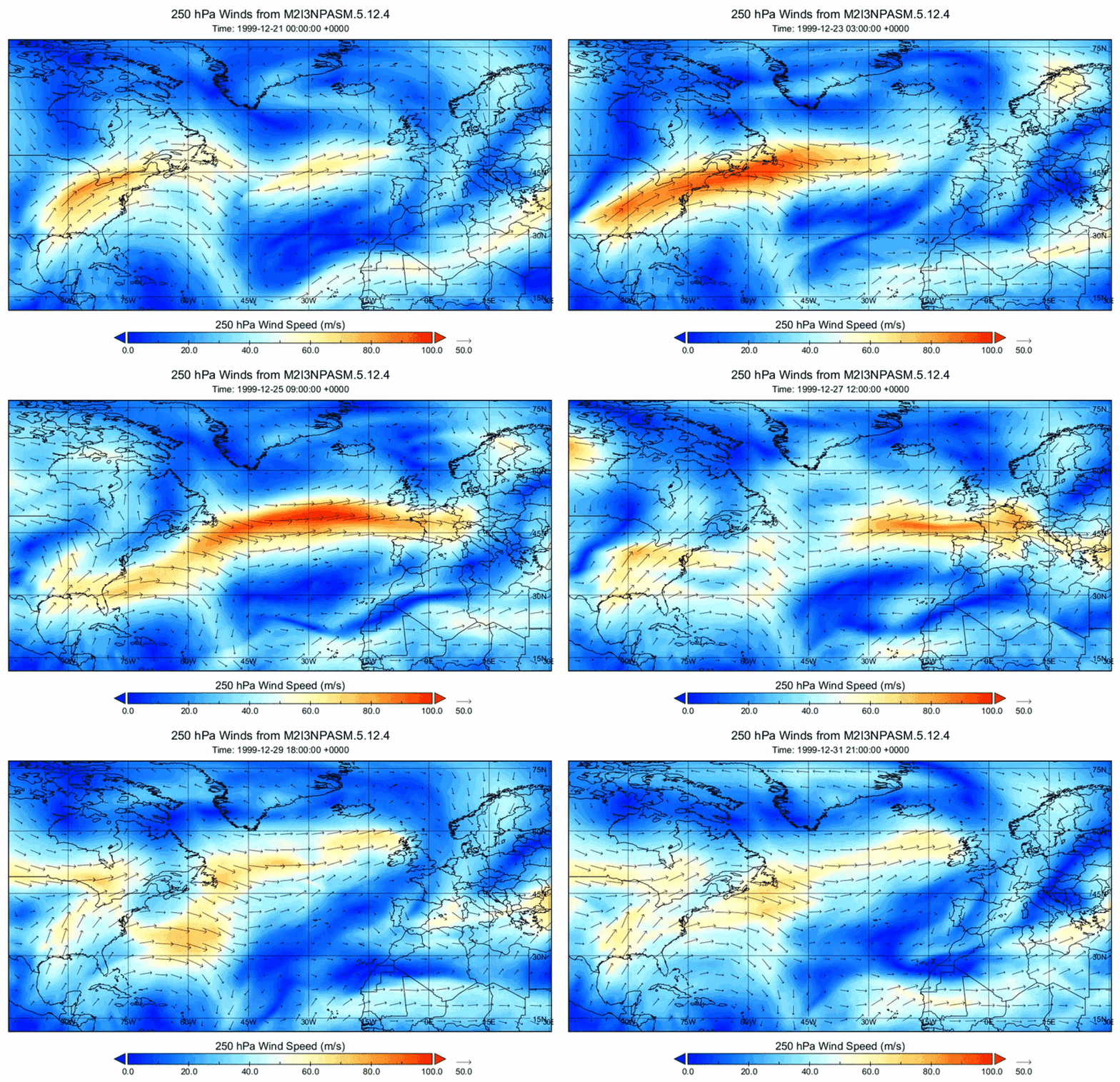
Meteorologists often note the position of jet streaks in the upper atmosphere, as they can hint where storms may develop at the surface. In general, the southwest and northeast sections of jet streaks promote upward vertical motion in the lower atmosphere as winds diverge aloft. Before Lothar’s landfall, a jet streak developed over the northwestern Atlantic Ocean on December 23 and then propagated to the east (Figure 4). Winds at the 250 hPa level topped 100 m/s (360 km/hr), which is very strong for a jet streak. 

Lothar began developing near the southwest of the jet streak on December 24, before moving to the northwest side of the jet streak before landing in Europe on December 26. Was this a coincidence? Not exactly, as storms at the surface generally move towards areas where conditions would be favorable for drops in pressure. This not only helped Lothar retain its intensity, but the elongation of the jet streak also helped increase the horizontal speed of the storm — one factor contributing to Lothar’s increased speed across the Atlantic seen in Figure 2. 

Storm Martin’s genesis and development may have also benefited from being in the northeast section of the jet streak.

The animation, drawn from the MERRA-2 model, shows wind speeds and directions over the Atlantic Ocean from December 21-31, 1999.
Caption

Figure 4: The animation above shows 250 hPa wind speeds mapped every 3 hours in the M2I3NPASM collection (in MERRA-2) from December 21, 1999 (0000 UTC) to December 31 (at 2100 UTC). The length of the wind vectors is a relative indication of the speed. (A vector twice as long as the 50 m/s vector would represent 100 m/s). The animation and graphics were generated using NASA’s Panoply Data Viewer.

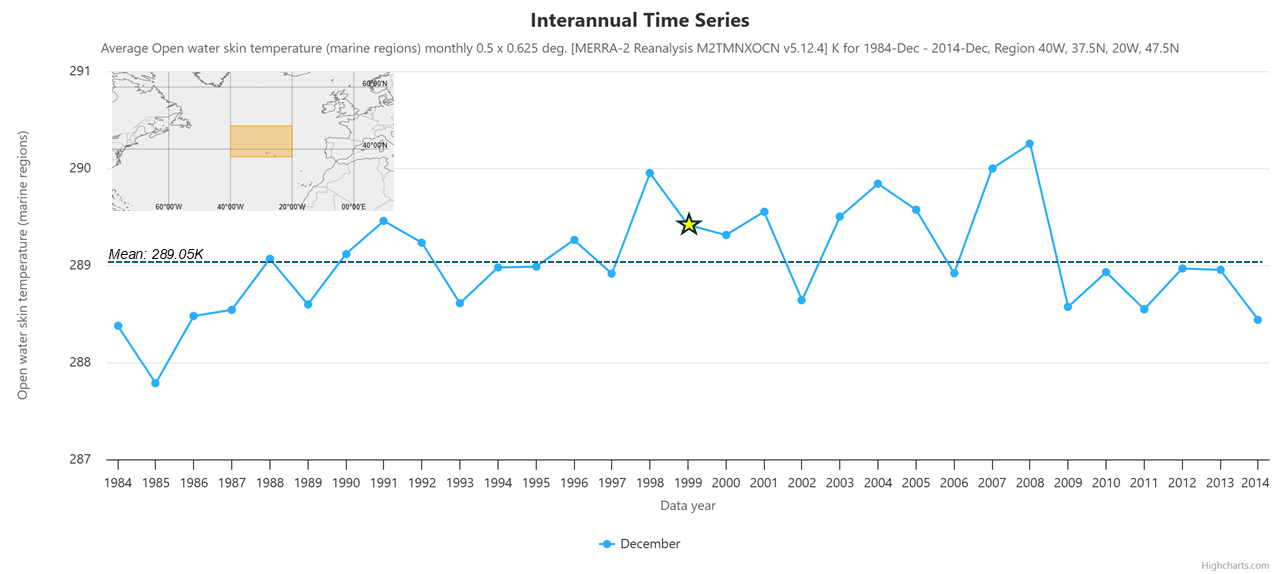
Wernli et al. also noted that high sea surface temperatures contributed to the rapid intensification of Lothar. Figure 5 shows a recurring area-averaged time series of December SSTs from 1984-2014 over the region where intensification increased for Lothar (plotted using Giovanni). SSTs over the whole domain were certainly above normal, though not high as in the previous year (1998) or what would be observed in the next decade. Some spots did see anomalies of 1.0+ K according to the authors, the highest in the preceding four decades. 

Much as for hurricanes, warm SSTs provide a source of heat and moisture. In this case, the evaporation of water from the ocean’s surface helped supply Lothar with the fuel necessary to sustain itself, while upper-level winds helped to provide the lifting mechanism needed for further intensification. The fast upper-level winds helped propagate Lothar, increasing the storm’s horizontal speed and essentially rocketing the storm towards France.

Image
Image Caption

Figure 5: This plot shows a time series of the monthly average sea surface temperatures (SSTs) in December from 1984-2014 as derived from the M2TMNXOCN collection (MERRA-2). Values are averaged over the domain shown in the top left corner of the figure, with the star indicating the year Lothar and Martin struck Europe. The dashed dark blue line represents the mean December SST for this domain from 1984-2014. This plot was created in Giovanni using the “Time Series, Area Averaged” function.

Impacts of Lothar and Martin

The "storm of the century" had devastating impacts across France and parts of central and western Europe. Lothar and Martin toppled many buildings and trees, with estimated damages up to €15 billion. At least 140 deaths were reported across Europe, 88 of them in France.

The timber industry, a major export commodity for countries in northwestern and central Europe was particularly hard hit. More than 200 million cubic meters of forest were destroyed by the storms across the continent. A study by Bründl and Rickli noted that approximately 12.7 million m3 of forests in Switzerland were destroyed, three times the annual utilization of timber for the country. The damage forced the rapid wholesale of timber due to the increase in supply, which then caused the price of lumber to drop by ~35% in the months following Lothar and Martin.

Despite the economic losses and damage to the many forests across Europe, the region has recovered quite well in recent years. An article from the Swiss Federal Institute for Forest, Snow and Landscape Research WSL details the remarkable recovery of some of the forests 25 years after Lothar and Martin. Beat Wermelinger, a retired entomologist of WSL, noted: “It is impressive how, after 20 years, apocalyptic tree graveyards have become dynamic and lush eco-paradises with rare inhabitants that are rarely seen elsewhere.”  

Many buildings have been rebuilt in the years following the storms and forests have rebounded with new trees and abundant vegetation growth. However, scars remain in some areas where the forests still contain windfall of trees toppled by those storms. This has changed the biodiversity of the forests, as locations containing lots of deadwood provide habitat and new opportunities for animals, plants, and insects. 

Many residents will never forget Storms Lothar and Martin, but the intervening years have brought useful advancements. Improvements in weather forecasting, technology, infrastructure, and coordination for emergency responses should make people in the region more resilient and better prepared for powerful storms in the future.

Citations

Blancq, F.W.L., and Searson, J.A. (2000) The 1999 Boxing Day low — some remarkable pressure tendencies. Weather, 55: 250-251. DOI: 10.1002/j.1477-8696.2000.tb04072.x

Bründl, M., & Rickli, C. (2002) The storm Lothar 1999 in Switzerland — an incident analysis. Forest Snow and Landscape Research77(1/2), 207-216.

Wernli, H., Dirren, S., Liniger, M.A. and Zillig, M. (2002) Dynamical aspects of the life cycle of the winter storm ‘Lothar’ (24-26 December 1999). Q.J.R. Meteorol. Soc., 128: 405-429. DOI: 10.1256/003590002321042036 

Additional Resources/News Articles

Chateau De Versailles:  The storm at Versailles, 1999

Meteo France Climate: Bulletin for December 1999

Swiss Re Group: Christmas 20 years ago: Storms Lothar and Martin wreak havoc across Europe

WSL News: 25 years after Lothar: How the windstorm rebuilt the forest

Details

Last Updated

April 15, 2026

Published

April 14, 2026