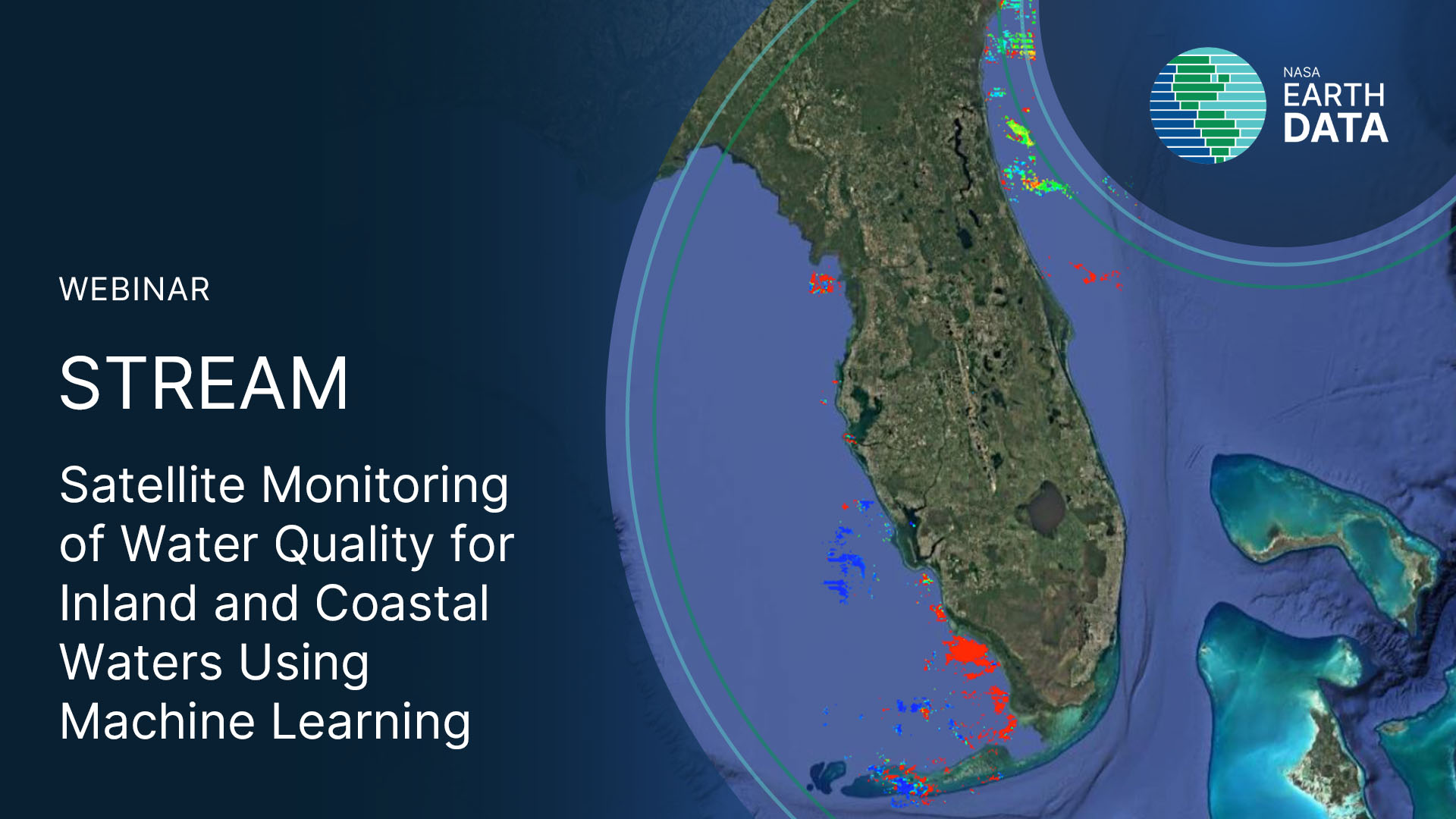
Join us to learn how the models behind the Satellite-based analysis Tool for Rapid Evaluation of Aquatic environMents (STREAM) work, what the data look like, and how to use STREAM to access them.
STREAM is a NASA web tool and API designed to enable near-real time monitoring of water quality in inland and coastal waters across the U.S. and parts of Africa and South America. STREAM operates on Landsat 8 & 9 and Sentinel-2 data to deliver high resolution maps for chlorophyll-a, total suspended solids, and Secchi disk depth. The tools include atmospheric correction and water quality parameter retrieval algorithms enabled by machine learning and trained on globally representative datasets like GLORIA and AERONET-OC.
Presenters
William Wainwright is an early career scientific programmer who graduated with a masters in astrophysics from Rochester Institute of Technology before applying his programming and data science skills to Earth Science. In his role as a scientific programmer at SSAI and NASA Goddard Space Flight Center, William has worked with a team and with end users to design, develop, and continually improve STREAM. With a passion for satellite-based data processing, he is the architect and end-to-end developer of STREAM's operational data pipeline, RESTful API, and interactive website.
Ryan O’Shea received his doctorate in mechanical and oceanographic engineering from the Massachusetts Institute of Technology and Woods Hole Oceanographic Institution (MIT-WHOI) Joint Program under a National Defense Science and Engineering Graduate fellowship. His thesis, titled "Computational Approaches for Sub-meter Ocean Color Remote Sensing," focused on the theoretical limitations, practical considerations, and potential future avenues for deploying lightweight hyperspectral cameras for ocean color remote sensing from low-altitude platforms.