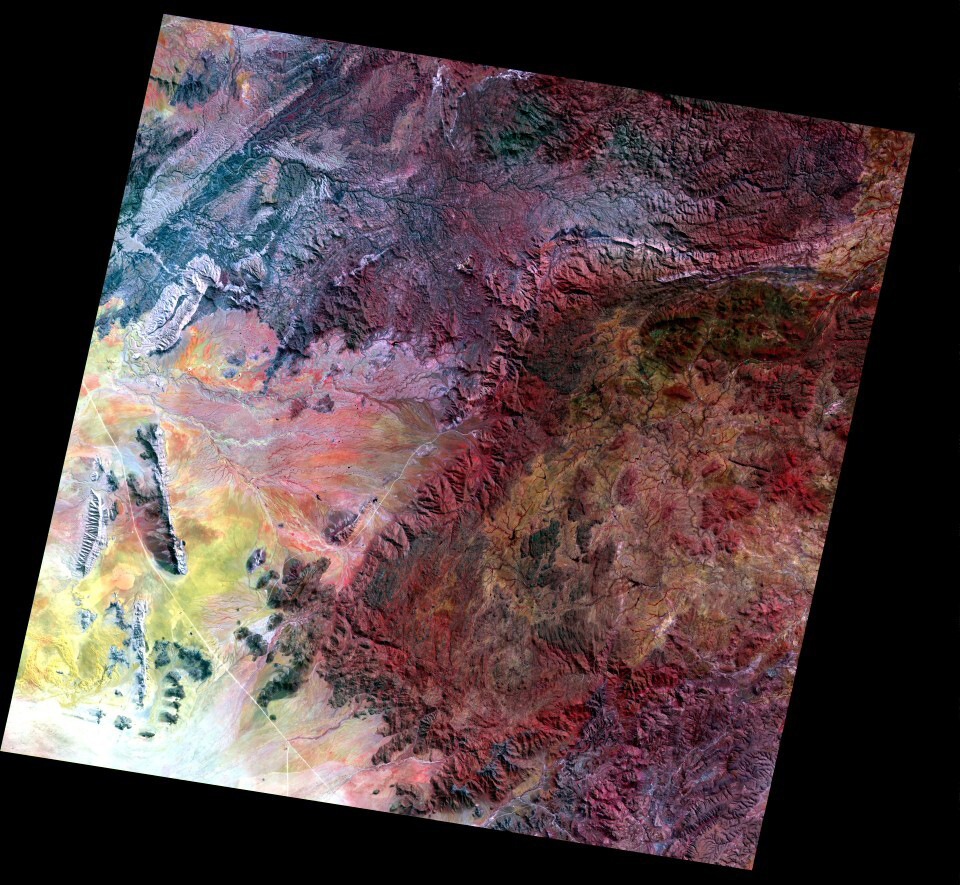
The U.S. Geological Survey (USGS) Earth Resources Observation and Science (EROS) User Services team presents “Introducing ASTER Version 4: What’s New in Data Access, Products, Formats, and How to Unlock the ASTER Cloud Archive," part of the EROS User Experience Webinar Series. The hour-long event includes presentations and conversations with EROS staff about the data, tools, and services available from the Advanced Spaceborne Thermal Emission and Reflection Radiometer (ASTER) instrument aboard NASA’s Terra satellite.
Since its launch in late 1999, ASTER has collected more than 4.7 million observations that can advance research and applications for volcano monitoring, mineral and geologic mapping, topography, and land cover change. NASA’s Land Processes Distributed Active Archive Center (LP DAAC) at the USGS Earth Resources Observation and Science (EROS) Center processes ASTER observations into 11 standard products that are archived within the Earthdata Cloud environment.
ASTER is a cooperative effort between NASA, Japan's Ministry of Economy, Trade and Industry (METI), and Japan Space Systems.
Key improvements in ASTER Version 4 include:
- Improved terrain correction and geolocation;
- Updated atmospheric correction algorithms and ancillary input data sources;
- Level-2 products delivered as Cloud-Optimized GeoTIFF (COG), enabling efficient access and analysis in cloud-based, high-performance computing environments.