Introduction
Sea ice extent in the Arctic Ocean has declined dramatically over the past decades. Sea ice advance in the fall is slower and occurs later, while summer sea ice melt is faster and occurs earlier. The result is a lengthening open-water period of 1 to 2 days each year, leading to changes in exchanges of heat between the atmosphere and the ocean, the water cycle, surface albedo (fraction of sunlight reflected back to the atmosphere) feedbacks, biological activity, and regional and global climate as well as human and ecological health. Therefore, it is of extreme importance to improve our understanding of the mechanisms that govern sea ice formation which is critical to understanding and predicting the impacts of the changing Arctic cryosphere.
Unlike other places in the world’s oceans, salinity controls stratification in the polar oceans, with colder, less-dense fresher waters situated above warmer, denser saltier waters. Therefore, variations in upper ocean salinity allows or prevents the vertical transport of stored subsurface heat to the surface, which can affect sea ice formation and melt.
The SASSIE Project
The Salinity and Stratification at the Sea Ice Edge (SASSIE) project is a NASA Arctic field campaign that occurred during the month of September 2022, during the transition period between sea ice melt and sea ice formation seasons. The goal of this campaign is to understand better if sea surface salinity variations generated by summer sea ice melt are an important predictor for sea ice advance in the fall.
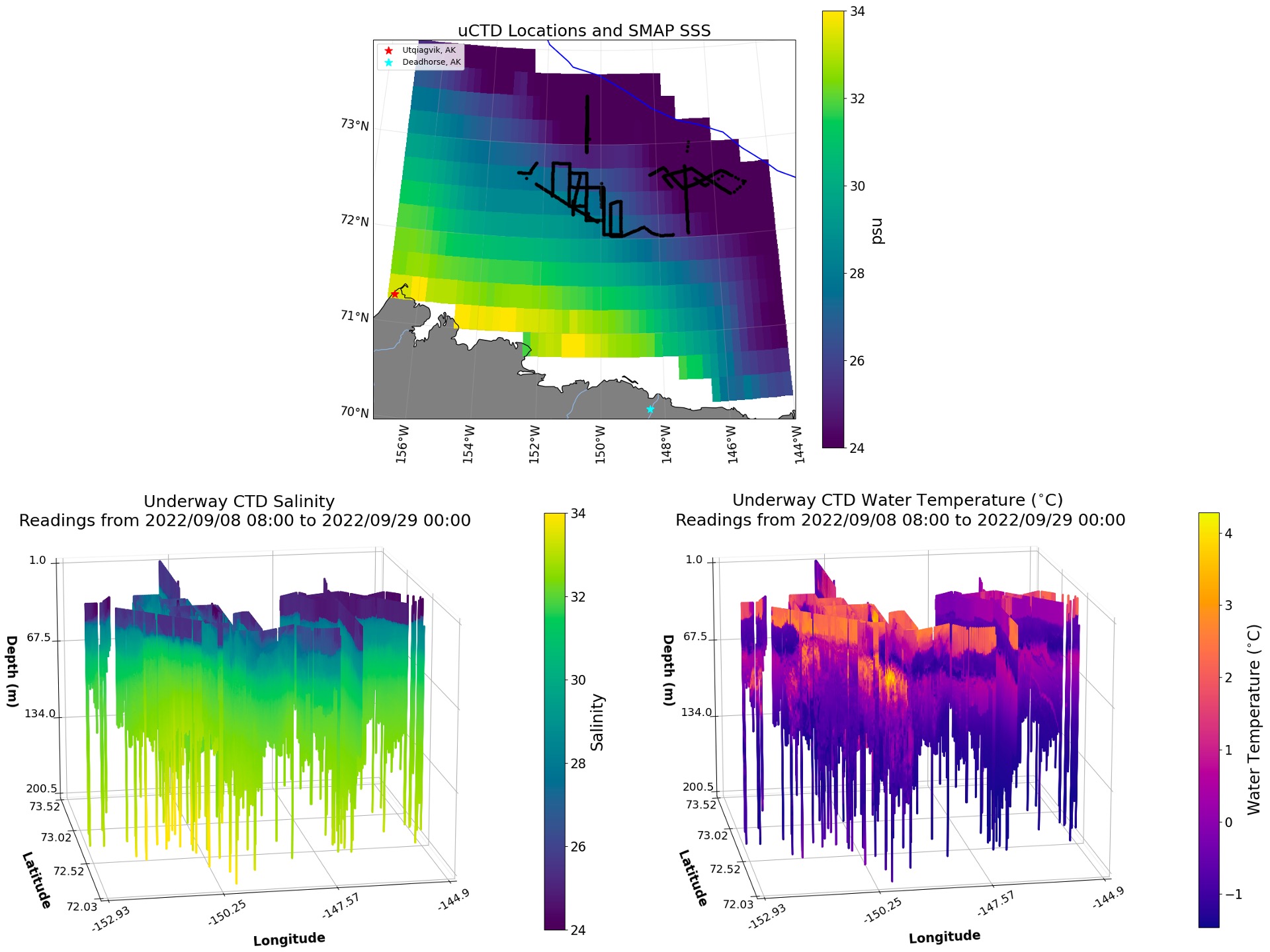
In September 2022, a ship was surveying the Beaufort Sea in the Arctic Ocean (see Figure 1) and deployed instruments that measured the salinity and temperature of the ocean along with the heat fluxes between the ocean and atmosphere, winds, ocean currents, and sea ice properties. During the last part of the campaign (September 25-29), the ship made 14 transects from open water to sea ice to capture the evolution of the upper ocean during the approach to freeze-up.
The bottom figures show the temperature and salinity of the ocean from the surface to more than 100 m depth along the ship transects every ~800 m, acquired using an instrument called continuous uCTD (Shipboard Underway Conductivity-Temperature-Depth instrument). Strong surface signals were observed at the north end of the line and an eddy was observed in the south. The figures show fresh water at the ocean surface (in blue on the bottom left figure) originated by sea ice melt and warm waters stored subsurface (in yellow on the bottom right figure).
Access Python tutorials and SASSIE data notebooks to reproduce the figures above.
References
Kyla Drushka, Elizabeth Westbrook, Frederick Bingham, Peter gaube, Suzanne Dickinson, Severine Fournier, Viviane Menezes, Sidharth Misra, Jaynise Perez, EJ Rainville, Julian Schanze, Carlyn Schmidgall, Andrey Shcherbina, Micheal Steele, Jim Thomson, and Seth Zippel. (2023) Salinity and Stratification at the Sea Ice Edge (SASSIE): An oceanographic field campaign in the Beaufort Sea. Earth System Science Data Journal. In review.