Introduction

A powerful snowstorm struck Mt. Everest, the highest mountain in the world, on Oct. 4, 2025. Blizzard conditions developed unexpectedly, catching hikers off guard while severely hindering the speed of rescue efforts. 

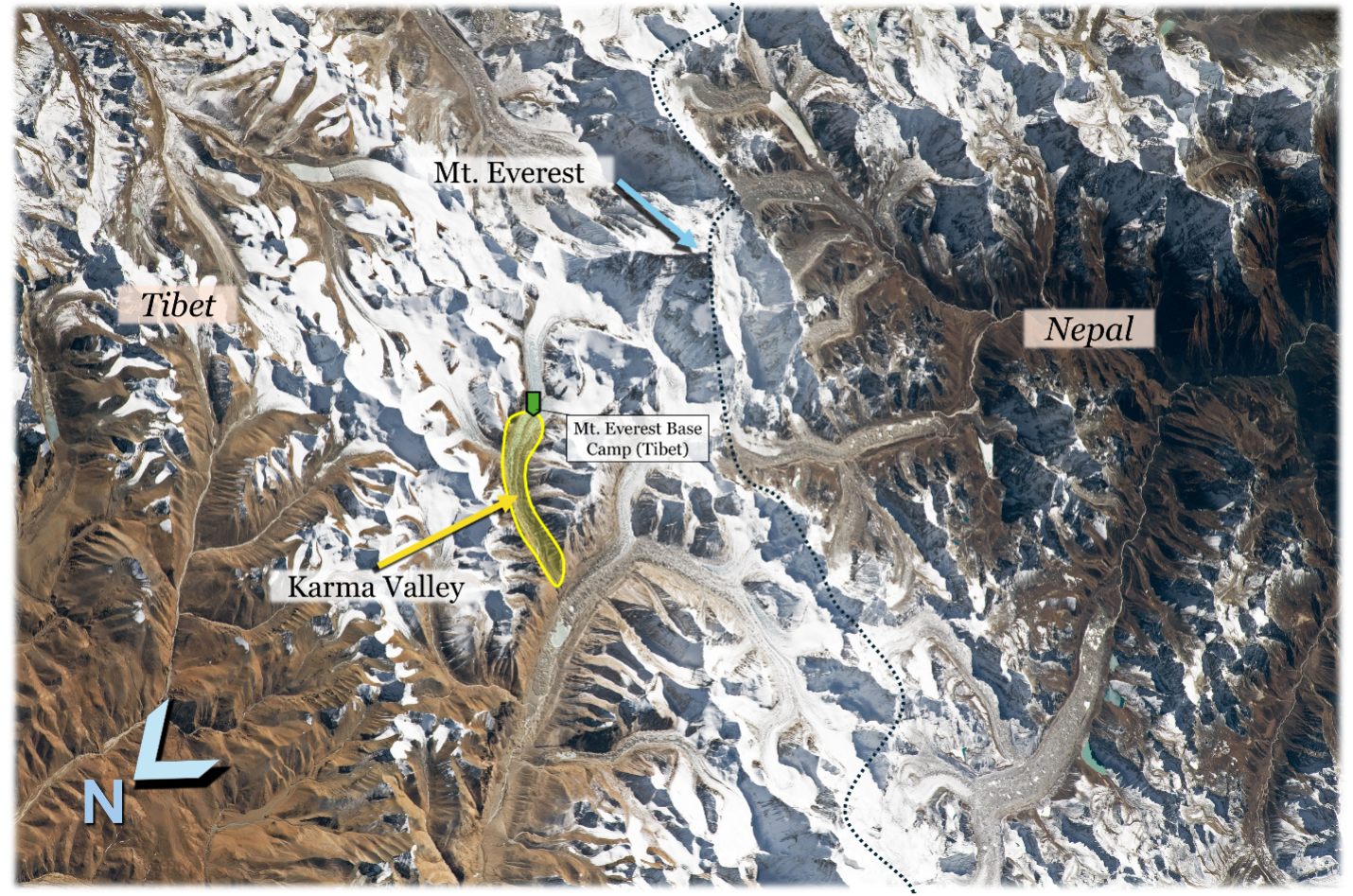
The snowstorm occurred during the Chinese Golden Week holiday when domestic tourism reaches its second annual peak in the region. Many tourists caught in the blizzard had been hiking up through the Karma Valley, just below Base Camp on the Tibetan side of the mountain (Figure 1), located at an elevation of ~4200 m (~13,800 ft). Hikers tried to shelter in their tents, but with snowfall accumulations exceeding 1 m (~3 ft), some collapsed beneath the weight of the snow, stranding many hikers and leading to dangerous and life-threatening conditions.
Image
Image Caption

Figure 1. Aerial view of the Mt. Everest area from the International Space Station (ISS). The yellow highlighted region shows the Karma Valley where hikers were rescued from during the snowstorm, with the green marker indicating the approximate location and proximity of the Tibetan Mt. Everest Base Camp. The black dotted line shows the approximate border between Nepal and the Tibet region of China; the blue arrow in the lower-left corner points due north. Credit: NASA Earth Observatory

Snowfall on Oct. 4, 2025

GPM IMERG Precipitation Rate

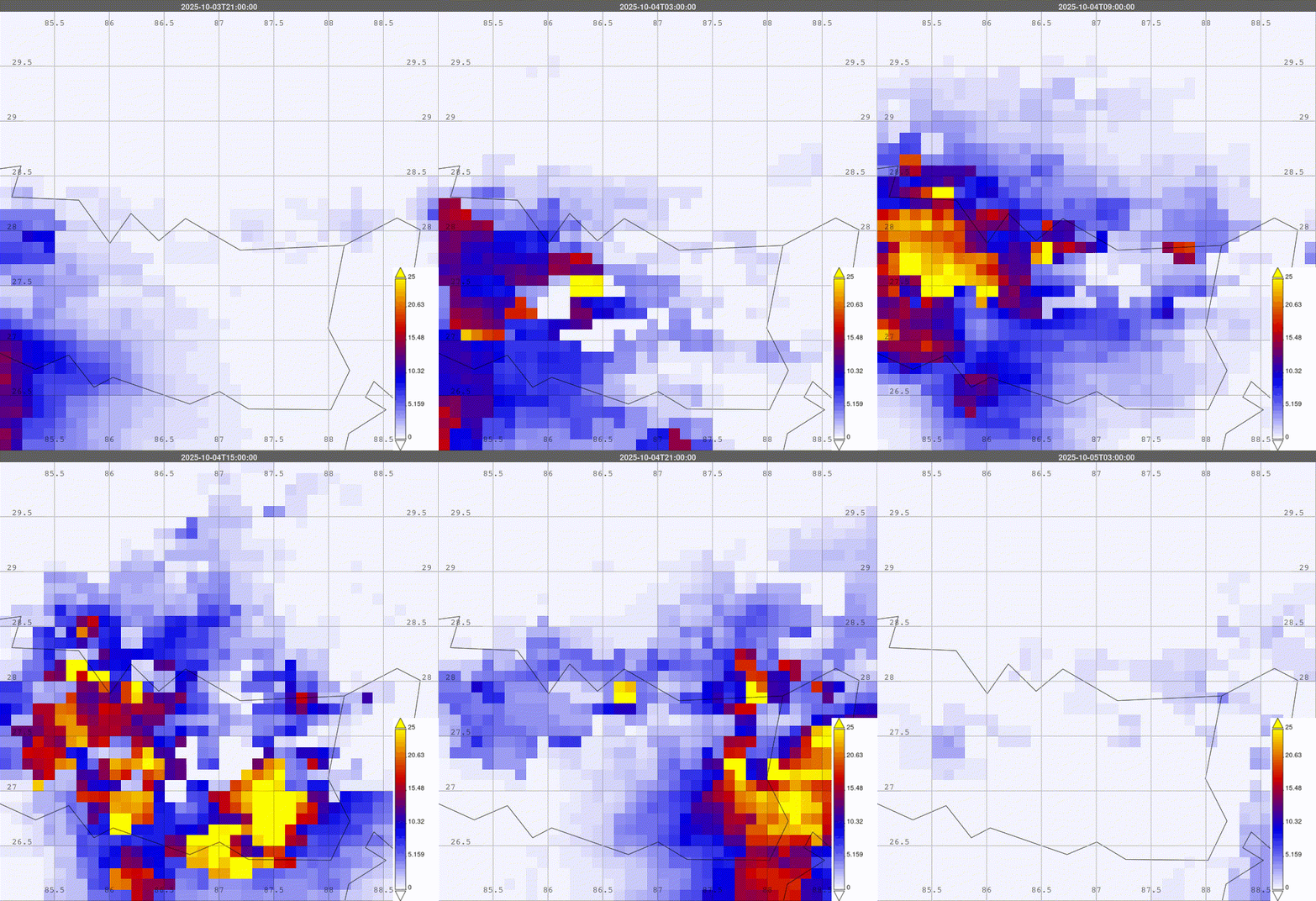
Precipitation rates from NASA’s Integrated Multi-satellitE Retrievals for GPM (IMERG) – Half-Hourly Late product show the progression of the Mt. Everest snowstorm (Figure 2). Snowfall began in the early hours of October 4, with the heaviest snow falling during the evening hours before tapering off early on October 5. 

A tropical depression in the Bay of Bengal funneled high amounts of moisture into the region where a process called orographic lift took place: the atmospheric flow directly into the Himalayas forced the moisture-laden air to ascend, and as it cooled, the moisture condensed and precipitated. The height of the Himalayan range created a scenario that enabled extremely high precipitation rates. Figure 2 shows liquid precipitation rates exceeding 25 mm hr-1 at times near Mt. Everest.

Animation of GPM IMERG late precipitation rate over the Eastern Himalayas.
Caption

Figure 2. GPM IMERG late precipitation rate over the Eastern Himalayas. The precipitation rate from IMERG is given every half hour from 2100 UTC on Oct. 3, 2025, to 0300 UTC on Oct. 5, 2025. Precipitation rates are shown using the color palette to the right, with units of mm hr-1. The approximate location of Mt. Everest is 27.99°N and 86.93°E. Credit: IMERG

FLDAS Snowfall Rate

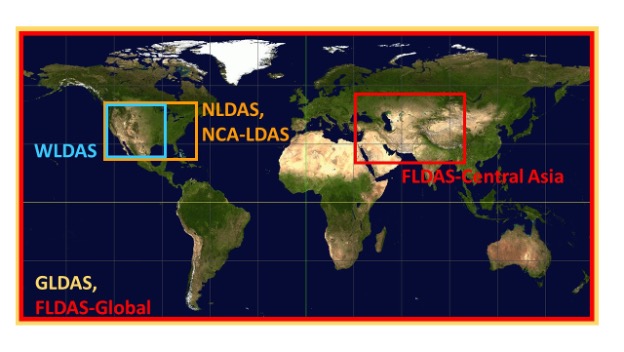
The Famine Early Warning Systems Network (FEWS NET) Land Data Assimilation System (FLDAS) is part of NASA’s Land Data Assimilation System (LDAS, Figure 3) and uses meteorological inputs and land surface models to produce high quality outputs of hydrometeorological variables. In the FLDAS-Central Asia region, these are available daily at 0.01° spatial resolution (the highest amongst the LDAS regions), allowing users to use visualization tools like NASA’s Giovanni to produce highly detailed maps of specific variables. 

Image
Image Caption

Figure 3. NASA’s LDAS dataset spatial domains. Credit: LDAS

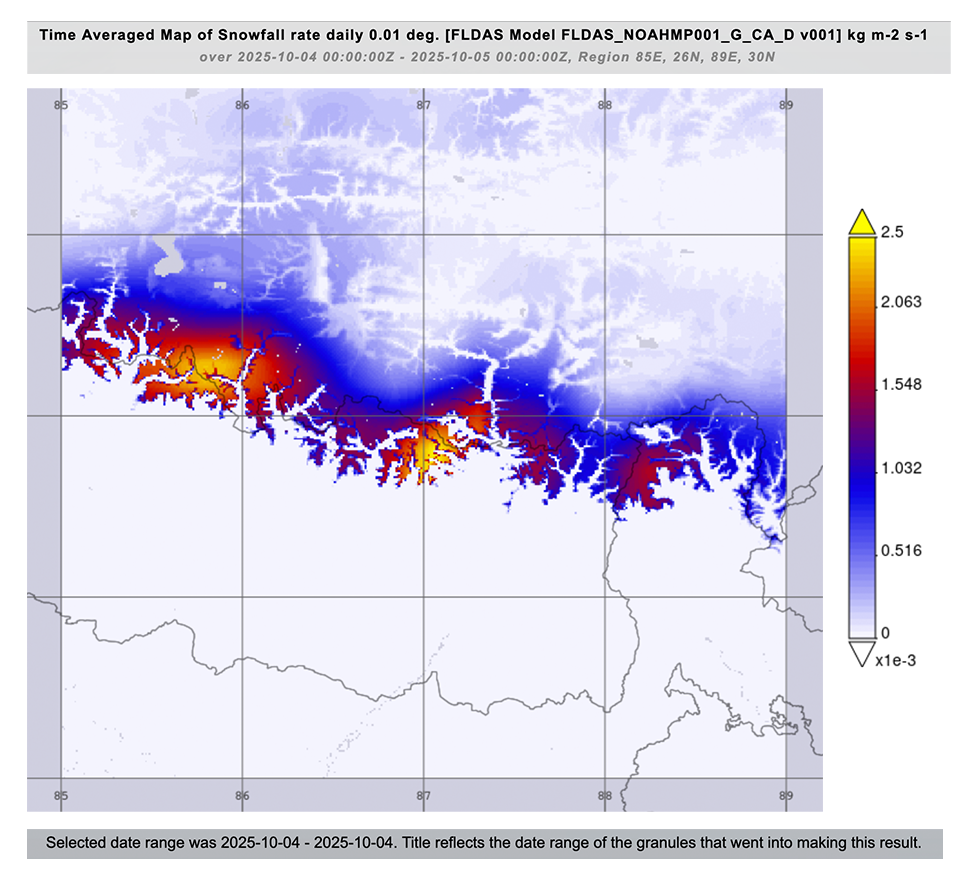
Figure 4 (below) illustrates the FLDAS snowfall rate for Oct. 4 in units of kg m-2 s-1 and captures the heavy amounts of snow that fell on Mt. Everest and the surrounding areas. The colors on the map are shaded according to the color palette to the right, with snowfall rate in kg m-2 s-1, in which 1 kg m-2 s-1 is equal to 1 mm s-1

Note: the snowfall rates are small and the bottom of the legend indicates the values shown on the color palette need to be divided by 1,000 (i.e., a value of 2.5 on the color palette is 0.0025 mm s-1). The approximate location of Mt. Everest is 27.99°N and 86.93°E. 

Image
Image Caption

Figure 4. Credit: GES DISC

Converting FLDAS Precipitation Rates to Snow Depth

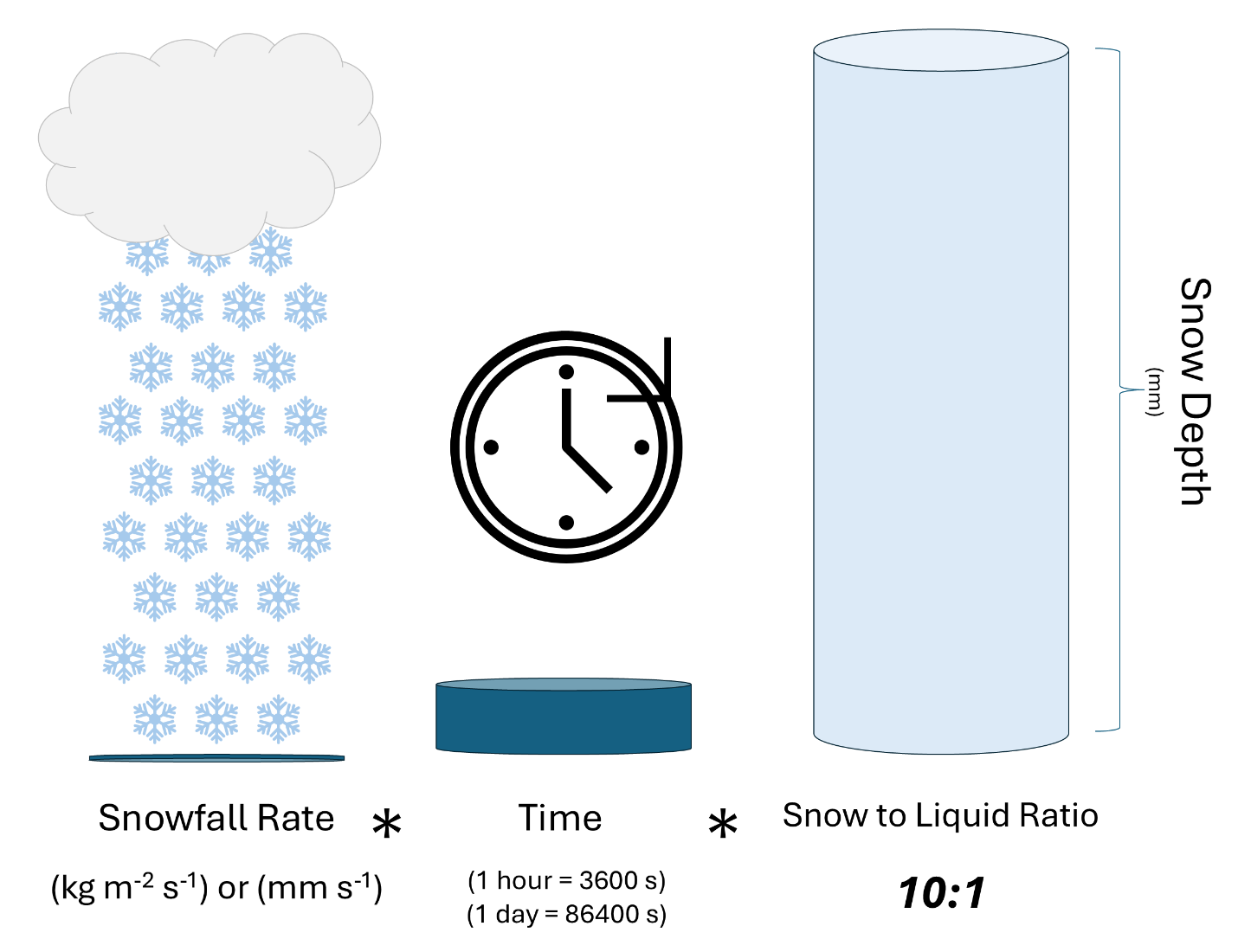
Snowfall rate from FLDAS is reported in units of kg m-2 s-1, but for mass fluxes of water, this is simply the same as saying mm s-1. However, the magnitude of even the highest precipitation rates is hard to conceptualize in mm s-1. Figure 5 shows how to convert snowfall rate to units of mm hr-1 (multiply by 3,600 seconds) or mm day-1 (multiply by 86,400 seconds), which is more intuitive to understand. 

FLDAS snowfall rate can be converted to snow depth by multiplying the snowfall rate by total time of the precipitation, which equals the snow depth in liquid form (also called snow water equivalent, or SWE). To convert SWE to snow depth, an additional step is needed where the SWE value is multiplied by a term called the snow-to-liquid ratio (SLR). 

Image
Image Caption

Figure 5. Convert FLDAS snowfall rate to snow depth. The snowfall rate can be converted to any time interval by multiplying the rate by the time in seconds (i.e., hourly or daily). The depth of water then needs to be converted to snow depth using an average snow to liquid ratio of 10 to obtain the snow depth in mm. Quick math: A value of 0.001 on the map in Figure 4 is approximately equal to 3 ft of snow.

SLR describes the depth of snow per unit of precipitation. In the United States, this is normally reported in inches, though the ratio itself is unitless. A ratio of 10:1 (10 for snow = 1 for rain) is historically used as the standard by many weather bureaus (Roebber et al., 2003). SLR has been shown to vary greatly — the ratios can range from 5:1 for heavy wet snow or even exceed 20:1 for dry fluffy powder snow. Generally, the colder the air temperature, the higher the SLR; however, other factors such as humidity, wind, and the shape of the snowflakes can also affect SLR. 

A climatology from Baxter et al., 2005, demonstrated that over the U.S. the mean SLR is greater than 10:1 in most areas. For Mt. Everest and the surrounding areas, it is likely the SLR was even greater than 10:1 on Oct. 4, 2025, but using 10:1 is still an appropriate and conservative approach for estimating the snow depth or snowfall rate from FLDAS and IMERG products, respectively (Figure 5).

Impacts of the Snowstorm

Following the steps in Figure 5, the FLDAS snowfall rate in Figure 4 can be converted to snow depth. On Oct. 4, areas surrounding the peak of Mt. Everest showed snowfall rates exceeding 0.0025 mm s-1 of SWE. Multiplying this value by 86,400 seconds yields a snowfall rate of 216 mm day-1. Then applying an SLR of 10:1 (or multiplying the snowfall rate by 10) provides an estimated 2,160 mm (~7 ft) of snow that fell on October 4. 

The same procedure can be done to convert the IMERG liquid precipitation rates in Figure 2 to snowfall rate. The animation shows that liquid precipitation rates approached 25 mm hr-1 (1 inch hr-1), using an SLR of 10:1 yields a snowfall rate of 250 mm hr-1 (10 inch hr-1). This high rate of snowfall piled up quickly, stranding hikers on the north side of Everest in the Karma Valley, where FLDAS snowfall totals on October 4th ranged from 1,000 – 1,500 mm (~3 – 4.5 ft).

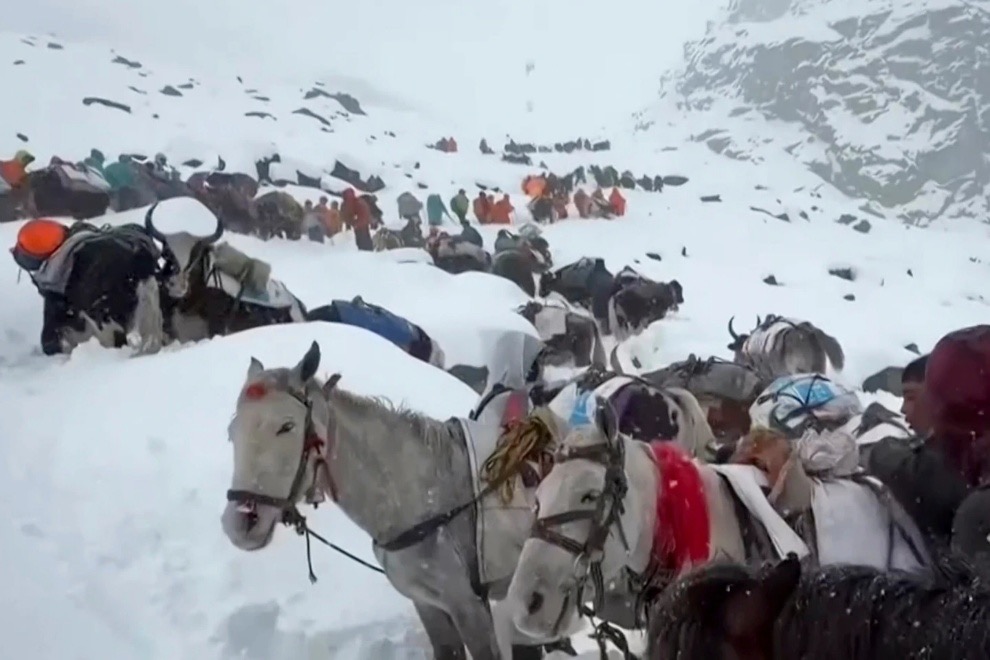
This extremely heavy snowfall, combined with vicious winds, trapped hikers and warranted rescue efforts (Figure 6). Thankfully, the trapped hikers were able to descend the mountain and trek safely to a nearby town, closing the chapter on the surprise Everest blizzard with no loss of life. However, rains falling at lower altitudes in Nepal triggered landslides that caused the deaths of more than 50 people.

Image
Image Caption

Figure 6. Villagers with their horses and oxen trek up the mountain to assist in rescue efforts of trapped hikers on Oct. 5, 2025. Credit: Lingsuiye via Associated Press (AP News)

NASA missions such as GPM and data assimilation from LDAS allow users to analyze, visualize, and interpret hydrometeorological data to investigate events like this one. Users can convert the units of precipitation rates and apply SLRs appropriate for their region to estimate the amount of snow that fell from recent or historical snowfall events. 

The rarity of such storms on Everest is hard to put into historical context, as weather stations were only recently installed on the mountain in 2019 (Matthews et al., 2022). The Oct. 4 storm will be remembered for its quick hitting intensity and timing with the 2025 Chinese Golden Week holiday.

References

Baxter, M. A., Graves, C. E., & Moore, J. T. A Climatology of Snow-to-Liquid Ratio for the Contiguous United StatesWeather and Forecasting20(5), 729-744. 2005.

Matthews, T., Perry, B., Khadka, A., Sherpa, T. G., Shrestha, D., Aryal, D., Tuldahar, S., Thapa, N., Pradhananga, N., Athans, P., Sherpa, D. Y., Guy, H., Seimon, A., Elmore, A., Li, K., & Alexiev, N. Weather Observations Reach the Summit of Mount EverestBulletin of the American Meteorological Society103(12), E2827-E2835. 2022.

Roebber, P. J., Bruening, S. L., Schultz, D. M., & Cortinas , J. V., Jr. Improving Snowfall Forecasting by Diagnosing Snow DensityWeather and Forecasting18(2), 264-287. 2003.

Details

Last Updated

Jan. 30, 2026

Published

Jan. 30, 2026

Data Center/Project

Goddard Earth Sciences Data and Information Services Center (GES DISC)