Introduction
Groundwater is the water stored beneath Earth's surface in the cracks and spaces in soil, sand, and rock, and is recharged by precipitation from rain and snow. It is the largest source of usable freshwater on Earth, used mostly to irrigate crops and as drinking water.
Using groundwater at a higher rate than its recharge rate is more and more common as demand increases under climate change conditions and can cause problems over the long-term such as reduced ground and surface water supplies; land subsidence due to a loss of support below the ground, which can damage infrastructures; water quality degradation; and lowering of the water table causing wells to run dry and increasing the cost of water pumping.1 Water resources have been under considerable stress around the world, however, it is very challenging to monitor groundwater storage around the globe effectively.2,3
Measuring Earth's Ground Water With GRACE
To fill this observational gap, the NASA/German Space Agency (DLR) Gravity Recovery and Climate Experiment and Follow-on missions (GRACE and GRACE-FO) were launched in 2002 and 2018. By accurately measuring month-to-month mass changes across Earth, GRACE and GRACE-FO help scientists estimate changes in the amount of water stored beneath the surface, which cause changes in gravity.
Major Findings
In the southwestern United States, dry conditions have prevailed for thousands of years, and the last several decades have seen population and agricultural expansion leading to consistent groundwater overuse during drought periods. The California Department of Water Resources (DWR) mission is to sustainably manage the water resources of California, in cooperation with other agencies, to benefit the state’s people and protect, restore, and enhance the natural and human environments.4
One of their key strategies is to manage California’s essential water resources by diverting surface water surplus in wet years (e.g., 2023) towards groundwater recharge. However, their semi-annual report mentions that systematic and regular statewide recharge reporting is not established, resulting in numerous data gaps, making it challenging to capture the complete picture of recharge and implement effective management strategies.5
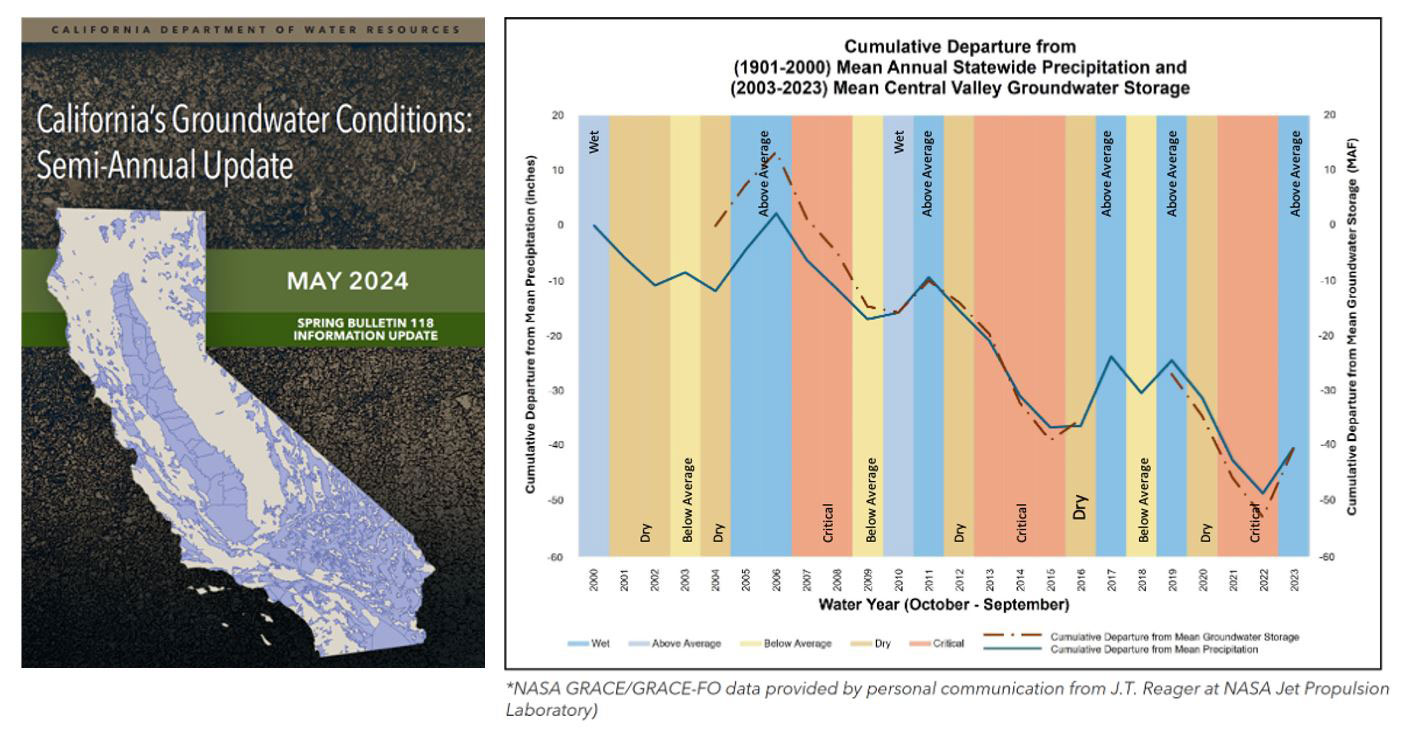
As of May 2024, the California’s DWR includes GRACE and GRACE-FO data on a semi-annual basis for "insight for the regional changes in groundwater", and "to help inform science-backed management decisions."5 The time series above, taken from the California DWR May 2024 semi-annual update of California’s groundwater conditions, shows the groundwater storage departure from the long time mean (2003-2023) in the Central Valley based on GRACE and GRACE-FO observations.
A decreasing trend in groundwater storage has been observed since 2003. Groundwater replenishment in 2005, 2010/11, 2017, and 2019 are observed, followed by critical and longer groundwater depletion periods. GRACE and GRACE-FO observations are now addressing the crucial need for sustainable groundwater management practices to ensure water resiliency amidst ongoing climate challenges in California.
References
- Groundwater Foundation
- Famiglietti, J. The global groundwater crisis. Nature Clim Change 4, 945–948 (2014). doi:10.1038/nclimate2425
- Medellín-Azuara, J., Escriva-Bou, A., Rodríguez-Flores, J.M., Cole, S.A., Abatzoglou, J.T., Viers, J.H., Santos, N., Summer, D.A., Medina, C., Arévalo, R. and Naumes, S., 2022. Economic Impacts of the 2020–22 Drought on California Agriculture. UC Merced.
- California Department of Water Resources
- CA DWR’s May 2024 report