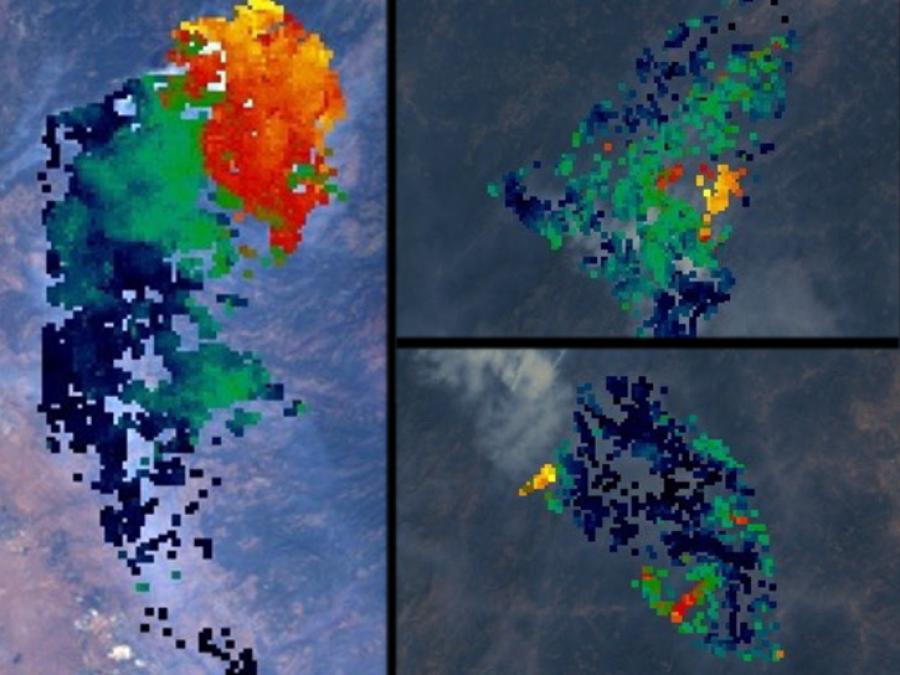
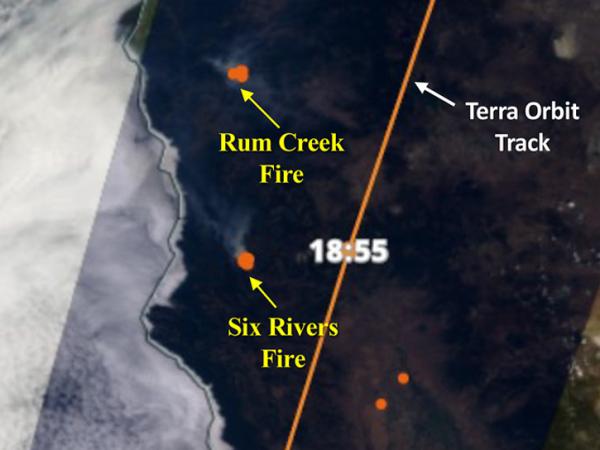
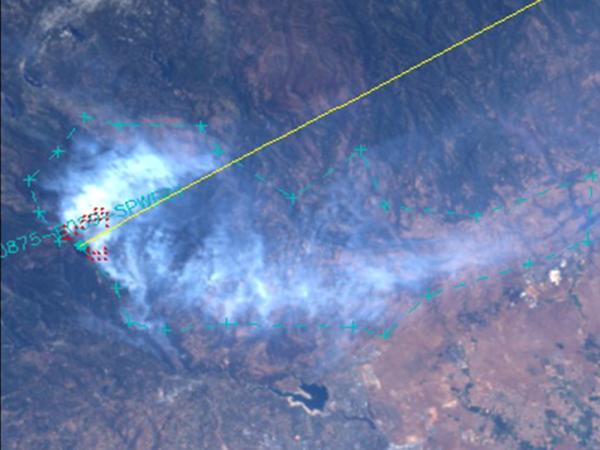
composite image of the wildfire data captured during the MISR Wildfire campaign
composite image of data captured during the MISR wildfre campaign

MISR Wildfire Research

Multi-angle Imaging SpectroRadiometer Wildfire Research Project

Wildfire-related aircraft campaigns frequently offer opportunities to validate retrievals of aerosol properties and other quantities derived from satellite-borne-instrument observations. Satellite instruments often provide regional context imagery to complement more sparsely sampled aircraft and surface-based measurements. 

However, aerosol amount, particle type, aerosol plume height, and the associated wind vector products retrieved from the NASA Earth Observing System’s Multi-angle Imaging SpectroRadiometer (MISR) instrument have matured sufficiently that these quantities can also contribute substantially to a campaign dataset in a regional context. This is especially useful when such measurements are not acquired at all from the suborbital platforms. 

During NOAA’s California Fire Dynamics Experiment (CalFiDE), aircraft operations were coordinated with MISR overpasses on two occasions: for the Rum Creek fire on August 30, 2022, and for the Mosquito fire on September 12, 2022. MISR-retrieved aerosol properties showed distinctly different patterns of black and brown smoke particle distributions and inferred plume evolution in the two cases. 

This paper presents the satellite-retrieved results that complement the field observations, demonstrating what such measurements can offer. It also contributes material for detailed fire dynamics and chemistry studies when combined with the CalFiDE suborbital observations and models in continuing studies.

MISR-derived output from a comprehensive analysis of wildfire smoke plumes observed in California August 30 to September 08 2022.

This dataset contains geometrically derived smoke-plume height and plume-level motion vectors to complement the National Oceanic and Atmospheric Administration's (NOAA) California Fire Dynamics Experiment (CalFIDE) field campaign which took place from Aug. 28 to Sept. 25 2022. The MISR Wildfire Research Dataset contains regional snapshots of the Rum Creek fire plumes in Oregon and the Mosquito fire plumes in California during MISR overpasses on Aug. 30 and Sept. 08, 2022, providing kilometer-scale observations of plume height with a vertical resolution of 250-500 meters and plume-level motion vectors, enabling estimations of smoke age downwind.

Junghenn Noyes, K.T., R.A. Kahn, J.A. Limbacher, A. Sedlechek, L. Kleinman, and Z. Li, 2020. Wildfire Plume Particle Properties and Evolution, From Space-Based Multi-angle Imaging. Biomass Burning special issue, Remote Sens. 12, 769; doi:10.3390/rs12050769.

Junghenn Noyes, K.T., R.A. Kahn, J.A. Limbacher, Z. Li, M.A. Fenn, D.A. Giles, J.W. Hair, J.M. Katich, R.H. Moore, C.E. Robinson, K.J. Sanchez, T.J. Shingler, K.L. Thornhill, E.B. Wiggins, and E.L. Winstead, 2020. Wildfire Smoke Particle Properties and Evolution, From Space-Based Multi-Angle Imaging II: The Williams Flats Fire During the FIREX-AQ Campaign. Remote Sens12, 3823, doi:10.3390/rs12223823.

Junghenn Noyes, K.T., R.A. Kahn, J.A. Limbacher, and Z. Li, 2022. Canadian and Alaskan Wildfire Smoke Particle Properties, Their Evolution, and Controlling Factors, Using Satellite Observations. Atm. Chem. Phys. 22, 10267–10290, doi:10.5194/acp-22-10267-2022.

Junghenn NoyesK.T., and R.A. Kahn, 2024.  Satellite Multi-angle Observations of Wildfire Smoke Plumes during the CalFiDE Field campaign: Aerosol Plume Heights, Particle Property Evolution, and Aging Timescales. J. Geophys. Res. 129, e2023JD039041, doi: 10.1029/2023JD039041.

Junghenn Noyes, K.T., and R.A. Kahn, 2025. Siberian wildfire smoke observations from space-based multi-angle imaging: A multi-year regional analysis of smoke particle properties, their evolution, and comparisons with North American Boreal fires. Atmosph. Chem. Phys. 25, 13879--13901, doi:10.5194/acp-25-13879-2025.