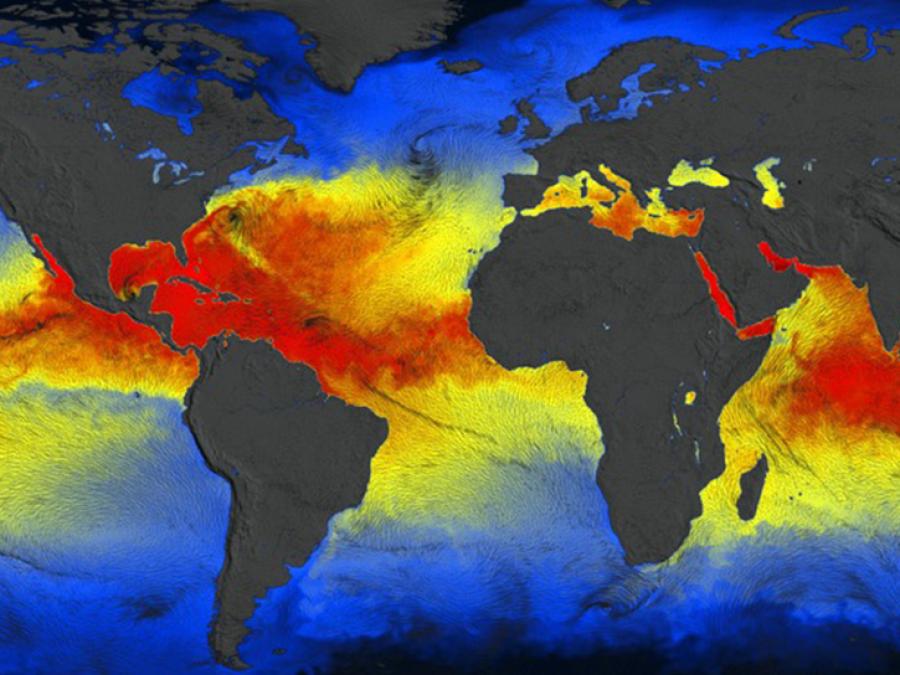
Global surface wind vector flow lines over sea surface temperature from June 1, 2011 to October 31, 2011.
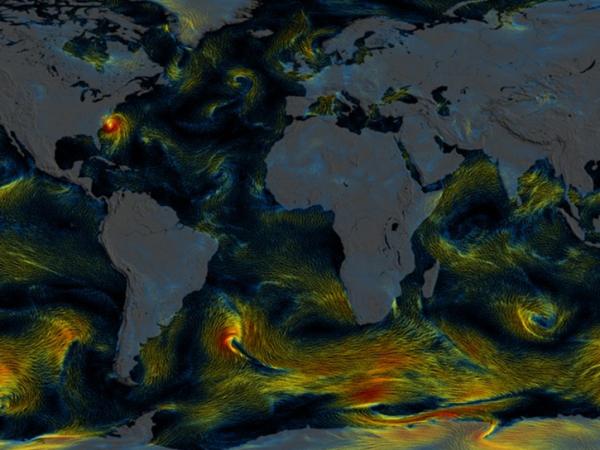
Global surface wind vector flow lines colored by wind speed from June 1, 2011 to October 31, 2011.
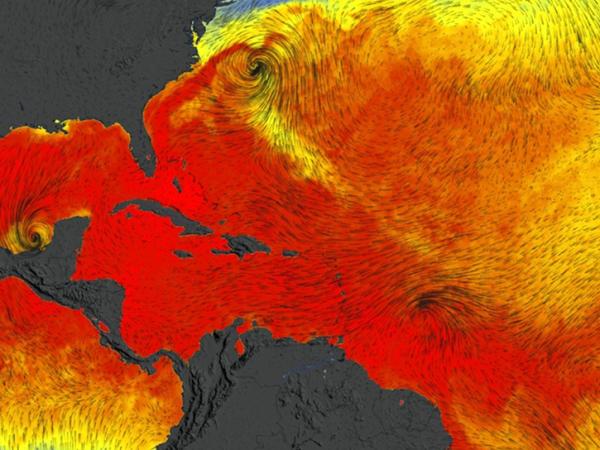
North Atlantic surface wind vector flow lines over sea surface temperature from June 1, 2011 to October 31, 2011.

CCMP

Cross-Calibrated Multi-Platform

The Cross-Calibrated Multi-Platform (CCMP) is a gridded product provided by NASA’s Physical Oceanography Distributed Active Archive Center (PO.DAAC) that provides a consistent, gap-free time-series of vector winds over the world's oceans from 1993 onward. It is the first surface wind analysis products that bridged the gap between state-of-the-art data assimilation and cross-calibration of wind data from uniquely different sensors, and has wide-ranging appeal to users in educational, operational and research environments. The current version is produced and maintained by Remote Sensing Systems (RSS).

Data Centers

PO.DAAC

CCMP is a combination of ocean surface 10 m wind retrievals from multiple types of satellite microwave sensors and a background field from reanalysis. The wind retrievals are derived by RSS and the background field is from ERA5 10m Neutral Stability winds. The resulting product is a spatially complete dataset available every six hours that remains closely tied to the satellite retrievals where they are available and closely collocated in time and space. Where satellite retrievals are not available, CCMP is statistically consistent with satellite winds. Creating a product using this method ensures a smooth transition in the wind field between regions with and without satellite retrievals. 

CCMP includes most of the wind-sensing U.S., Japanese, and European satellites flown to date. This includes the scatterometers QuikScat, Advanced Scatterometer (ASCAT)-A and ASCAT-B as well as the Special Sensor Microwave Imager (SSM/I), SSMIS, Tropical Rainfall Measuring Mission (TRMM) Microwave Imager (TMI), Global Precipitation Measurement (GPM) Microwave Imager (GMI), Advanced Microwave Scanning Radiometer-EOS (AMSR-E), Advanced Microwave Scanning Radiometer 2 (AMSR2), and WindSat radiometers. Winds from ASCAT-C were withheld from the current version of CCMP (V3.1) so that they can serve as an independent source of winds to validate the product.

The current versions of CCMP (V3.x) are produced by RSS with support from a NASA Ocean Vector Winds Science Team grant (ROSES proposal 17-OVWST-17-0023). Previous versions were produced first by Bob Atlas (then at the Goddard Space Flight Center) and after by RSS. The previous versions were funded by NASA's Making Earth System Data Records for Use in Research Environments (MEaSUREs) program, which develops consistent global- and continental-scale Earth System Data Records.

The current CCMP Project produces two products: a 6-hourly record and a monthly record, both providing global coverage. These records begin and 1993 and are ongoing, updated every few months.

Dataset NameProcessing
Level
Start/StopFormat
RSS CCMP 6-Hourly 10 Meter Surface Winds Level 4 Version 3.141993-Jan-01 to PresentnetCDF-4
RSS CCMP Monthly 10 Meter Surface Winds Level 4 Version 3.141993-Jan-01 to PresentnetCDF-4

The CCMP datasets combine cross-calibrated satellite winds using a Variational Analysis Method (VAM) to produce a 0.25 degree gridded analysis. The CCMP dataset uses satellite winds derived by Remote Sensing Systems (RSS) from a number of microwave satellite instruments. RSS intercalibrates radiometers on the brightness temperature level to within 0.5 deg C and applies a highly refined sea-surface emissivity model and radiative transfer function to derive surface winds. This results in high consistency between wind speed retrievals from microwave radiometers (i.e., SSM/I, SSMIS, AMSR-E, TMI, WindSat, AMSR2, and GMI). RSS also has developed a geophysical model function for deriving wind speeds and directions from microwave scatterometers (including QuikScat, SeaWinds, and ASCAT). Both radiometer and scatterometer data are validated against ocean moored buoys, which prove the measurements are in excellent agreement (within 0.8 m/s) despite the different instrument measurement dynamics wind retrieval methodologies. The VAM (Hoffman et al., 2003) combines the RSS data with in situ measurements and a starting estimate (first guess) of the wind field. 10-meter neutral stability winds from the European Center for Medium-Range Weather Forecasts (ECMWF) Reanalysis 5 (ERA5) are used as the first-guess.  The ERA5 winds are compensated for the moving ocean surface using the OSCAR current analysis.

The CCMP Version 3.1 (V3.1) data product described here is a continuation of the widely-used original CCMP product and builds on decades of careful VAM and dataset development. CCMP V3.1 is more completely described in Mears et al., 2022. Other publications are included in the References section. A user guide and readme file are also available.