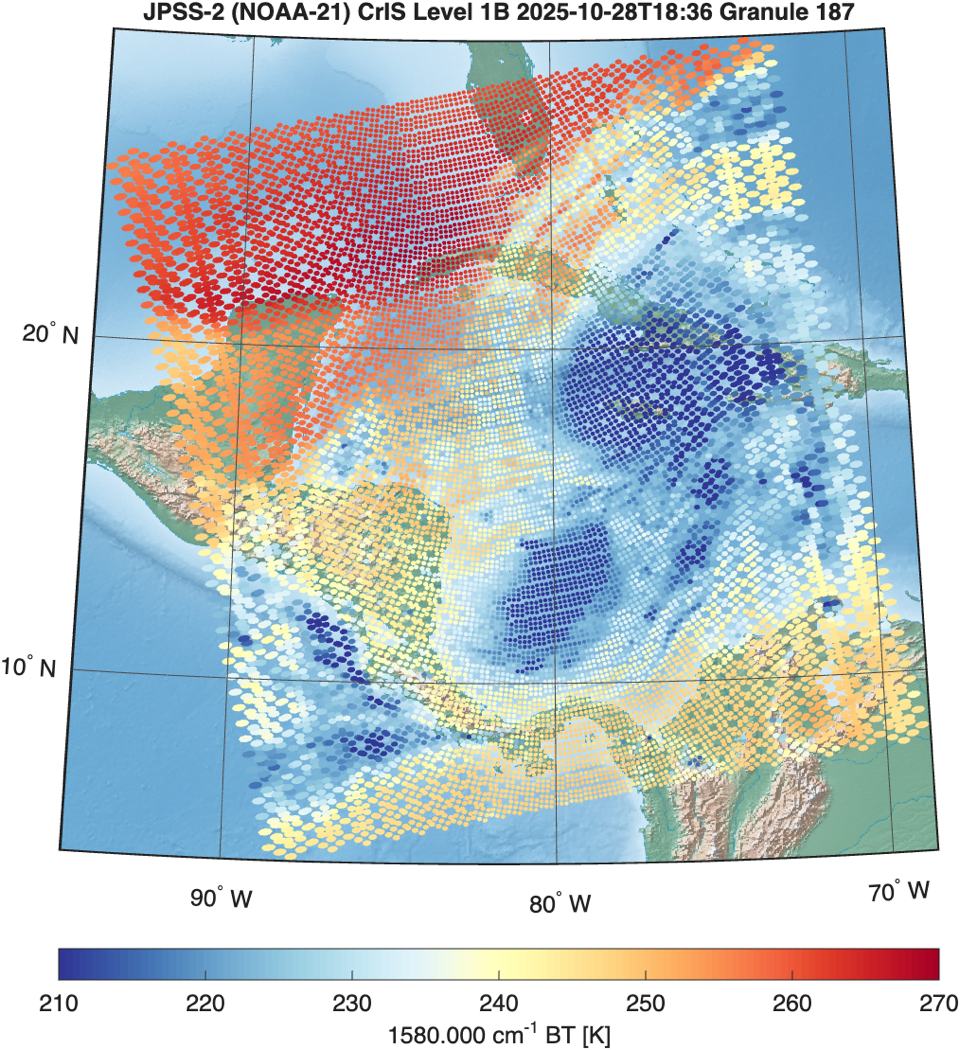
The Cross-track Infrared Sounder (CrIS) Level 1B Sounder Development Team at the University of Wisconsin-Madison and the Jet Propulsion Lab (JPL) Sounder Science Investigator-led Processing Systems (SIPS) group have released the CrIS Level 1B Version 4 data collection from the Joint Polar Satellite System 2 (JPSS-2) satellite, also known as NOAA-21. This data product was generated at the Goddard Earth Sciences Data and Information Services Center (GES DISC) using software authored by the University of Wisconsin-Madison and the University of Maryland-Baltimore County under NASA funding.
Applications using the CrIS L1B radiance products include retrievals of atmospheric and surface parameters — temperature, water vapor, cloud radiative properties, cloud top height and temperature, surface emissivity and temperature, and trace gases — as well as evaluations of radiative transfer models, climate trends, and climate process studies.
The current version (Version 4) is the first science-quality data product from the JPSS-2 CrIS sensor, superseding the preliminary JPSS-2 CrIS Level 1B Version 3 beta product released in 2023. Compared to the previous version, Version 4 contains improvements to the L1B calibration, geolocation, quality monitoring, and metadata.
Additional details on these improvements can be found in the NASA Cross-track Infrared Sounder (CrIS) Level 1B Product Users’ Guide and the NASA Cross-track Infrared Sounder (CrIS) Level 1B Delta Algorithm Theoretical Basis Document (ATBD).